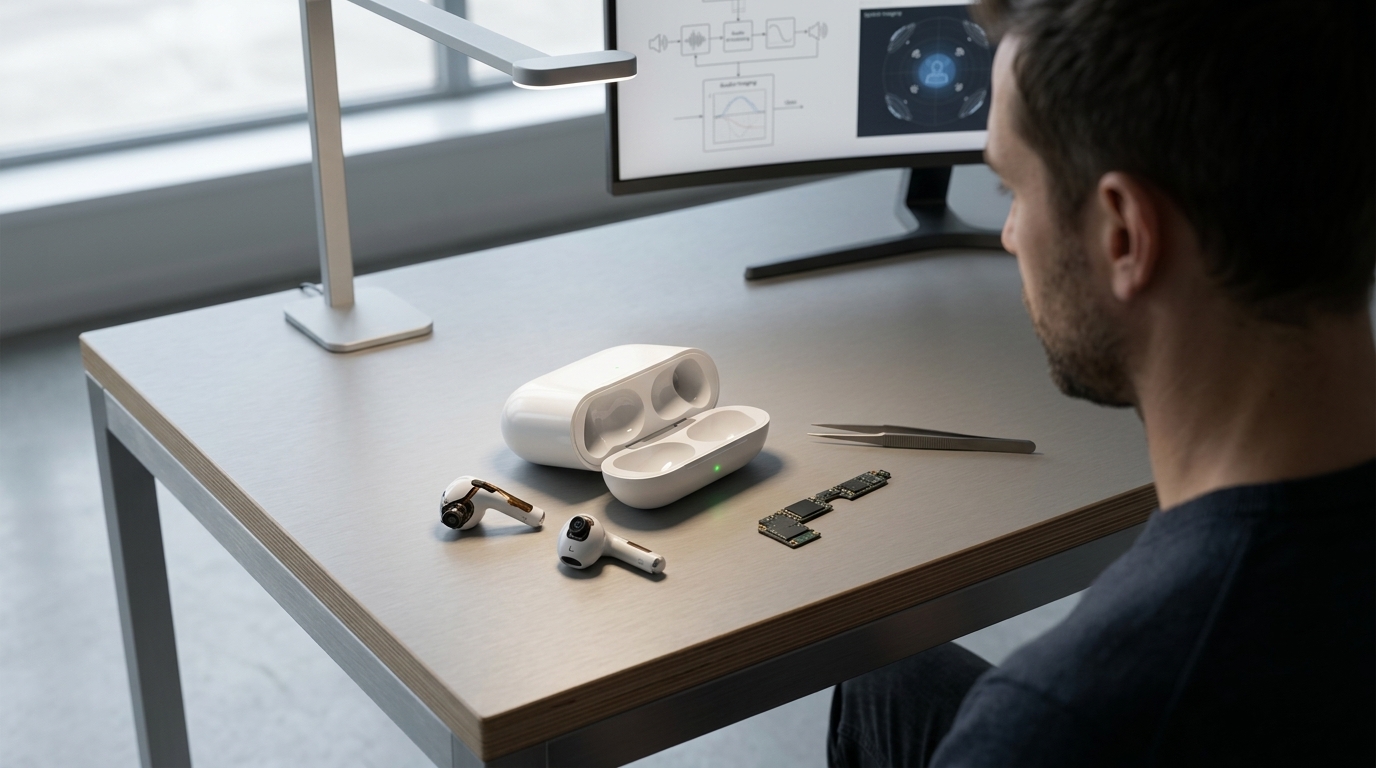
In the ever-evolving landscape of technology, Apple appears to be preparing its next major strategic bet that will redefine the wearables category. According to recent reports and supply chain leaks, the Cupertino-based tech giant is in the final stages of developing a new generation of AirPods. These will not be limited to mere audio playback but will feature integrated infrared (IR) cameras and advanced Artificial Intelligence capabilities. This move is not just an upgrade of a successful product; it is a strategic shift toward what the company calls "Spatial Computing," bringing Apple Intelligence directly to the ears—and eyes—of users.
The Tech Behind the Lens: Infrared and Spatial Awareness
Integrating cameras into earbuds might initially sound counterintuitive, but Apple’s approach is highly targeted. The cameras expected in the new AirPods will not be the typical RGB sensors found in iPhones, but rather infrared sensors similar to those used for FaceID. These sensors will allow the AirPods to "map" the user's environment in three dimensions. Their primary function will be to enhance the Spatial Audio experience. As a user moves their head or changes position in a room, the AirPods will be able to adjust the audio source with pinpoint accuracy, creating an unprecedented sense of immersion.
Furthermore, these cameras will play a crucial role in the synergy with the Vision Pro. Apple's headset will be able to collaborate with the AirPods to better understand the user's hand gestures, even when they are outside the headset's primary field of view. This represents an effort to create a unified ecosystem where devices "talk" to each other to perceive human movement within physical space seamlessly.
Apple Intelligence: An Assistant with Eyes
The true revolution, however, lies in the integration of Apple Intelligence. By adding optical sensors, the digital assistant Siri effectively gains "eyes." Imagine walking through a foreign city, looking at a monument, and asking: "What am I looking at?" Through image analysis from the IR cameras and AI processing, the AirPods could provide real-time information, translate signs, or even guide you with audio-based Augmented Reality (Audio AR) directions.
This multimodal AI approach is the next frontier. Apple no longer wants AI to be confined to a screen; it wants it to be an invisible companion that understands the context of a user's life. The new AirPods will be able to recognize objects, understand distances, and offer assistance without the user ever needing to take their phone out of their pocket. This reinforces Apple’s philosophy of "distraction-free" technology, where information flows naturally through sound.
Competition and the Privacy Paradox
Apple's move places it in direct competition with Meta, which has already found success with its Ray-Ban Meta smart glasses. While Meta chose the glasses route to offer visual AI, Apple is betting on AirPods—a device millions of people already wear for hours every day. The advantage of AirPods lies in social acceptance; earbuds have become an integral part of daily attire, whereas glasses with cameras still face social friction and skepticism.
However, adding cameras to a device that enters private spaces raises serious privacy concerns. How will Apple ensure that these cameras do not record without consent? The company is expected to leverage its strong brand reputation for data protection as a "shield," emphasizing that data processing will occur on-device and that infrared captures will not be recognizable photos but rather mathematical models of the environment. Nevertheless, regulators, particularly in the European Union, are expected to scrutinize the product rigorously.
Economic Implications and the Road Ahead
From a business perspective, AirPods with cameras represent an attempt by Apple to revitalize a category that has reached a level of maturity. With iPhone sales showing signs of stabilization, Apple is turning to high-tech accessories to maintain profit margins and further lock users into its ecosystem. If AirPods become the primary interface for interacting with AI, then the dependency on Apple hardware will become even more profound.
In conclusion, the new AirPods are not just earbuds; they are the harbingers of an era where technology becomes sensory. Apple is betting that the future lies not just in what we touch, but in what we hear and what our devices can "see" on our behalf. The success of this venture will be judged by the balance between utility and privacy protection in a world that is becoming increasingly transparent.