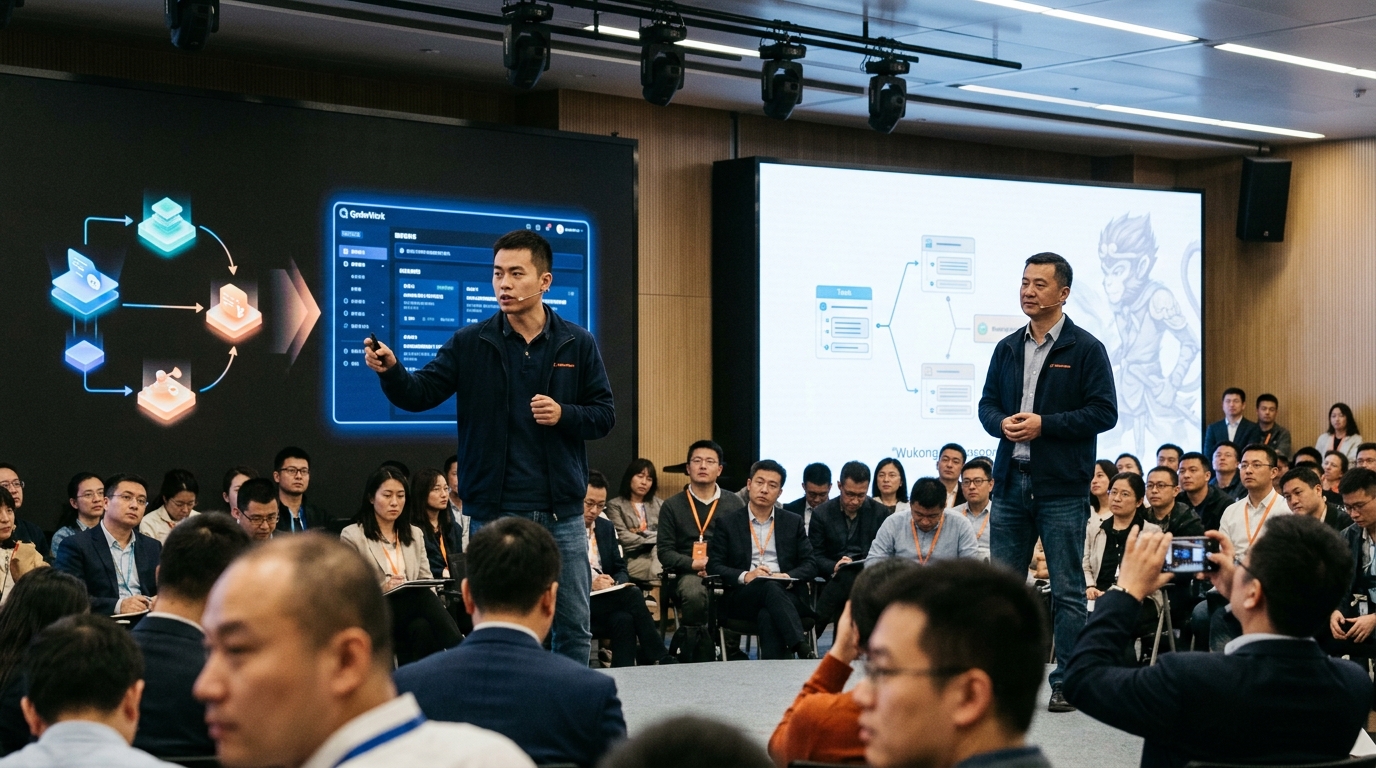
In the quiet corridors of Alibaba's Xixi Campus in Hangzhou, a silent but fierce battle is unfolding. This is not a clash of executives, but a digital duel between two sophisticated artificial intelligence systems: QoderWork and Wukong. This internal rivalry, known in Chinese corporate culture as 'horse racing' (赛马), represents the spearhead of the group's strategy to conquer the AI Agent market—systems that do not just chat, but execute complex tasks autonomously.
The 'Horse Racing' Strategy and Alibaba's Rebirth
Alibaba, under the leadership of CEO Eddie Wu, has shifted its center of gravity from traditional e-commerce toward AI and cloud computing. The decision to develop two competing AI agents simultaneously is no accident. Historically, Tencent used the same method to create WeChat, pitting different teams against the same problem. In Alibaba's case, the stake is the 'digital employee' of the future.
QoderWork appears to focus on technical excellence and developer productivity. Based on the Qwen model, QoderWork doesn't just write code; it audits, optimizes, and integrates it into existing infrastructures. On the other hand, Wukong—named after the mythical Monkey King, a symbol of agility and power—aims for a broader enterprise application. Wukong is designed to manage workflows, from accounting to supply chain management, exhibiting a more 'polymathic' personality.
QoderWork: The Architect of Productivity
The strength of QoderWork lies in its specialization. In a world where the shortage of skilled developers is increasingly felt, Alibaba is betting that an AI agent capable of acting as a 'senior developer' will be invaluable. QoderWork integrates directly into Alibaba Cloud's internal tools, allowing businesses to turn natural language into functional applications in minutes. Precision is its hallmark, aiming for zero errors in code synthesis.
- Automated real-time debugging and error correction.
- Cloud system architecture optimization.
- Seamless integration with the DingTalk ecosystem for corporate communication.
Wukong: The Versatility of the 'Monkey King'
If QoderWork is the surgeon, Wukong is the general. The name Wukong refers to the mythical hero's ability to take on 72 different forms. Within the context of Alibaba, this translates into an AI agent that can adapt to any department of an enterprise. Wukong is not limited to text or code; it analyzes sales data, predicts market trends, and can even conduct negotiations with suppliers based on predefined parameters.
"The transition from Large Language Models to Large Action Models is the next great frontier. Wukong is not just a conversationalist; it is an executor," internal sources report.
Wukong's ability to 'think' before acting, using techniques like Chain-of-Thought (CoT), gives it an edge in environments where decision-making requires complex logic rather than mere information retrieval.
Global Market Impact and Competition
The QoderWork vs. Wukong battle is not just about Alibaba. It is a reflection of global competition with OpenAI (and its GPTs), Microsoft (Copilot), and Google (Gemini). However, Alibaba possesses a unique advantage: a massive database from China's e-commerce and supply chain ecosystem. This data is the 'fuel' that makes these agents more experienced in real-world market conditions.
Internal competition ensures that the product eventually reaching the end customer will have been tested under the harshest conditions. Alibaba Cloud intends to offer these tools as a service (Agent-as-a-Service), radically changing the SaaS (Software-as-a-Service) model. Instead of companies buying software that humans must operate, they will 'rent' digital intelligence that performs the work autonomously.
Conclusion: Who Will Prevail?
It is likely that Alibaba will not choose a single winner but will merge the best capabilities of both into a unified platform. However, the process of conflict generates innovation at rates that bureaucratic development could never reach. What is certain is that the era of AI Agents is here, and Alibaba is positioning itself as the dominant player in Asia, ready to challenge the West on its own turf: that of business intelligence.