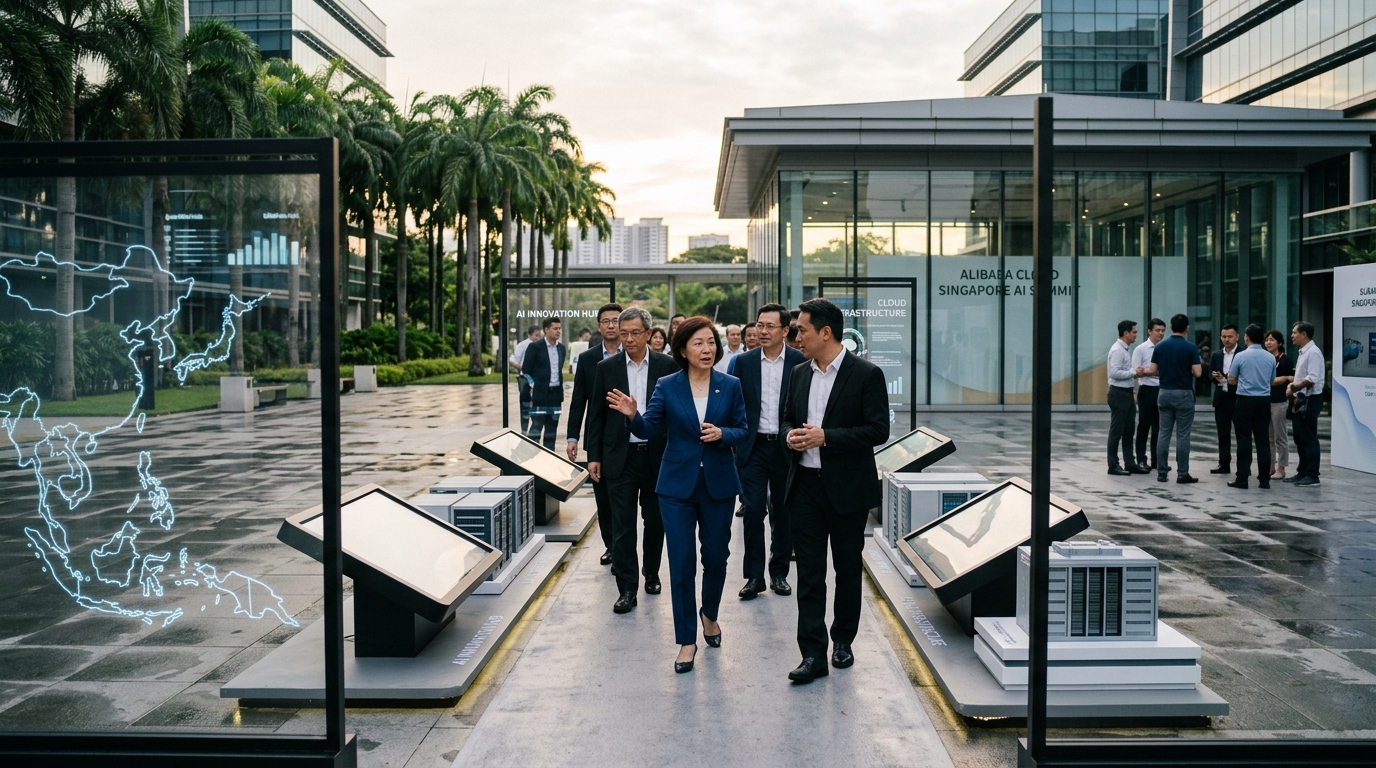
In a move that underscores the shifting geopolitical gravity of the tech industry, Alibaba Cloud has announced a sweeping expansion of its operations in Singapore. This initiative is far more than a mere business upgrade; it represents a strategic realignment at a time when China is seeking alternatives to US-imposed restrictions and Southeast Asia is emerging as the world's most dynamic theater for digital transformation.
Singapore: The New Digital 'El Dorado'
Alibaba’s choice of Singapore is calculated and precise. For the Chinese giant, the city-state serves as a 'golden bridge' connecting Chinese technological prowess with the global market. By establishing a new innovation center and fortifying its cloud infrastructure, Alibaba Cloud aims to offer 'Model-as-a-Service' (MaaS) to local enterprises, enabling them to train and deploy their own AI models atop Alibaba’s robust framework.
This strategy involves deep integration with local universities and government agencies, fostering an ecosystem that will be difficult for American competitors like AWS or Microsoft Azure to dislodge. Alibaba Cloud is investing in training programs for thousands of professionals, ensuring that the region's workforce becomes natively fluent in its proprietary tools and platforms.
The Geopolitical Chessboard and the 'China+1' Strategy
Beneath the polished corporate announcements lies the stark reality of Sino-American relations. Export controls on advanced semiconductors (such as Nvidia’s high-end chips) to China have compelled Alibaba to seek territory where access to cutting-edge hardware is less encumbered. Singapore, maintaining its delicate balance between the two superpowers, provides the ideal sanctuary.
- Access to global talent pools without the constraints of mainland Chinese regulations.
- The ability to procure and utilize hardware that faces sanctions within mainland China.
- Bolstering trust among international clients who may be wary of hosting data within Chinese borders.
"Singapore is no longer just a market for us; it is the operational hub for our global AI expansion," company executives noted during the Singapore AI Summit.
The Competitive Gauntlet
Despite its aggressive maneuvers, Alibaba Cloud faces an uphill battle. Amazon Web Services (AWS) maintains a deeply entrenched dominance in Southeast Asia, while Google Cloud is rapidly gaining ground in data analytics. Alibaba’s counter-strategy focuses on aggressive pricing and niche expertise. By offering its Tongyi Qianwen LLM at highly competitive rates and focusing on sectors like retail and logistics—where parent company Alibaba has unparalleled domain knowledge—it hopes to erode the market share of Western incumbents.
The critical question remains whether Singapore’s 'technological neutrality' will withstand pressure from Washington if the city-state is perceived as a back door for Chinese technological influence. For now, Alibaba Cloud is building its fortress, betting that the future of AI will have a strong Chinese accent, even far beyond the borders of the Middle Kingdom.