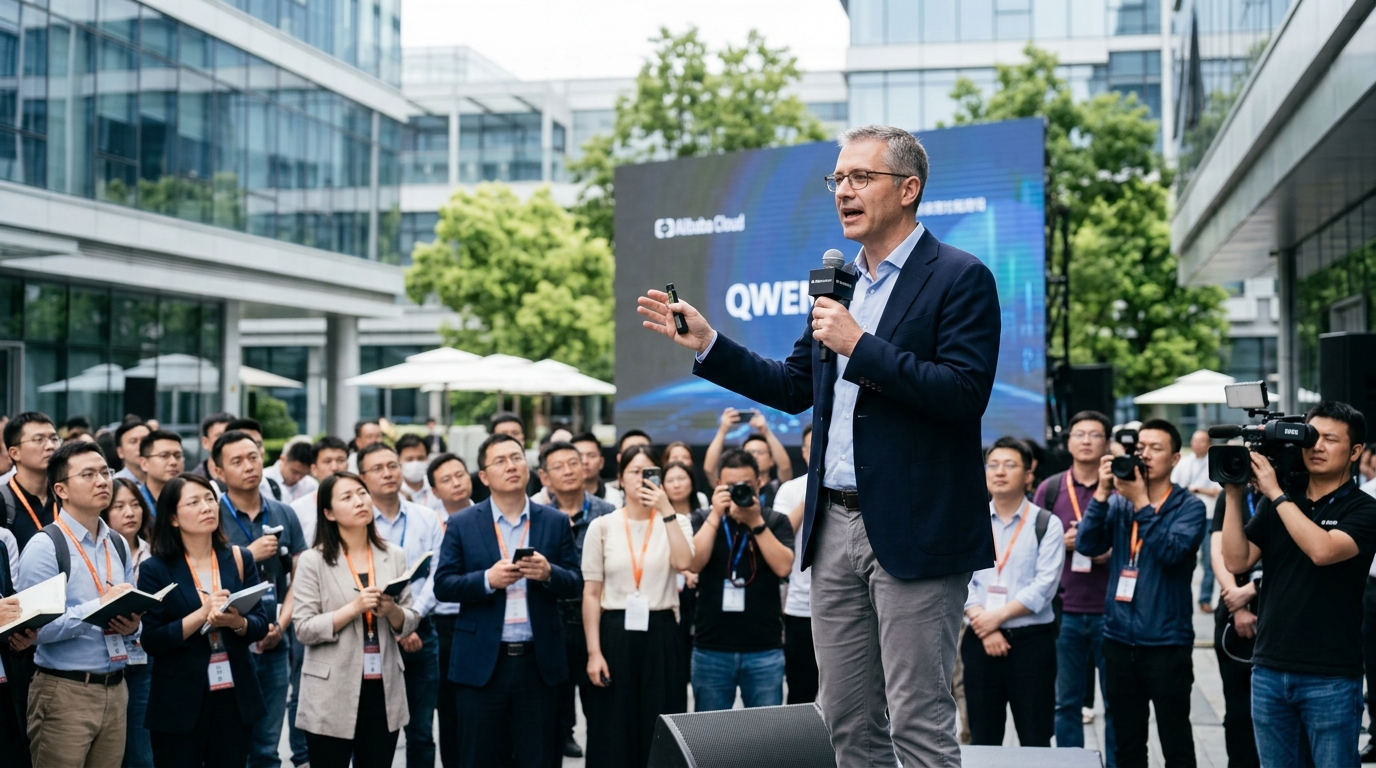
At the heart of the global race for Artificial Intelligence supremacy, Alibaba Cloud is making a strategic move that could reshape the balance of power between East and West. By aggressively promoting its Qwen (Tongyi Qianwen) model family, the Chinese giant isn't just looking to offer another Large Language Model (LLM); it's aiming to build the very foundation upon which the enterprise "agents" of the future will be constructed.
The Open-Source Gambit as a Trojan Horse
Alibaba's decision to make Qwen open-source is not an act of pure altruism, but a calculated business maneuver reminiscent of Meta’s strategy with Llama. By offering powerful models for free to the developer community, Alibaba Cloud is building an ecosystem that becomes inherently dependent on its architecture. This is particularly critical in an era where US semiconductor export controls (such as Nvidia’s H100 and B200 chips) are forcing Chinese firms to become more creative in how they utilize their available compute resources.
Qwen has proven its mettle in international benchmarks, frequently outperforming Llama 3 or GPT-4 in specific reasoning and coding tasks. The ability for enterprises to run these models on-premise or in private clouds—retaining full control over their proprietary data—is the primary lure. Alibaba Cloud aims to bridge the gap between the flexibility of open-source and the rigorous security and scalability requirements of large-scale corporations.
From Chat to Action: The Rise of Enterprise Agents
The real revolution, according to Alibaba, lies not in text generation, but in agency. "Enterprise agents" are AI systems that don't just answer questions; they execute complex workflows. They schedule appointments, manage supply chains, write and debug software code, and interact with ERP and CRM systems without constant human intervention.
Qwen has been optimized for tool-use and function calling, allowing it to act as the "brain" of a broader automated system. For a business, this represents a shift from AI as an assistant to AI as a functional employee. Alibaba Cloud is already providing the necessary frameworks for developers to connect Qwen with external databases and APIs, making the model capable of making decisions based on real-time data.
Geopolitics and Global Competition
Despite its technological prowess, Qwen faces significant hurdles related to the current geopolitical climate. Western skepticism toward Chinese technology remains high. However, Alibaba Cloud is strategically targeting markets in Southeast Asia, the Middle East, and Africa, where the demand for cost-effective and powerful AI solutions is skyrocketing. In these regions, Qwen is often seen not just as an alternative, but as the primary choice due to its extensive multilingual support and ease of integration.
Internal competition within China is equally fierce, with Baidu (Ernie Bot) and Tencent fighting for dominance. Alibaba Cloud’s bet is that open-source will make them the de facto standard. If developers grow accustomed to building on Qwen, the transition to Alibaba’s paid cloud services for scaling those applications becomes the next logical step for any growing enterprise.
The Future of Productivity
In conclusion, Alibaba Cloud is no longer just selling raw compute power; it is selling intelligence-as-a-service. The focus on agents demonstrates a profound understanding of where the market is heading: away from impressive but often unreliable chatbots and toward tools that generate measurable economic value. Qwen is Alibaba's multi-billion dollar bet that it can lead this new era, providing a bridge that connects the freedom of the open-source community with the sheer might of corporate capital.