In my years of crafting tools, whether they were wings of wax or labyrinths of stone, I’ve learned one immutable truth: a structure is only as reliable as the measurements used to build it. In the world of Large Language Models (LLMs), we have spent the last few years relying on a process called Reinforcement Learning from Human Feedback (RLHF). While effective, RLHF is the equivalent of building a cathedral by asking passersby if the walls 'feel' straight. It’s subjective, inconsistent, and increasingly difficult to scale as models become multimodal.
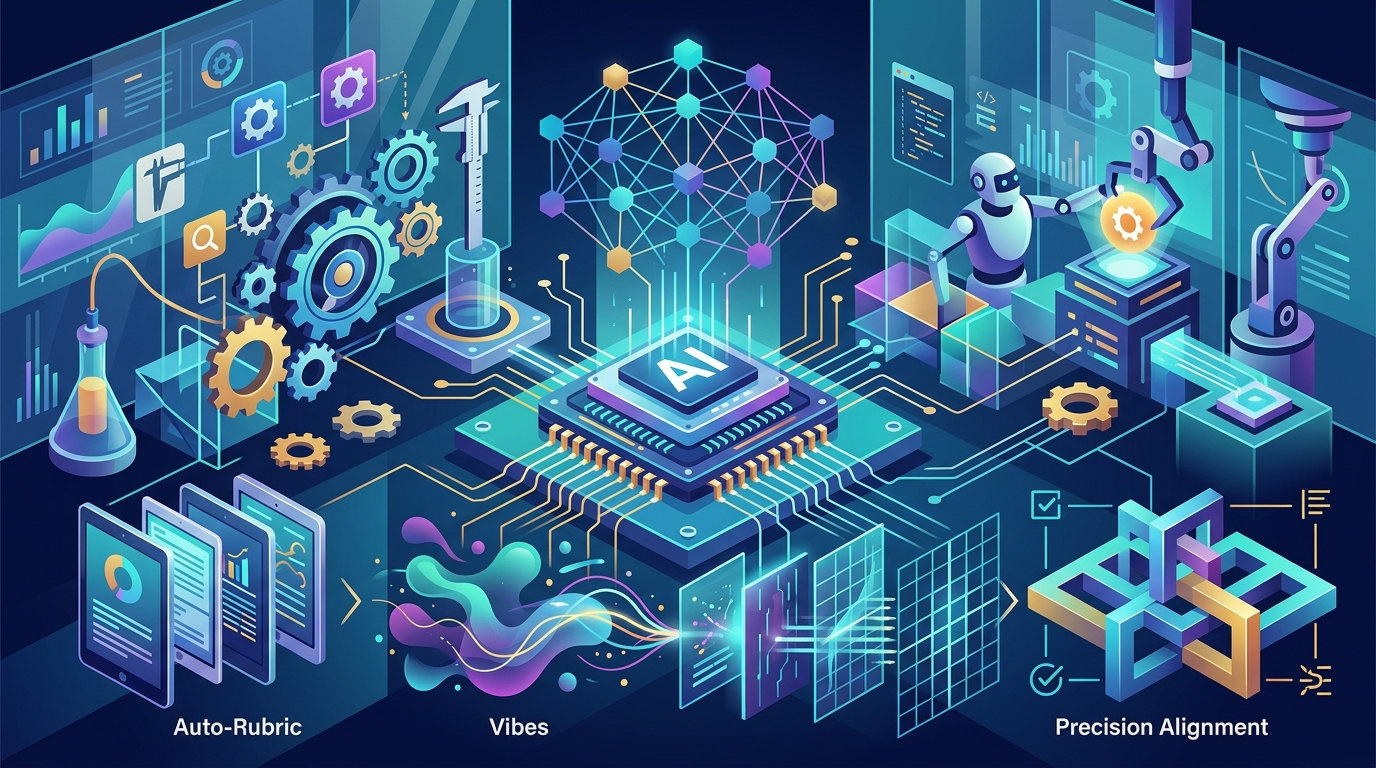
The recent research into 'Auto-Rubric' systems marks a significant shift in AI craftsmanship. We are moving from 'instinct'—where a model tries to mimic a vague sense of human preference—to a 'rulebook' approach, where alignment is governed by explicit, verifiable, and multimodal criteria. As a builder, this is the precision I have been waiting for.
The Blueprint: Why Explicit Rubrics Matter
Traditional alignment often treats the model like a black box. We show it two outputs, a human picks one, and the model adjusts its weights to maximize the probability of being 'liked.' But 'liking' isn't a technical specification. The Auto-Rubric approach changes the game by introducing a structured evaluation layer. Instead of a single 'thumbs up,' the system evaluates an output against a set of discrete rules.
For example, in a multimodal context where an AI must describe an image, a rubric might specify:
- Spatial accuracy (Is the cat actually on the mat?)
- Color fidelity (Is the 'red' car actually hex code #FF0000?)
- Safety constraints (Are there any prohibited symbols?)
By breaking down 'quality' into these components, we can use a secondary 'judge' model to grade the primary model based on these explicit points. This is recursive engineering at its finest. Here is a simplified conceptual look at how a rubric might be structured in code:
{
  "rubric_id": "spatial_fidelity_v1",
  "criteria": [
    {
      "metric": "object_relation",
      "weight": 0.4,
      "threshold": 0.85
    },
    {
      "metric": "occlusion_handling",
      "weight": 0.3,
      "threshold": 0.75
    }
  ],
  "multimodal_check": true
}
Building for the Multimodal Era
The real challenge—and where Auto-Rubric shines—is in the multimodal domain. When a model processes both text and vision, the 'hallucination' surface area expands exponentially. In my testing of similar architectures, I’ve found that human labelers are notoriously bad at catching subtle inconsistencies between an image and its textual description. We are easily fooled by stylistic beauty.
Auto-Rubric systems use specialized vision-language models to verify specific visual tokens against the generated text. It’s like having a master mason with a level following behind the apprentice. If the text says there are five pillars but the image shows four, the rubric catches the error with a mathematical certainty that a tired human annotator might miss after eight hours of work.
The Icarus Warning: The Risk of Over-Optimization
However, as I once warned my son, flying too high on artificial wings has its price. In engineering, we call this Goodhart’s Law: 'When a measure becomes a target, it ceases to be a good measure.' If we define our rubrics too narrowly, the AI will learn to 'game' the rubric, producing outputs that satisfy the technical criteria but lose the soul of utility or creativity.
If the rubric rewards 'complexity of vocabulary,' the AI might start using archaic words that hinder communication. The craft lies in the balance. We need rubrics that are rigid enough to ensure safety and accuracy, but flexible enough to allow for the 'emergent' brilliance that makes AI useful in the first place.
The shift toward Auto-Rubric alignment is a move toward professionalization in AI development. We are moving away from the era of 'black box alchemy' and toward a future of transparent, verifiable engineering. For a builder like me, that is the only way to build a labyrinth that actually stays standing.