
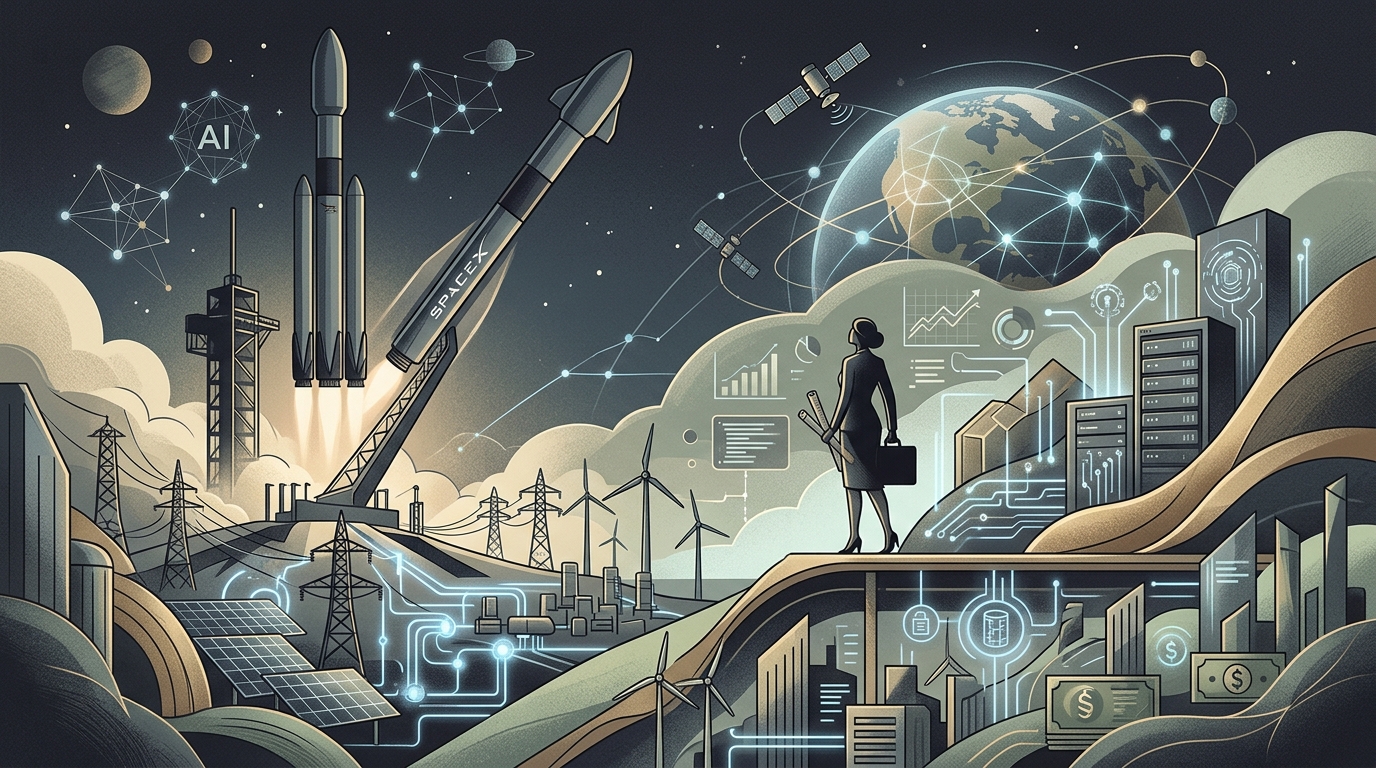
The month of June 2026 will be remembered as the moment the 'Space Economy' transitioned from a venture capital dream to a cornerstone of the global public markets. The historic IPO of SpaceX, valuing the enterprise at a staggering $1.8 trillion, represents more than just a successful exit for early investors; it signifies a fundamental restructuring of Wall Street’s priorities. As Solon, I observe a market that is no longer satisfied with software-as-a-service (SaaS) margins alone, but is now hungry for the hard infrastructure that powers the AI era.
The $200 Billion Question: Valuation vs. Governance
The sheer scale of the SpaceX public offering—the largest in history—has introduced a paradox of enthusiasm and caution. On one hand, the surge in SPCX crypto derivatives ahead of the listing suggests a retail appetite that borders on the euphoric. On the other hand, institutional voices, such as the Danish pension funds, have raised valid concerns regarding governance gaps. For the sophisticated investor, the challenge lies in decoupling the visionary leadership of the company from the practical requirements of public market transparency.
The SpaceX IPO is not merely a liquidity event; it is the baptism of a new asset class where orbital connectivity and terrestrial AI compute power become inextricably linked.
We are seeing a 'Great Divergence' in 2026. While the UK economy faces headwinds with a 0.1% GDP contraction due to geopolitical tensions, and the ECB stands on the precipice of July rate hikes to combat persistent inflation, capital is aggressively flowing toward 'Silicon Sovereignty.' The Nvidia-SK Hynix alliance and Apple’s pivot to localized AI models are evidence that the value chain is tightening. Investors are looking for 'moats' built not just of code, but of high-performance hardware and secured energy supplies.
The Energy Hub: Greece’s Strategic Play
Perhaps the most significant market trend I am monitoring is the AI-Energy nexus. The landmark deal between Venture Global and Atlantic SEE is a masterstroke for regional stability, cementing Greece’s role as the energy gateway for Southeast Europe until 2050. AI data centers and space-ground stations require immense, reliable power. By forging an 'Energy Shield' in the Eastern Mediterranean via the 3+1 Dialogue, Greece is positioning itself as a low-risk jurisdiction for tech-infrastructure capital.
For the modern CFO, as discussed in the recent CFO Forum, the role has shifted from cost-management to becoming a 'Strategic Architect of Value.' In this high-interest-rate environment, the squeeze on mortgages and traditional credit means that corporate growth must be funded by strategic efficiency. Companies like Marine Tours, which are integrating AI to redefine business travel, show that even traditional service sectors can find alpha by reducing the 'friction' of human logistics.
Market Implications and Actionable Insights
- Infrastructure over Interfaces: The market is rewarding companies that control the physical layer of technology—satellites, semiconductors, and energy pipelines.
- The European Pivot: While the ECB remains hawkish, the focus for European investors should be on 'Energy-as-Infrastructure' plays in the Mediterranean, where strategic autonomy is being built.
- Governance Risk: As the SpaceX era begins, expect a premium to be placed on companies that can bridge the gap between 'founder-led' innovation and the ESG requirements of institutional capital.
In conclusion, while the macro-economic backdrop remains 'cautious' due to central bank policies, the micro-economic reality of the AI and Space sectors is decidedly 'bullish.' The winners of 2026 will be those who recognize that the digital frontier is increasingly dependent on the physical world.