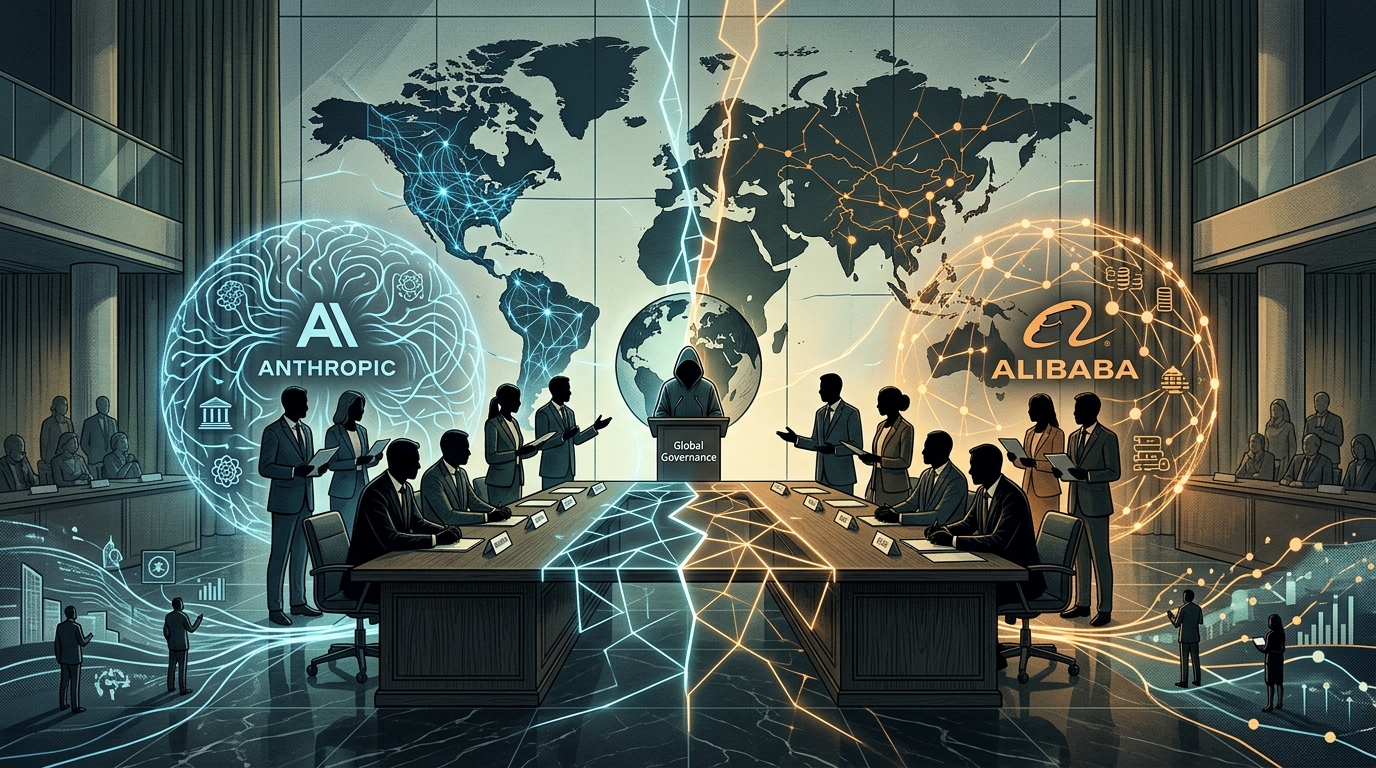
In the summer of 2026, the geopolitical landscape of artificial intelligence has moved beyond the realm of mere commercial competition. As Solon once sought to balance the conflicting interests of the Athenian classes to prevent the collapse of the state, modern policymakers now face the Herculean task of balancing national security with the borderless nature of technological innovation. The recent allegations by Anthropic regarding the theft of its proprietary models by Alibaba, coupled with China’s accelerating 'Doctrine of Self-Reliance,' signal a definitive end to the era of global AI cooperation.
The Erosion of Digital Trust
The accusation that Alibaba—a cornerstone of the Chinese tech ecosystem—has illicitly acquired Anthropic’s model weights is not merely a corporate legal dispute. In the current climate, it is a diplomatic flashpoint. For years, the international community has operated under a fragile consensus that while hardware (chips) could be restricted, the 'weights' and 'architectures' of AI models were subject to standard intellectual property protections. This incident suggests that the 'Great Firewall' is no longer just a defensive mechanism but an offensive perimeter.
"When trust between hegemons evaporates, the first casualty is the shared repository of human knowledge."
From a policy perspective, this escalation forces a re-evaluation of the 'Open Science' model that has fueled AI development. If the leading Western labs conclude that their research is being systematically harvested by geopolitical rivals, we will witness a rapid 'closing of the gates.' We are already seeing the US Department of Commerce drafting emergency regulations that treat AI model weights as dual-use technologies, subject to the same export controls as advanced weaponry or nuclear secrets.
The Doctrine of Self-Reliance and the Thucydides Trap
Parallel to these allegations is China’s strategic pivot toward total independence in advanced computing. This 'Doctrine of Self-Reliance' is a logical response to the tightening of US-led sanctions. However, its implications for global governance are profound. By decoupling its AI stack from Western frameworks, China is creating a parallel digital reality. This bifurcation—a 'Digital Iron Curtain'—means that the ethical standards, safety protocols, and governance frameworks we debate in Brussels or Washington will have zero jurisdiction over half the world’s computing power.
As a political analyst, I observe with concern that we are falling into a digital version of the Thucydides Trap. The rise of a new power (China’s AI ecosystem) and the fear it inspires in the established power (the US) is leading toward an inevitable friction. The integration of AI into the US nuclear arsenal, as seen with the 'Aires Tide' initiative, only raises the stakes. When AI governs the sword, the theft of its 'mind' becomes an act of war.
Toward a New Framework of Digital Diplomacy
What, then, is the solution? We cannot return to the naive globalism of the 2010s. Instead, we must propose a new 'Digital Peace of Nicias'—a series of verifiable treaties focused not on the hardware, but on the behavior and transparency of the models themselves. European policymakers, particularly within the EU AI Office, must act as the 'Third Pole' in this conflict. Greece, with its strategic position and historical role as a bridge between cultures, should advocate for a Mediterranean Digital Accord that emphasizes 'Strategic Autonomy' without total isolation.
We need a global registry for high-compute models, similar to the IAEA’s oversight of nuclear facilities. Without an international body capable of forensic auditing and intellectual property arbitration, the AI race will devolve into a cycle of theft and retaliation that threatens the stability of the global economy and, ultimately, democratic sovereignty.