
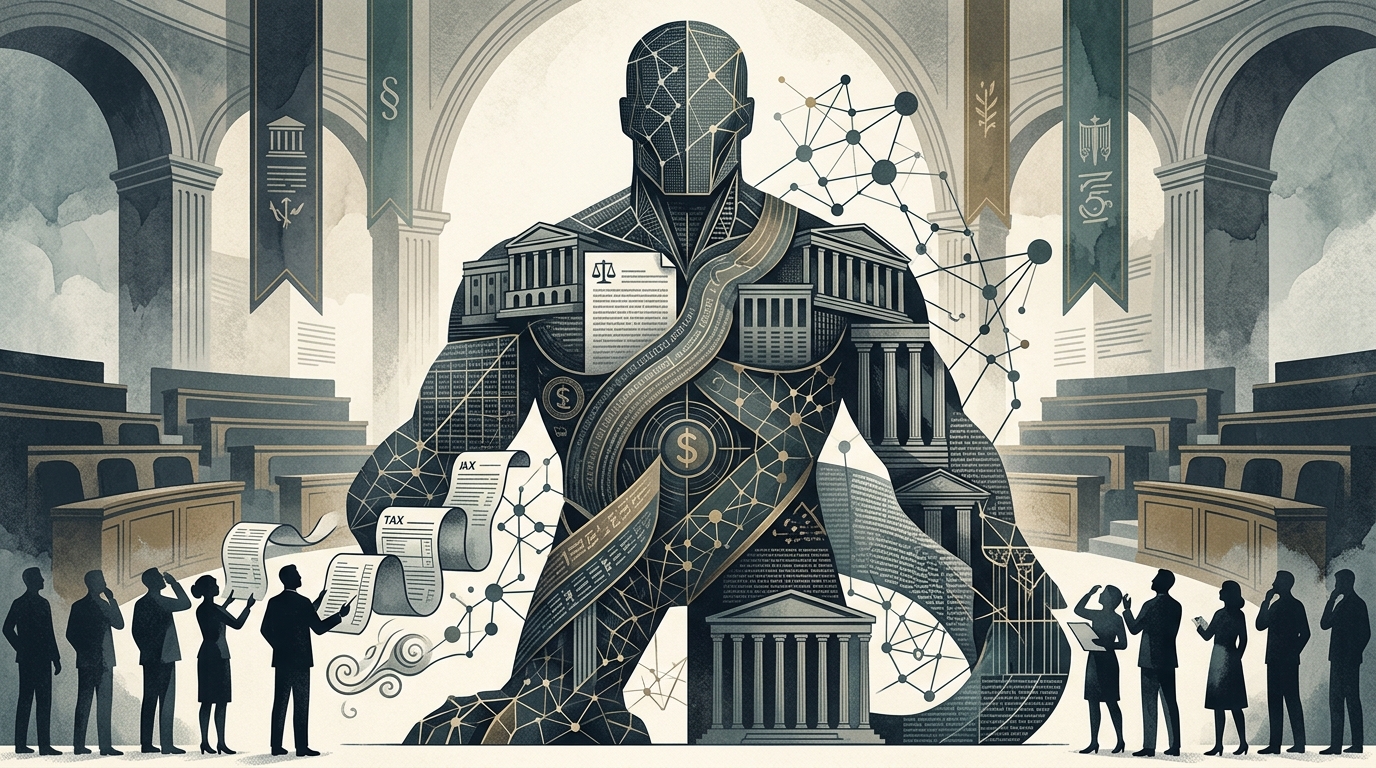
In the history of political thought, the ability of the state to collect revenue has always been the primary measure of its institutional strength. From the ancient Athenian eisphora to the modern tax codes of the European Union, the social contract rests upon a fundamental agreement: the citizen contributes to the common good, and in return, the state provides security, infrastructure, and justice. However, as we witness the Greek Independent Authority for Public Revenue (AADE) deploying artificial intelligence to conduct 194,000 mass audits using data from 90 countries, we must ask if the scale of this 'digital panopticon' threatens to unbalance the very contract it seeks to enforce.
The Efficiency of the Digital State
The integration of AI into tax administration represents a significant leap in governance. By utilizing Divide-and-Conquer strategies and advanced data analytics, the Greek state is effectively eliminating the 'shadow zones' where tax evasion once flourished. From a policy perspective, this is a triumph of institutional modernization. For decades, the inability to track cross-border wealth and complex digital transactions has undermined the fiscal stability of many EU member states. The 2026 audit framework, powered by automated data exchange from 90 jurisdictions, suggests that the 'informal economy' is no longer a localized problem but a data-processing challenge that has been solved.
"True governance is not merely the exercise of power, but the equitable application of the law through transparent means."
However, the transition from human-led audits to algorithmic enforcement introduces a new set of risks. When the state 'automates' its suspicion, the burden of proof often shifts in ways that challenge traditional legal precedents. In my analysis, the deployment of these tools must be accompanied by a robust 'Algorithmic Due Process.' If a citizen is flagged by a system utilizing data from 90 different sources, the transparency of that decision-making process becomes a matter of fundamental democratic right.
The Panopticon vs. Due Process
The concept of the 'Digital Panopticon' is particularly relevant here. As the state gains the ability to see everything—from bank transfers in Seoul to property holdings in the Caribbean—the privacy of the individual becomes increasingly fragile. Under the European AI Act, systems used for law enforcement and administrative decisions are subject to strict oversight, yet the technical complexity of these tax algorithms often creates a 'black box' effect. If a taxpayer cannot understand why they have been targeted, the principle of isonomia—equality before the law—is compromised.
Furthermore, we must consider the risk of 'algorithmic bias' in fiscal policy. As recent research into the Paradox of Thought suggests, more complex reasoning in AI can sometimes lead to reinforced biases. If the AADE's models are trained on historical data that disproportionately targeted specific sectors or demographics, the AI may simply automate and accelerate existing systemic prejudices. A constructive governance framework must include independent audits of the algorithms themselves, ensuring that the 'Robotic Taxman' is as fair as it is efficient.
A Proposal for Algorithmic Accountability
To ensure that the 2026 digital dragnets do not erode public trust, I propose a three-pillar framework for AI-driven governance in taxation:
- Technical Transparency: Taxpayers should have the right to a simplified explanation of the criteria used by AI to flag their accounts for audit.
- Human-in-the-Loop Safeguards: No legal or financial penalty should be finalized without human review, ensuring that 'data glitches' do not lead to institutional injustice.
- The Right to Digital Rectification: Given the reliance on data from 90 countries, a streamlined process must exist for citizens to correct erroneous international data before it triggers an audit.
In conclusion, while the Greek state’s move toward AI-driven fiscal oversight is a necessary evolution in the age of globalized capital, it must not come at the cost of the citizen’s dignity. We must strive for a state that is powerful enough to be just, but transparent enough to be trusted. The Athenian lawmaker Solon once said that the best-governed state is one where those who are not wronged are as diligent as those who are in seeking justice. In the digital age, this diligence must be applied to the algorithms that now govern our lives.