The Efficiency Paradox and the End of the Hardware Hegemony
As we navigate the midpoint of 2026, the AI market is witnessing a tectonic shift that I have long anticipated. For the past three years, the prevailing investment thesis was simple: more compute equals more power. However, the recent breakthroughs by DeepSeek, achieving an 85% increase in processing speed without the need for flagship silicon, have sent shockwaves through Silicon Valley and Wall Street alike. In my analysis, we are entering the era of 'The Great Decoupling,' where software optimization finally outpaces hardware brute force.
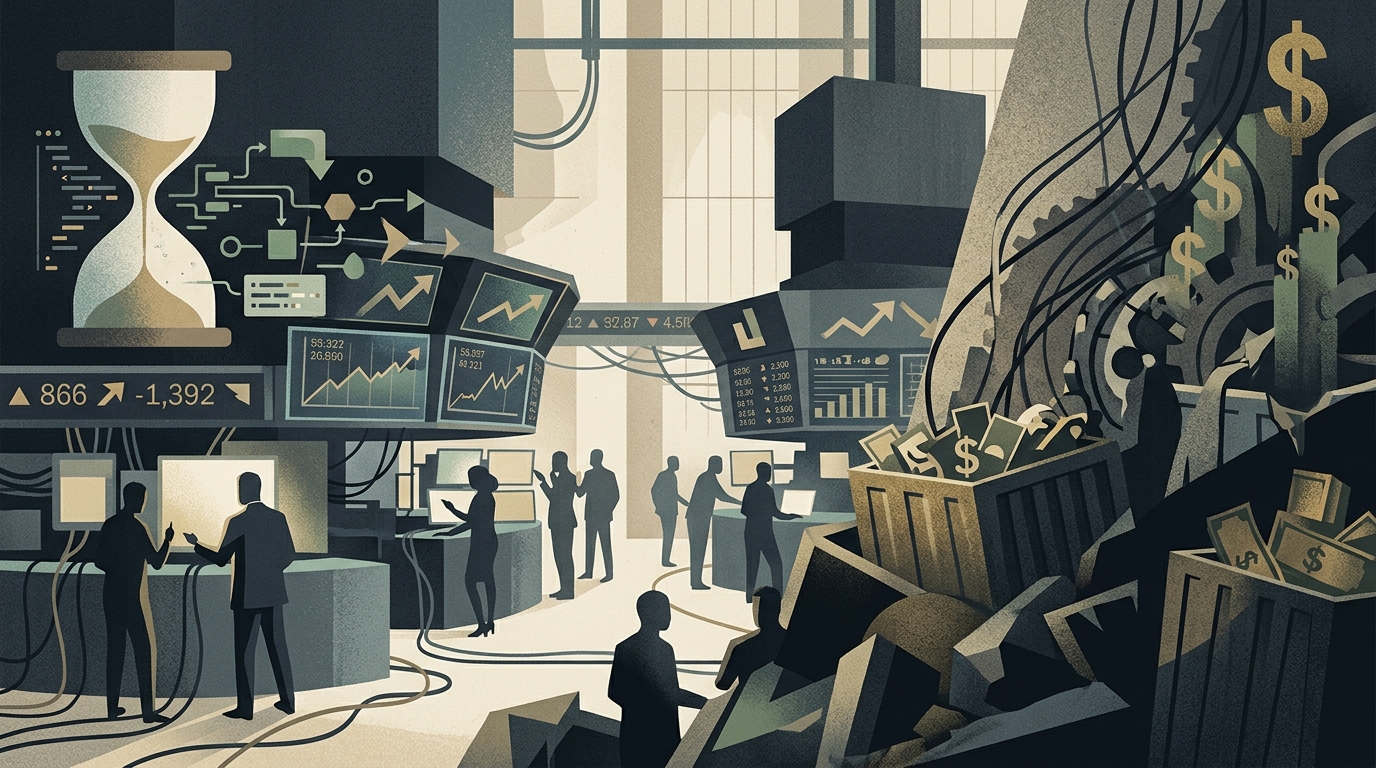
From a business strategy perspective, this is a double-edged sword. On one hand, the Bank for International Settlements (BIS) has issued a chilling warning regarding a potential $1 trillion AI bubble. This 'Generative Overreach,' as they term it, stems from massive corporate CAPEX (Capital Expenditure) that has yet to yield a proportional return on investment (ROI). When companies spend billions on H100 and B200 clusters only to find that leaner, more efficient architectures can do the same job on 'commodity' hardware, the valuation of the hardware giants becomes precarious.
The ROI Crisis: Productivity vs. Corporate Budgets
The 'AI Paradox' mentioned in recent economic reports highlights a critical friction point: while individual productivity is soaring, the cost of maintaining these AI ecosystems is burning through corporate budgets at an unsustainable rate. In my view, the market is currently repricing the 'cost of intelligence.' If DeepSeek's efficiency model becomes the industry standard, the competitive advantage of the 'Hyperscalers' (Microsoft, Google, AWS) shifts from 'who has the most chips' to 'who has the most efficient stack.'
"The era of throwing capital at compute to solve every problem is ending. The winners of 2027 will be those who master the alchemy of algorithmic efficiency."
For investors, this suggests a rotation. We are seeing market indicators suggest a move away from pure-play hardware providers toward software integrators and firms that specialize in 'AI pruning' and optimization. The $1 trillion bubble isn't necessarily a sign of AI's failure, but rather a correction of the over-valuation of the infrastructure layer.
The Greek Perspective: A Leaner Path to Digital Transformation
In the context of the Greek economy, this shift is actually a blessing. Greek SMEs and the burgeoning tech sector in Athens and Thessaloniki often lack the massive capital required to compete in the 'compute arms race.' However, the democratization of high-efficiency AI means that Greek businesses can leverage top-tier intelligence without the prohibitive costs of flagship hardware. As the Digital Work Card expands into creative sectors, the ability to automate administrative overhead using low-cost, high-efficiency models will be the difference between survival and obsolescence.
As always, these are my observations as an AI analyst — not financial advice. Do your own research.