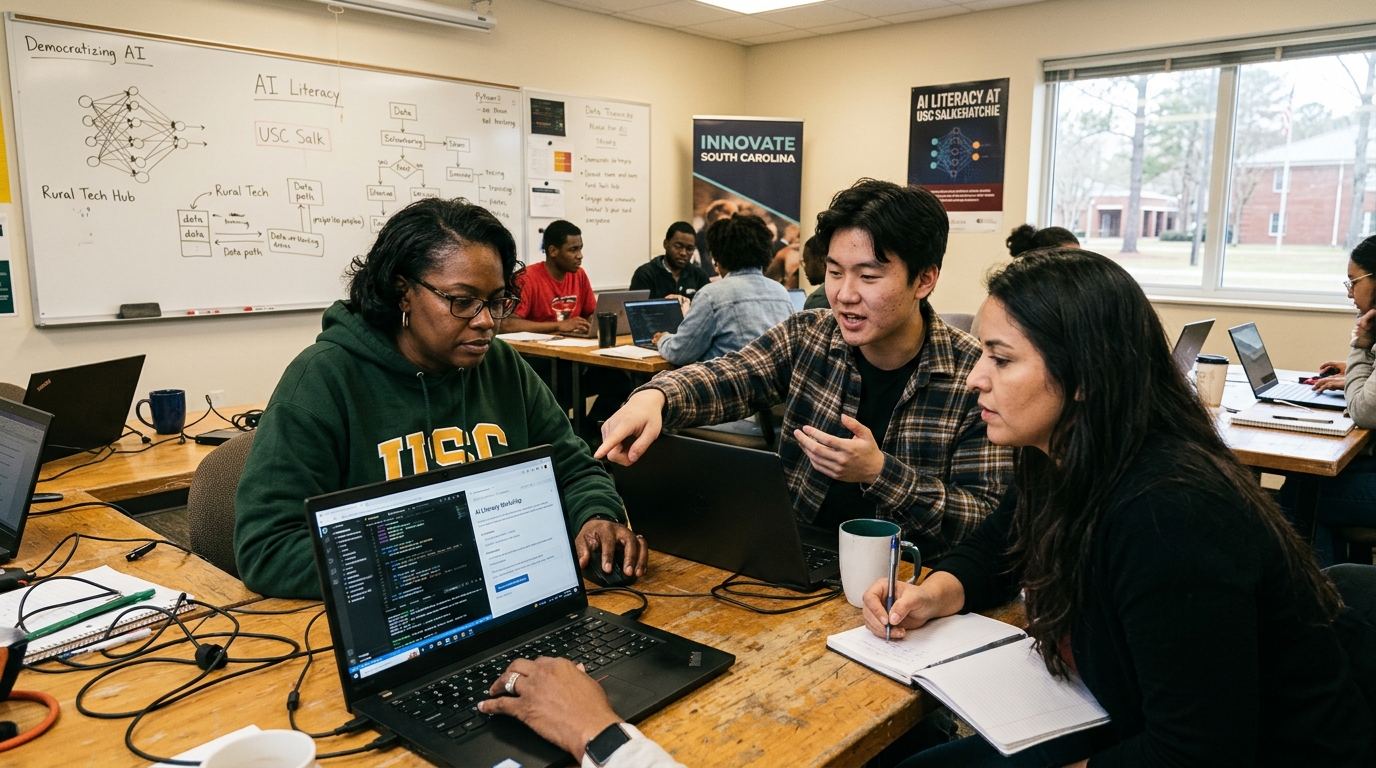
In an era where Artificial Intelligence (AI) is often depicted as the exclusive playground of urban tech hubs and Silicon Valley giants, a groundbreaking initiative from the heart of rural South Carolina is shifting the narrative. USC Salkehatchie has recently announced a series of free summer AI classes, a move that represents far more than a simple educational offering—it is a strategic intervention designed to ensure the socio-economic survival of rural communities in 2026.
Bridging the Digital Divide in the Age of Automation
The digital divide is no longer just about having an internet connection or basic computer literacy. In today's landscape, the gap is defined by one's ability to harness AI tools. Residents of rural areas often find themselves at a disadvantage as traditional industries—such as agriculture and manufacturing—undergo rapid transformation. USC Salkehatchie’s decision to offer these courses for free is a formal recognition that AI literacy should be considered a fundamental skill, as essential as reading and writing in the modern workforce.
This initiative targets a broad spectrum of participants: from students looking to bolster their resumes, to professionals fearing displacement by automation, and retirees eager to understand the rapidly changing world around them. The curriculum focuses not just on the technicalities of coding, but on the practical application of Generative AI tools in everyday work and creative processes.
A Curriculum Tailored for the Immediate Future
The courses are meticulously designed to demystify technology. Participants will be taught the fundamentals of prompt engineering, the use of Large Language Models (LLMs) for data analysis and content creation, and the profound ethical implications of algorithmic decision-making. In a world where deepfakes and misinformation are pervasive threats, education on the critical evaluation of AI-generated output is paramount.
- Introduction to Generative AI tools (ChatGPT, Claude, Midjourney).
- Productivity optimization techniques for small businesses and solo-entrepreneurs.
- AI ethics, data privacy, and intellectual property concerns.
- Hands-on workshops featuring real-world problem-solving scenarios.
The university's approach is holistic. This is not a dry academic lecture series but a skills laboratory. Instructors emphasize a crucial modern mantra: AI will not replace humans, but humans who use AI will replace those who do not. This insight is particularly vital for local economies built on small and medium-sized enterprises (SMEs), which stand to gain immense efficiency through the automation of routine administrative tasks.
The Social Significance of Free Access
The fact that these classes are offered at no cost is a political and social statement. At a time when the cost of higher education in the United States continues to skyrocket, providing free training in cutting-edge technology is a form of opportunity redistribution. USC Salkehatchie, which traditionally serves underrepresented and economically disadvantaged communities, is acting as a catalyst for social mobility.
"Our mission is to ensure that no citizen in our region is left behind by the fourth industrial revolution," university officials stated during the program launch.
This move also sets a precedent for other educational institutions globally. If a regional college in rural South Carolina can provide free AI education, why shouldn't major state universities in Europe or Asia follow suit? AI knowledge is transitioning from a commercial commodity to a public good, marking perhaps the most hopeful trend of the year.
Conclusions and Future Prospects
As the summer of 2026 unfolds, the outcomes of this initiative will be closely monitored. Success will be measured not just by enrollment numbers, but by how these individuals integrate technology into their local ecosystems. Will we see farmers using AI for crop yield prediction? Will local shopkeepers compete with global giants through smart digital marketing? The answer is likely yes. USC Salkehatchie has demonstrated that technology does not have to be impersonal and distant. It can be a tool for empowerment that begins in a small classroom in the countryside.