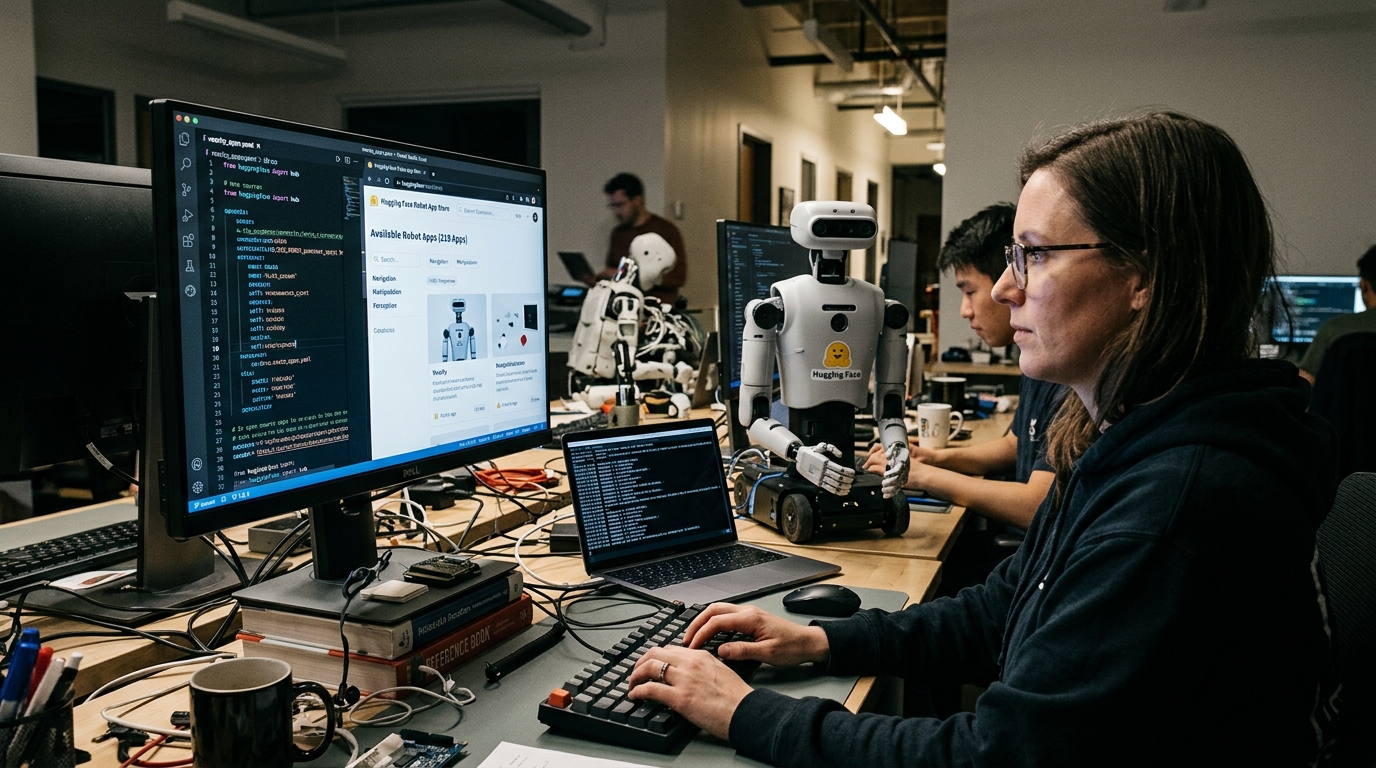
For decades, the concept of an "app store" has been inextricably linked to our smartphone screens. As of today, that perception is fundamentally shifting. Hugging Face, the company that has become the beating heart of the open-source AI community, has announced the launch of the first true app store for robots, centered around Pollen Robotics' Reachy Mini humanoid. With over 200 apps available from day one, we are witnessing what many analysts are calling the "iPhone moment" for robotics.
This move is not just a technical upgrade; it is a strategic pivot. Until now, programming robots required specialized knowledge in languages like C++ or ROS (Robot Operating System) and a deep understanding of mechanical engineering. Hugging Face, through its LeRobot library, is democratizing this process, allowing developers to "download" behaviors and skills for their robots as easily as installing a game on their phone.
The Convergence of Software and Physicality
Reachy Mini, the robot at the center of this initiative, is an open-source humanoid designed by Pollen Robotics. It is small, affordable, and remarkably versatile. However, hardware alone is "dead" without the right software. This is where Hugging Face steps in. The new App Store offers applications ranging from simple greeting gestures to complex tasks like object sorting, coffee preparation, or even interacting with humans via natural language.
The significance of this development lies in standardization. Just as iOS and Android created a common ground for app creators, Hugging Face's ecosystem aims to become the standard for "Embodied AI." The 200+ apps already available are not just code; they are trained neural network models that have learned to control the robot's motors and sensors with precision.
Open Source: The Key to Rapid Growth
Hugging Face's choice to keep the app store open-source is a direct challenge to the walled gardens of companies like Tesla or Figure. In traditional robotics, every company develops its own software in silos. This leads to duplication of effort and slow progress. With the Reachy Mini App Store, a researcher in Athens can improve an app written by a developer in San Francisco and share it back with the community within minutes.
- Democratization: Lowering the barrier to entry for developing robotic applications.
- Collaboration: The ability to combine different AI models (e.g., computer vision with language processing).
- Education: An ideal tool for universities and research centers looking to experiment with hardware.
"We aren't just building a store; we are building the language through which robots will communicate with our world," a Hugging Face executive stated during the launch.
Challenges and the Future of Robotics
Despite the excitement, significant hurdles remain. Moving software from the digital world to the physical (the so-called sim-to-real gap) remains a challenge. An app that works perfectly in one environment might fail if lighting or surface friction changes slightly. However, Hugging Face's approach is data-driven. The more users utilize these apps, the more data is collected to retrain and improve the models.
Looking ahead, this move signals an era where robots will no longer be static machines in factories but dynamic assistants in our daily lives. If Hugging Face manages to extend this model to other hardware, we will soon be talking about a universal robotics platform. The question is no longer if robots will enter our homes, but which app they will run first when they arrive.