In the rapidly evolving landscape of Artificial Intelligence, the ability of machines to comprehend human speech is no longer a luxury but a fundamental necessity. However, generic Automatic Speech Recognition (ASR) models often falter when faced with the intricacies of local accents, specialized medical or legal terminology, or low-resource languages. The recent collaboration between NVIDIA and Hugging Face regarding the Nemotron 3.5 ASR model promises to bridge this gap, offering fine-tuning tools that enable organizations and developers to build systems that truly 'listen' to their users.
The Architecture of Specialization
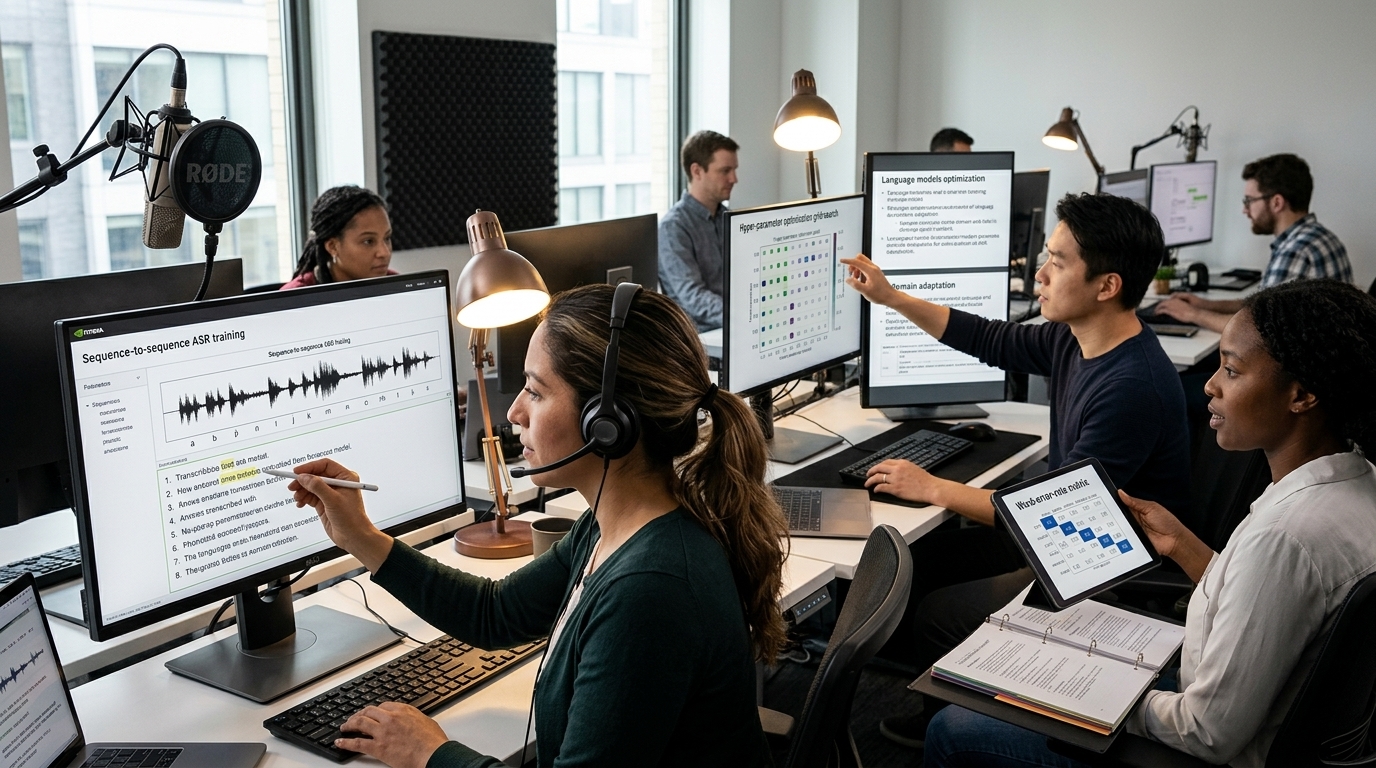
Nemotron 3.5 ASR is not just another speech-to-text model. Built upon the NVIDIA NeMo ecosystem, it utilizes advanced techniques such as Connectionist Temporal Classification (CTC) and Transducer architectures, allowing it to maintain high accuracy even in noisy environments. The key to its success lies in its flexibility. While out-of-the-box models perform exceptionally well in standard English, the fine-tuning process allows the model to learn the nuances of a specific dialect—such as Scottish English or regional Greek accents—dramatically reducing the Word Error Rate (WER).
The process begins with data preparation. Unlike the past, where thousands of hours of recorded material were required, Nemotron 3.5 can achieve impressive results with significantly less data, provided it is high-quality and representative of the target domain. Developers use 'manifest files' to link audio files with their corresponding transcriptions, enabling the model to align sounds with linguistic symbols effectively.
Applications in Specialized Domains
The need for specialized ASR is most evident in sectors like healthcare. A physician dictating a diagnosis uses terminology that a generic model might transcribe as gibberish. By fine-tuning Nemotron 3.5, the system is trained on medical dictionaries and real-world clinical conversations, ensuring that complex terms like 'hyperlipidemia' are not misidentified. The same applies to the legal field, where the precision of a single word can alter the meaning of an entire contract.
- Local Dialects: Adaptation to accents often neglected by major tech giants.
- Technical Terminology: Enhanced recognition in fields such as engineering, IT, and law.
- Low-Resource Languages: The ability to develop models for languages with limited digital footprints.
One of the most significant advantages of using Nemotron via NVIDIA NeMo is the possibility of on-premises hosting. In an era where data privacy is paramount, the ability for a company to train and run its own ASR model on its own servers—without sending sensitive audio data to the cloud—is a powerful competitive advantage.
The Technical Workflow: From Data to Production
To begin fine-tuning, access to GPU computing power is required, as processing audio signals is computationally intensive. Hugging Face provides the necessary scripts and model checkpoints, making the process more accessible than ever. The 'LoRA' (Low-Rank Adaptation) strategy plays a crucial role here, as it allows for training only a small fraction of the model's parameters, reducing training time and costs without sacrificing performance.
"Specializing speech recognition is no longer a research project; it is a production tool that democratizes access to technology for every language and every community," industry analysts note.
In conclusion, Nemotron 3.5 ASR represents a shift toward 'cultural intelligence.' It is not enough for AI to speak English; it must understand the world in its entirety. For global markets, this opens vast prospects, from automating customer service centers with a perfect grasp of local vernacular to supporting individuals with disabilities through customized voice interfaces.