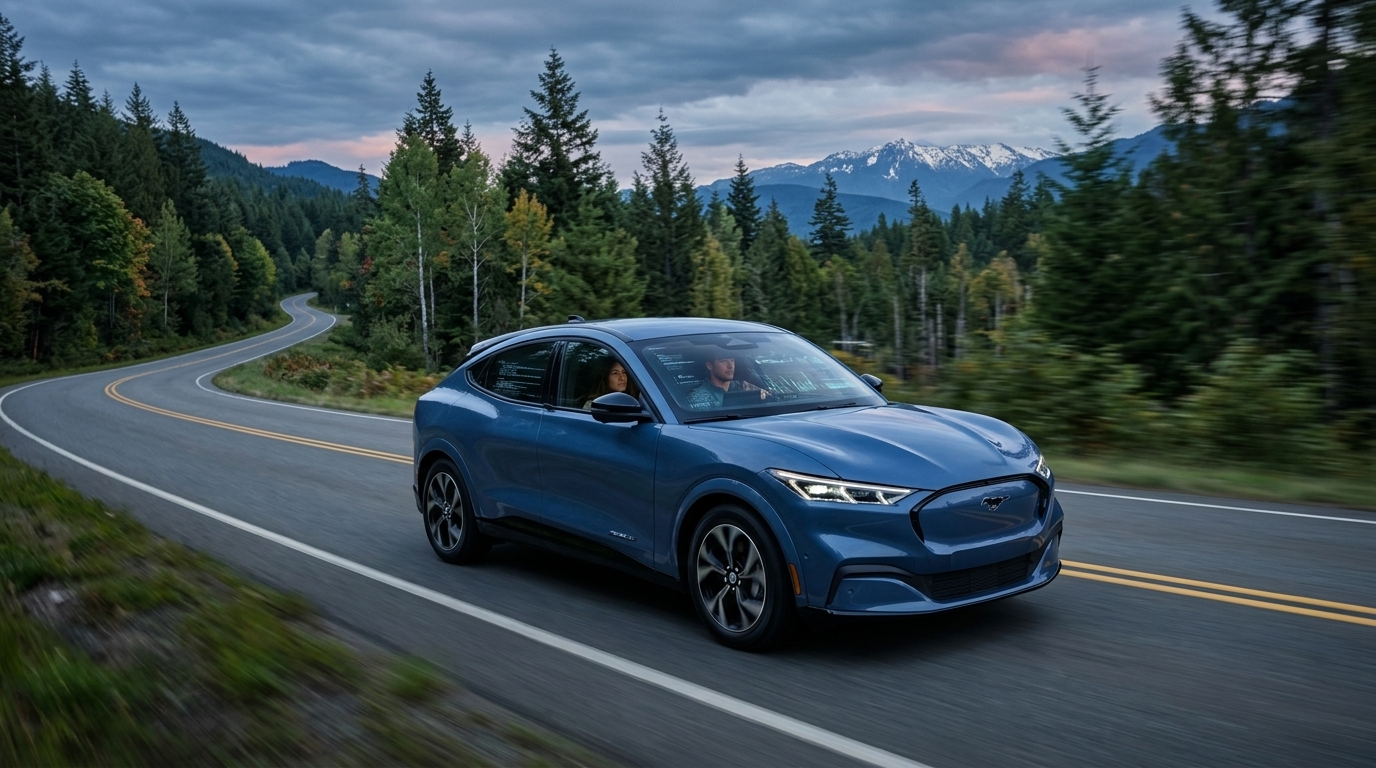
When Ford first announced that the iconic Mustang nameplate would grace an electric SUV, the automotive world was shaken to its core. For traditional muscle car enthusiasts, the idea of a silent Mustang felt almost sacrilegious. However, as we move through 2026, the Mustang Mach-E has proven it is not only a worthy successor to the 'galloping horse' legacy but also a pioneer in integrating artificial intelligence and digital intelligence into everyday driving.
Artificial Intelligence at the Helm
The heart of the Mach-E no longer resides in cylinders and pistons, but in its high-performance processors. The BlueCruise system, now in version 3.5, represents the pinnacle of semi-autonomous driving. Utilizing a sophisticated network of cameras, radar, and ultrasonic sensors, the vehicle can take control on thousands of miles of pre-mapped highways, allowing the driver to go hands-free while AI continuously monitors their gaze to ensure situational awareness.
Furthermore, the Over-the-Air (OTA) update system allows Ford to refine the vehicle constantly. Unlike traditional cars that begin to age the moment they leave the showroom, the Mach-E evolves. Battery management algorithms learn from the owner's driving style and environmental conditions, optimizing range in real-time. In markets like Greece, where temperature fluctuations and mountainous terrain challenge EVs, the Mach-E's ability to accurately predict remaining charge is a critical advantage.
Performance That Challenges the Senses
Despite its electric nature, the Mach-E retains the Mustang DNA in its immediate responsiveness. The GT version, with all-wheel drive and massive instantaneous torque, delivers acceleration that leaves many traditional sports cars in its wake. The MagneRide suspension, controlled by an onboard computer thousands of times per second, adapts to road conditions, offering a perfect balance between long-distance comfort and dynamic handling.
However, the true innovation lies in how technology enhances the experience. The SYNC 4A system (and its 2026 successors) utilizes machine learning to suggest destinations, music, or even phone calls based on the driver's routines. The massive 15.5-inch screen is not merely an accessory but the command center of a digital ecosystem that connects seamlessly with smart homes and personal devices.
Ford's Strategy and the Global Market Shift
The transition to electromobility is not without its hurdles. Charging infrastructure remains a concern in many regions, but Ford has invested heavily in the BlueOval Charge Network, providing access to hundreds of thousands of charging points globally. The Mach-E, with its DC fast-charging capability, can recover a significant portion of its energy in under 30 minutes, making long-distance travel a realistic and comfortable endeavor.
Ford's strategy to use the Mustang name was a calculated risk that paid off. It managed to attract a new demographic seeking cutting-edge technology without sacrificing style or emotional connection. In a market flooded with anonymous electric SUVs, the Mach-E stands out with its signature curves and heritage, proving that the future of motoring can be digital without being clinical.
- Advanced BlueCruise system for hands-free highway driving.
- Continuous software improvements via Cloud-based OTA updates.
- Impressive range reaching up to 600 kilometers (WLTP).
- AI integration for a deeply personalized user interface.
In conclusion, the Ford Mustang Mach-E redefines the 'driving experience.' It is no longer just about getting from point A to point B; it is about a continuous interaction between human and machine, where artificial intelligence acts as an invisible co-pilot, ready to provide safety, entertainment, and exhilarating performance.