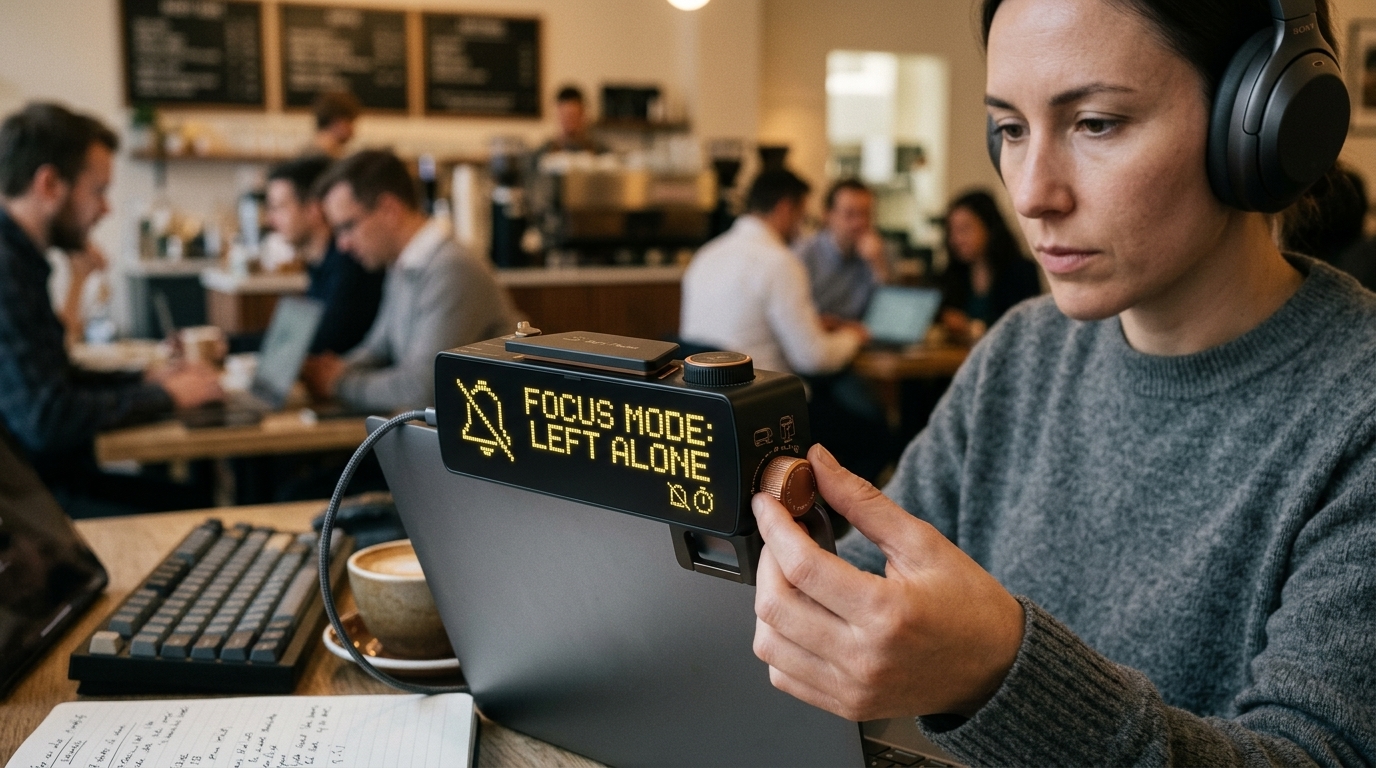
In an era of hyper-connectivity, the greatest luxury is not access to information, but the absence of it. Flipper Devices, a company that became globally famous (and occasionally notorious) for the Flipper Zero—a multi-tool capable of "hacking" everything from garage doors to digital signs—is now turning its attention to a different kind of "intrusion": the human interruption. Their new product, the Busy Bar, is an RGB LED light bar designed to tell others what we often hesitate to say ourselves: "Do not disturb me."
From Hacking Systems to Hacking Social Norms
The Busy Bar is not a complex cybersecurity tool. In fact, it is a strikingly simple gadget. It is a light bar that connects to your computer or smartphone and changes color based on your status. Red means "in a meeting" or "deep work," green means "available for a chat." While the idea of status lights is not new, Flipper’s approach carries a particular weight due to the company’s heritage in underground tech culture.
The need for such a tool emerged from the pandemic and the normalization of remote work. In an environment where the home became the office, the boundaries between professional and personal life collapsed. The Busy Bar attempts to restore these boundaries in a visual, non-verbal way. Instead of having to explain to your children, your partner, or your colleagues in an open-plan office that you are in the middle of a critical thought process, the light takes on the role of the "bouncer" of your attention.
The Psychology of "Do Not Disturb" in the Digital Age
Why do we need a $50 or $100 gadget to do something that could be handled with a simple conversation? The answer lies in the psychology of "flow." According to research, after an interruption, the human brain takes an average of 23 minutes to return to the same level of concentration. The Busy Bar acts as a preemptive measure to protect this precious time.
- Reduces the social anxiety of refusal: It is easier to show a red light than to say "go away."
- Creates a focus ritual: Activating the device psychologically prepares the user for work.
- Offers high customization: Through open-source software, users can program the light to react to specific triggers, such as a Twitch live stream or a Zoom call.
An Ironic Pivot for Flipper Devices
There is a subtle irony in the fact that Flipper, a company accused of facilitating the violation of others' privacy, is now selling a tool to protect our own. The Flipper Zero was banned by platforms like Amazon and faced scrutiny from customs authorities in Canada and the US, as it was deemed a tool for car theft and signal interception. With the Busy Bar, the company is attempting to "sanitize" its image, entering the productivity hardware market while maintaining its signature cyberpunk design.
However, the Busy Bar also raises questions about the quality of human relationships in the workplace. If we need a glowing sign to communicate with people in the same room, have we lost the capacity for basic social transaction? Critics argue that such gadgets reinforce isolation and turn the office into a series of "islands" communicating only via light signals, resembling lighthouses in a dark sea rather than a vibrant community.
The Future of Attention Management
The Busy Bar is just the tip of the iceberg. As artificial intelligence increases the speed of information production, human attention is becoming the rarest currency in the economy. Tools that help limit stimuli will become essential. Flipper Devices is betting that its users—primarily tech-savvy professionals and developers—will appreciate the aesthetics and customization the Busy Bar offers. In a world that is constantly screaming for our attention, the silence of a red light might be the most revolutionary act we can perform.