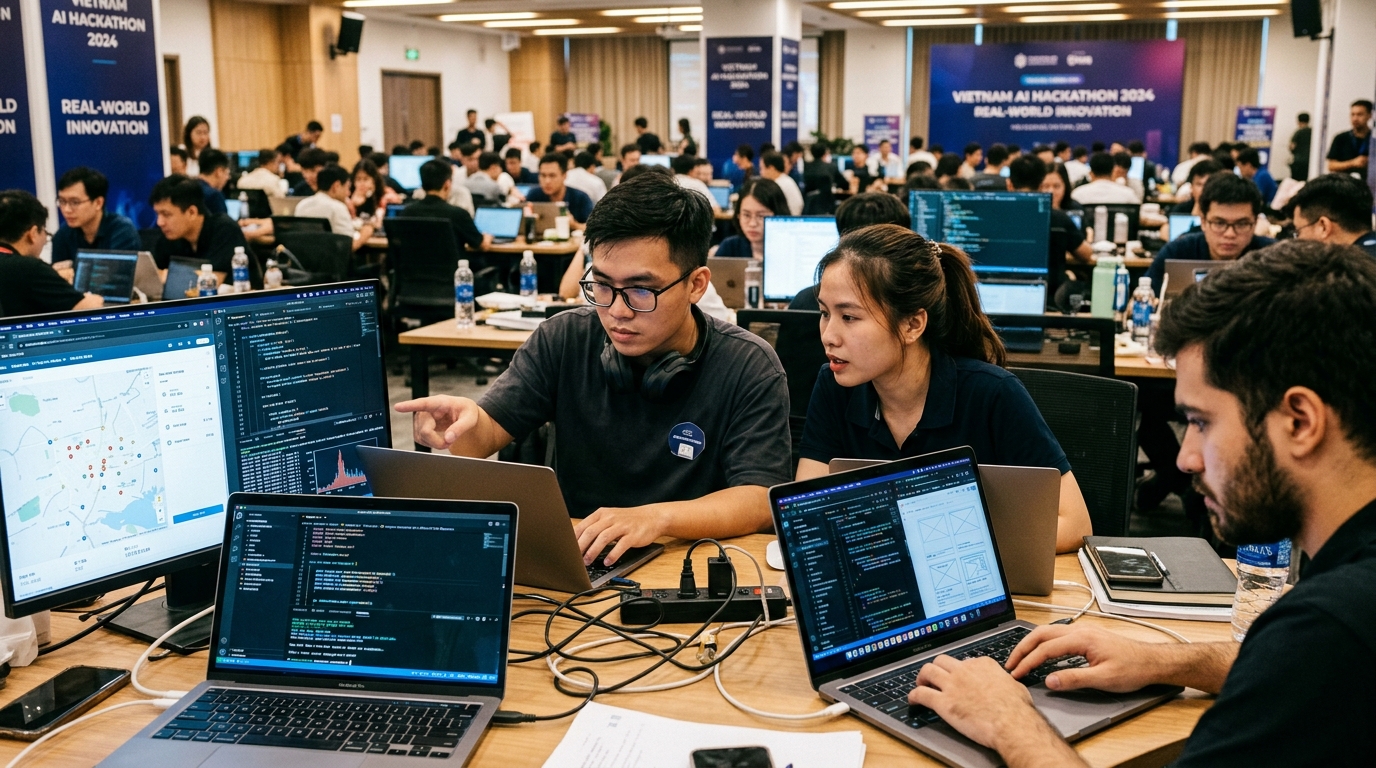
The image of thousands of individuals hunched over screens, in an atmosphere electrified by creativity and time pressure, is not new to the world of information technology. However, what recently transpired in Vietnam, with the participation of 2,000 developers in the country's first large-scale AI Hackathon, represents a milestone that transcends the narrow boundaries of a local event. This was not merely a coding competition; it was a statement of intent from an emerging economy aspiring to become the next global hub for Artificial Intelligence.
From Theory to Practice: Solving Real-World Problems
For years, the discourse surrounding Artificial Intelligence (AI) was consumed by theoretical models, impressive but often impractical chatbots, and ethical dilemmas. The Vietnam Hackathon posed a different question: How can AI solve the problems faced by a citizen in Hanoi or Ho Chi Minh City today? The 2,000 participants were tasked with developing solutions for sectors such as traffic management, supply chain optimization, and environmental monitoring.
Using AI to solve "real-world" problems requires more than just coding proficiency. It demands a profound understanding of local conditions. For instance, algorithms developed for traffic management had to account for the massive volume of two-wheelers that characterize Vietnamese cities—a factor that Western models often fail to predict accurately. This "localization" of technology is what makes this specific endeavor so significant.
Vietnam as an Emerging Tech Superpower
The success of this event is no coincidence. Vietnam has been systematically investing in STEM (Science, Technology, Engineering, and Mathematics) education for over a decade. The country's government has set a target for the digital economy to represent 30% of GDP by 2030. With a young and technologically literate population, the nation is transforming from a low-cost manufacturing hub into a source of high-value innovation.
"Artificial intelligence is no longer a tool of the future. It is the infrastructure of the present," stated one of the organizers, emphasizing that the mass participation demonstrates the younger generation's hunger to contribute meaningfully through technology.
The fact that 2,000 developers managed to collaborate and compete simultaneously, utilizing tools such as Large Language Models (LLMs) and Computer Vision, proves that the gap between traditional tech centers (Silicon Valley, London) and Southeast Asia is closing rapidly.
Challenges and the Future of AI Hackathons
Despite the enthusiasm, transitioning from a prototype created in 48 hours to a large-scale functional application remains difficult. Issues related to data quality, privacy protection, and computational power are real. However, the value of these Hackathons lies in cultivating a culture of experimentation. When 2,000 minds focus on the same challenge, the chances for a disruptive innovation increase exponentially.
In the future, we expect to see similar initiatives popping up globally as access to AI tools becomes increasingly democratized. Vietnam has set the bar high, demonstrating that quantity can be transformed into quality when there is a clear goal: the improvement of human life through AI. The international community is now watching with interest, as the next major AI startup may well originate not from a garage in California, but from a hackathon in Hanoi.
Key Strategic Takeaways
The scale of this event suggests a shift in the global distribution of technical talent. It highlights that AI is becoming a utility rather than a specialized luxury. Furthermore, it underscores the importance of public-private partnerships in fostering an environment where innovation can flourish under pressure.
- Scale: 2,000 developers signify a massive mobilization of human capital.
- Focus: Real-world applications prioritize social impact over abstract research.
- Geography: Southeast Asia is moving to the forefront of the AI race.
- Democratization: Open-source tools are enabling rapid development in emerging markets.