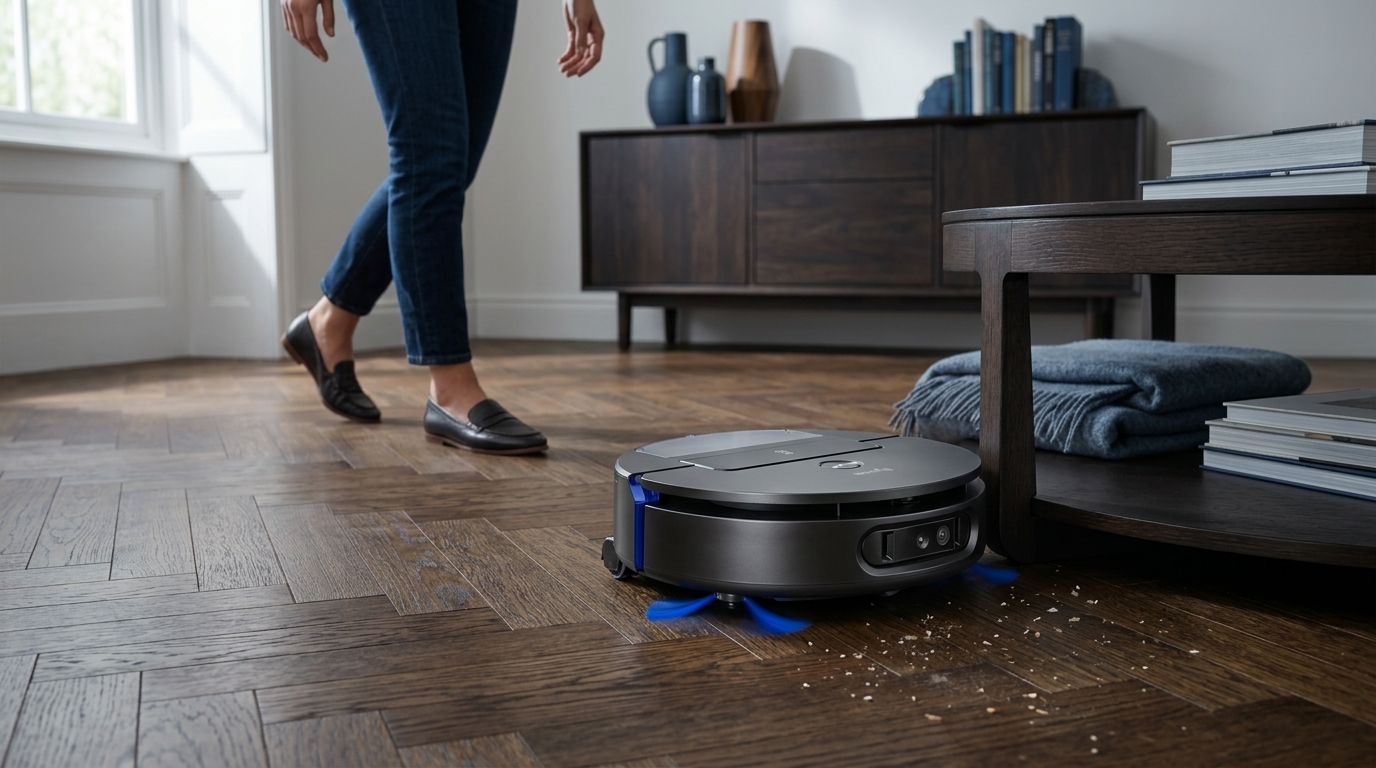
For decades, the Dyson name has been synonymous with the relentless pursuit of perfect suction. From the first cyclonic vacuums to the powerful cordless models, the British company has always prioritized power above all else. However, in the arena of robotic appliances, Dyson has struggled to find its footing. Its previous models, while powerful, were often bulky, clunky, and lagged in navigation compared to competitors from China. With the new Dyson Spot + Scrub Ai, the company seems to have finally solved the "robot" problem, but at a paradoxical price: it has sacrificed part of its identity as the world's premier "vacuum."
The Navigation Revolution and AI
The biggest leap for the Spot + Scrub Ai is found in its brain. Dyson has finally abandoned its obsession with the 360-degree panoramic camera that required bright lighting to function, adopting a sophisticated LiDAR system combined with AI sensors. The result is impressive. The robot maps the space with millimeter precision, avoiding cables, socks, and pets with a skill we haven't seen before from the brand. Its ability to recognize different types of stains and adjust cleaning intensity in real-time shows that Dyson finally understands that intelligence is just as important as power.
- Advanced LiDAR system for operation in total darkness.
- AI object recognition that reduces entanglements by 80%.
- Automatic multi-floor mapping with dynamic updates.
The Suction Paradox
But this is where the problems begin. In its attempt to fit a sophisticated mopping system and a massive battery into a chassis that fits under furniture, Dyson had to make compromises in the cyclonic mechanism. For the first time in a product from the company, suction power seems to lag behind its flagship cordless models, such as the V15 or Gen5outsize. In tests on deep-pile carpets, the Spot + Scrub Ai struggles to pull up the fine dust that its predecessors vanished with ease. It is an ironic twist for a company that built its empire on the power of air: it has built a robot that knows where to go, but doesn't know how to clean as well as we'd expect when it gets there.
"Dyson seems to be trading raw power for elegant automation, a move that may disappoint its loyal fans," market analysts note.
Mopping: The New Protagonist
If suction is the weak point, mopping is the revelation. The Dyson Spot + Scrub Ai features an active scrubbing mechanism that applies pressure to the floor, unlike the simple wet cloths found on cheaper models. The device separates clean from dirty water with surgical precision, ensuring it doesn't transfer dirt from one room to another. The self-cleaning base is also a masterpiece of engineering, albeit a bulky one. It washes and dries the mop with hot air, eliminating odors and mold. It is clear that Dyson is now targeting hard floors (wood, tile), leaving carpets as a secondary priority.
Conclusion: A Device in Identity Crisis
The Dyson Spot + Scrub Ai is the best robotic device the company has ever made, but perhaps the least "Dyson" vacuum cleaner. In its attempt to compete with Chinese giants like Roborock and Dreame, it has adopted their rules: more features, more software, less emphasis on the pure physics of suction. For the user who wants a home that is mopped daily without effort, it is a marvel. For the buyer who expects ultimate cleanliness on their carpets, the Spot + Scrub Ai is a reminder that even the best engineering has its limits when you try to do everything at once.