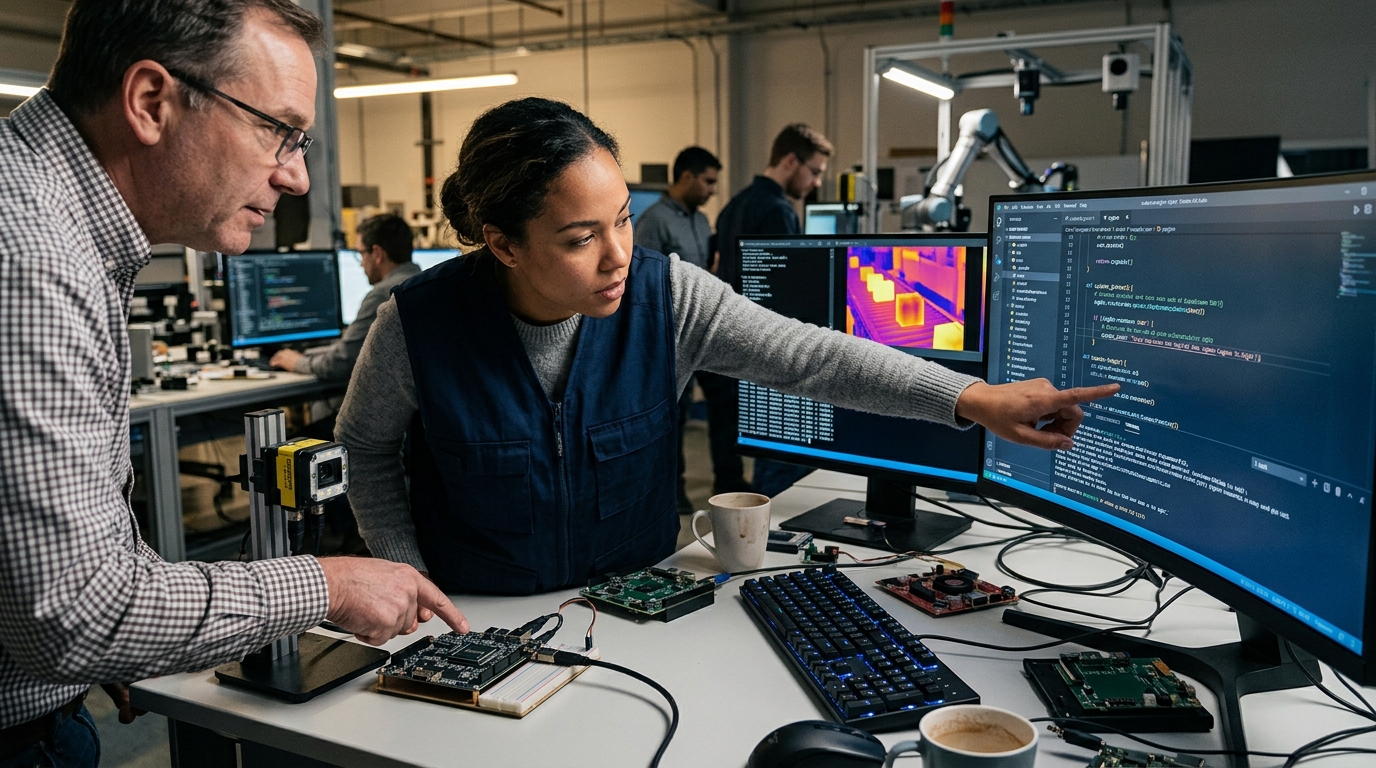
In the beating heart of the Fourth Industrial Revolution, the ability of machines to "see" and "understand" their environment is no longer a luxury but a prerequisite for survival. Cognex Corporation’s recent announcement regarding the launch of its new In-Sight SnAPP system, powered by Qualcomm processors, marks a pivotal moment in the convergence of mobile technology and industrial automation. This is not merely a hardware upgrade; it is a strategic shift toward the "Intelligent Edge," where data processing happens instantaneously, exactly where production takes place.
The Convergence of Giants: Qualcomm and Cognex
The collaboration between Cognex, a leader in machine vision, and Qualcomm, the semiconductor titan, highlights a fascinating trend: the transfer of expertise from the world of smartphones and consumer AI to the rugged environment of heavy industry. Qualcomm processors, renowned for their energy efficiency and immense computational power in AI tasks, provide Cognex’s new system with the ability to execute complex Deep Learning algorithms directly on the device, without the need for connection to central servers or the cloud.
This "embedded" approach eliminates data transfer delays (latency), offering response speeds that were unthinkable just a few years ago. For a production line moving at breakneck speeds, the difference of a few milliseconds in identifying a defective product can mean saving millions of dollars annually.
Deep Learning and the Simplification of Automation
Cognex’s big bet with this new system is the democratization of artificial intelligence. Traditionally, machine vision systems required specialized programmers and complex parameter settings. The In-Sight SnAPP, however, uses Qualcomm’s power to simplify the training process. Through an interface that resembles a modern smartphone app more than an industrial tool, production workers can "teach" the system what constitutes a "good" or "bad" product simply by showing it a few examples.
- Precision: The ability to recognize patterns in low-light conditions or changing environments.
- Flexibility: Rapid reconfiguration for different products on the same production line.
- Reliability: Reduction of false positives that often plague older systems.
The use of AI Vision allows for the detection of anomalies that the human eye—or even traditional rule-based systems—would fail to spot. From verifying the correct placement of a label to detecting microscopic cracks in metal components, precision is now approaching absolute perfection.
Economic Impact and the Future of Work
It is evident that the entry of such systems into the market is reshaping the economic landscape of manufacturing. Reduced waste and increased efficiency are the immediate benefits. However, there is also a deeper socioeconomic dimension. As AI systems become more capable, the role of the unskilled worker in quality control is diminishing, giving way to technicians who will oversee and train the machines.
"Integrating AI at the manufacturing edge is not just a technical improvement; it is the redefinition of the very concept of quality in industry," industry analysts note.
In the context of the global supply chain, the adoption of such technologies by companies in Europe and America represents an effort toward reshoring production. With high automation, labor costs cease to be the deciding factor, allowing factories to operate close to their final markets while simultaneously reducing their carbon footprint.
Conclusions
Cognex, supported by Qualcomm, is not just launching a product; it is setting a new standard for what we should expect from industrial equipment in 2026. The era when artificial intelligence was confined to massive data centers is ending. The future is embedded, fast, and incredibly precise, turning every camera into an intelligent partner that never tires and never makes mistakes.