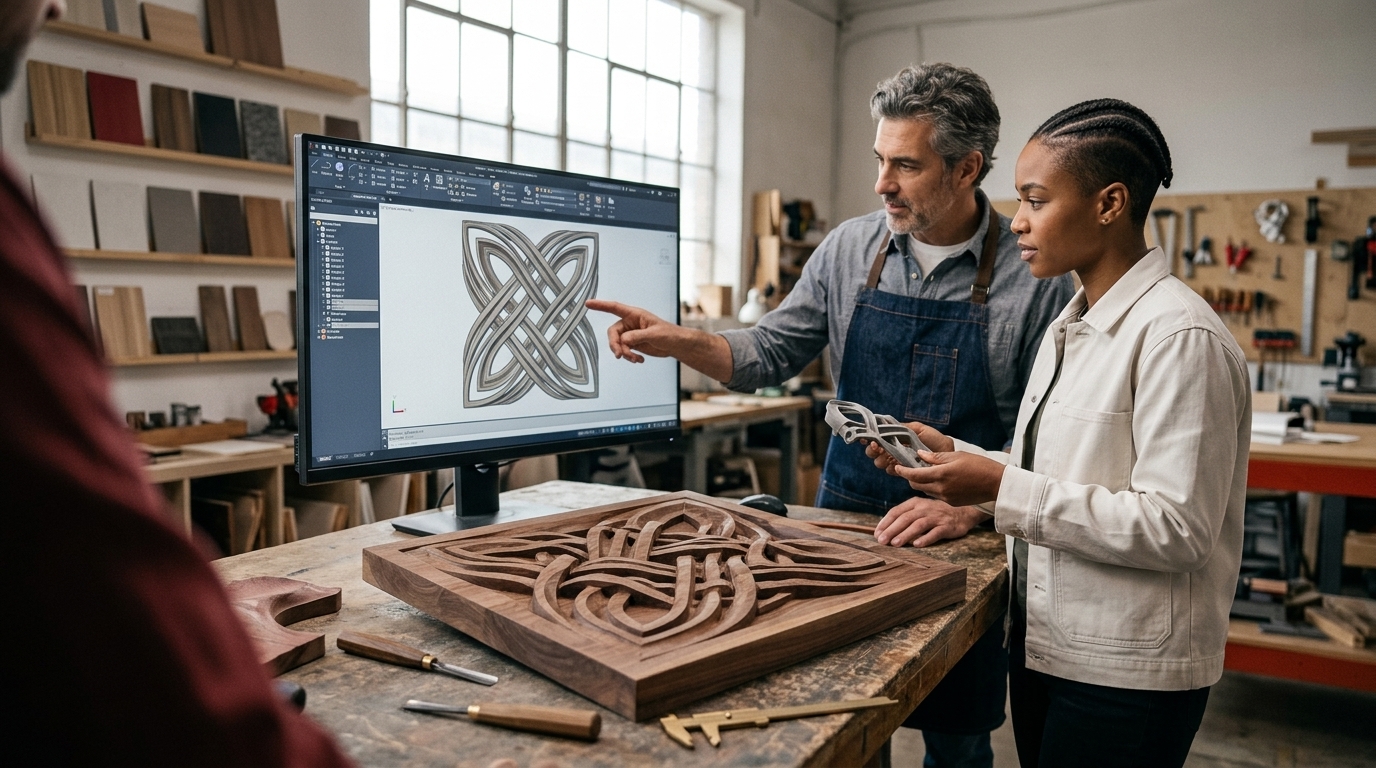
The evolution of Generative AI has yielded impressive results in text, image, and video creation. However, in the realm of Computer-Aided Design (CAD), things remained significantly more complex until recently. While models like Midjourney can generate a visual representation of a part, manufacturing a real, functional object requires mathematical precision, parametric editability, and a sequence of operations that adhere to the laws of engineering. ArtisanCAD, recently introduced on ArXiv (2607.05750), steps in to bridge this gap, proposing an industrial-level AI agent based on "Expert-Grounded Knowledge Distillation."
The Challenge of Industrial Design
In the world of mechanical engineering, a CAD model is not just a 3D mesh. It is a collection of geometric entities defined by Boundary Representation (B-Rep). This method allows engineers to modify dimensions, add holes, fillet edges, and maintain model integrity throughout the production process. Previous text-to-CAD models often failed to produce such "smart" files, remaining limited to static meshes that cannot be used in production lines.
ArtisanCAD changes the landscape by focusing on "long-horizon procedural modeling." Instead of trying to predict the final shape in one go, the agent learns to execute a series of CAD commands—such as extrude, fillet, and chamfer—using the same logic an experienced designer would follow. This is achieved through a sophisticated training method where the AI model observes and learns from the best practices of human experts, distilling this knowledge into an efficient decision-making algorithm.
Expert-Grounded Knowledge Distillation: The Heart of ArtisanCAD
The innovation of ArtisanCAD lies in its training methodology. Traditional training on large datasets often includes noise or sub-optimal solutions. The research team behind ArtisanCAD employed a method where a "teacher" (a more powerful but slower model or a database of expert designers) guides the "student" (the ArtisanCAD agent). This process isn't just about the final output, but the journey: the sequence of steps that ensure the model remains parametric and easily editable.
- Feature Dependency Robustness: Every design command builds on the previous one. ArtisanCAD ensures these dependencies don't break when a parameter is changed.
- B-Rep Generation: The output is compatible with professional software like SolidWorks, CATIA, and Autodesk Inventor.
- Natural Language Understanding: Users can provide commands like "design a motor mount with four M8 holes and reinforced ribs," and the system understands the technical requirements behind the words.
From Prototype to Production
The application of ArtisanCAD is expected to revolutionize Industry 4.0. Today, the design cycle of a component can take anywhere from hours to weeks, involving multiple revision stages. By using AI agents that understand industrial constraints, this time can be drastically reduced. Furthermore, ArtisanCAD's ability to produce editable CAD code means engineers don't have to start from scratch. They can use AI to generate 80% of the work and then focus on detailed optimization.
Moreover, this technology paves the way for "Generative Design" at a new level. We are no longer just talking about topology optimization based on loads, but a creative collaboration between human and machine, where the AI suggests solutions that are both innovative and manufacturable (Design for Manufacturing - DfM). ArtisanCAD's ability to "think" procedurally means it can avoid design errors that would make a part impossible to manufacture on a CNC lathe or mill.
Challenges and Future Prospects
Despite the promise, obstacles remain. Designing complex assemblies with hundreds of parts remains a challenge that requires even greater computational power and a deeper understanding of mechanical interactions. Additionally, the issue of intellectual property for AI-generated designs remains a gray area for the industry.
However, ArtisanCAD represents a milestone. It demonstrates that AI is moving beyond the boundaries of "creative play" and entering the hard core of heavy industry. For the global manufacturing sector, adopting such tools could provide a unique opportunity to enhance productivity, allowing companies to design and produce high-value components with minimal initial design overhead.