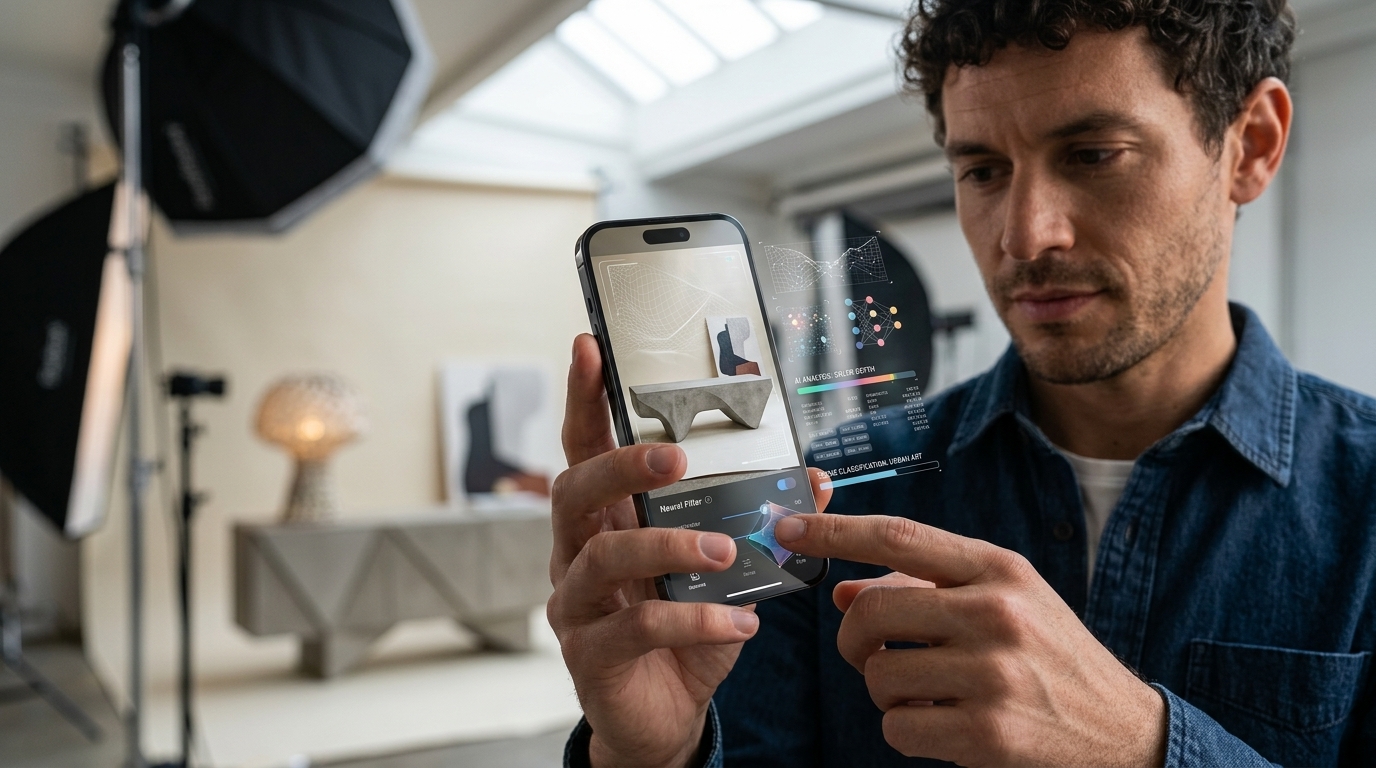
In the heart of Cupertino, Apple’s philosophy on photography has never been just about lenses and apertures. It has been about capturing a memory. However, with the arrival of iOS 27 and the full integration of Apple Intelligence, the line between reality and digital fabrication is becoming blurrier than ever. Jon McCormack, Apple’s Vice President of Camera Software Engineering, in a recent interview with Wired, presented a vision where Artificial Intelligence (AI) is not just an editing tool, but a 'superpower' that allows users to capture what their heart saw, even if the lens failed to record it perfectly.
The Fine Line Between Enhancement and Manipulation
For years, Apple maintained a cautious stance toward generative AI. While Google and Samsung rushed to offer tools that allow moving objects or completely changing backgrounds, Apple remained committed to what it calls 'photographic intent.' McCormack argues that Apple’s approach is fundamentally different: 'We’re not using AI for the sake of AI,' he states. In iOS 27, the 'Clean Up' feature and new capabilities in the Photos app use generative models to add pixels where distracting elements—like a passerby or a glare—once were, but they do so in a way that preserves the photographer’s original intent.
The question arises: is a photo containing 'fake' pixels still a photo? Apple answers this by integrating C2PA (Coalition for Content Provenance and Authenticity) standards. Every image edited with Apple Intelligence tools carries digital metadata indicating the use of AI. This transparency is key to maintaining trust in a world where deepfakes are becoming commonplace. Apple is trying to balance the user’s desire for the 'perfect' photo with the ethical obligation to record the truth.
The Technical Edge of On-Device Processing
One of Apple’s most significant advantages in this new era is its control over hardware. The A-series and M-series chips feature specialized Neural Engine units that allow these complex models to run locally on the device. This isn't just about speed; it's primarily about privacy. When you remove an object from a private family photo, the data never leaves your iPhone to be processed on a cloud server. This 'local' approach allows Apple to offer 'superpowers' without the price of exposing the user’s personal data.
Furthermore, computational photography has evolved into something much deeper than simple HDR. Today, the iPhone camera captures dozens of frames before the shutter is even pressed, analyzing depth, lighting, and texture. AI steps in to synthesize the best possible version of reality. McCormack emphasizes that the goal is to eliminate the technical barriers that often frustrate amateur photographers, allowing them to focus on composition and emotion.
The Future of Visual Memory
As we move deeper into the 2020s, the concept of photography as an 'objective witness' is dying. Apple knows this and chooses to lead the transition toward photography as 'interpretation.' The 'superpowers' McCormack refers to are not about creating fake worlds, but about enhancing the human ability to remember. If a photo is dark or blurry, AI can 'fix' it based on what it knows about the world, creating an image closer to what the human eye saw than what a tiny sensor recorded.
However, the challenge remains: where does enhancement end and fantasy begin? Apple seems to draw the line at the identity of the subjects. While you can remove a trash can from the background, Apple’s AI refuses—for now—to change your facial features or place you in a location you never visited. It is a conservative but necessary stance in an age where visual truth is under siege from all sides.
"Our goal is to make sure that the person who took the photo feels like it’s their photo, their memory, just better than they could have captured with traditional optics alone." — Jon McCormack