The era of artificial intelligence confined to a simple chat box is drawing to a close. Anthropic, the company behind the Claude model, has announced a suite of "Creative Connectors" that allow its model to integrate and interact directly with some of the world's most powerful software: Adobe Photoshop, Blender, Ableton Live, and Autodesk. This move signals a transition from "Generative AI" to "Agentic AI," where the model doesn't just produce content but manipulates tools on behalf of the user.
From Theory to Practice: How Connectors Work
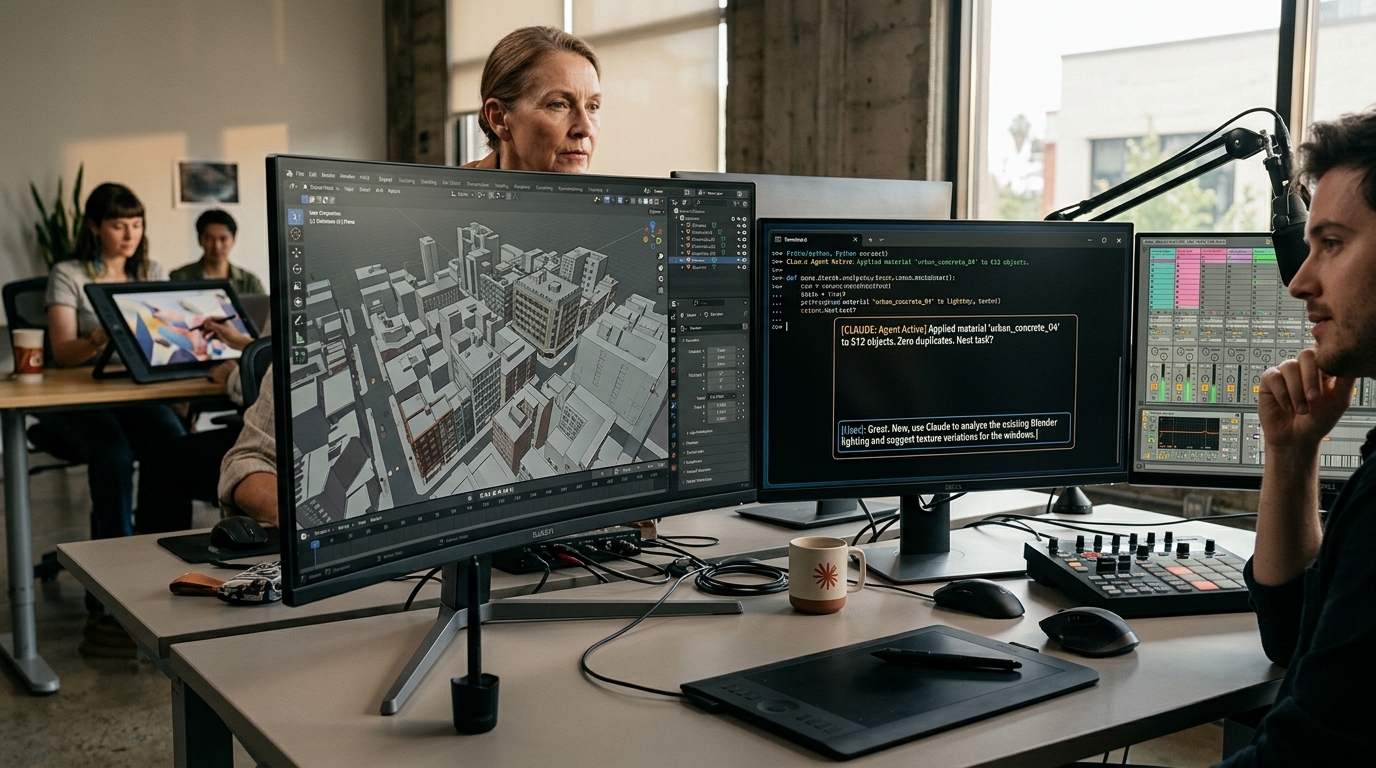
Until now, using AI in the creative process required constant tab-switching. A creator would have to prompt ChatGPT or Claude, copy the result or code, and then manually apply it in Photoshop or Blender. With the new Connectors, Claude gains the ability to "see" and "touch" the interface of these applications. For instance, in Blender, Claude can write and execute Python code in real-time to create 3D objects, adjust lighting, or modify geometries without the user needing to know the programming language themselves.
In Ableton Live, Claude can analyze the structure of a track, suggest arrangement changes, or even automate complex synthesis parameters. This deep integration is not just a convenience; it is a reallocation of the creator's cognitive resources. Instead of getting bogged down in the technicalities of "how" to do something, the professional can focus on "what" they want to achieve, leaving Claude to execute the technical commands.
Anthropic’s Strategy and the Competitive Landscape
Anthropic’s move is strategic. It comes at a time when OpenAI is strengthening its ecosystem with Canvas and Adobe is attempting to establish Firefly as the de facto AI tool for designers. However, Anthropic is choosing a different path: the path of open collaboration. Rather than trying to replace existing tools with its own applications, it offers Claude as a highly capable "assistant" that lives within the tools professionals already trust.
- Adobe Creative Cloud: Claude can manage layers, apply filters, and coordinate complex workflows in Photoshop and Illustrator.
- Blender: Translating text descriptions into fully parametric 3D models via Python scripting.
- Ableton Live: Assisting in music production, from beat-making to intricate sound design.
- Autodesk: Optimizing architectural designs and mechanical models.
This approach makes Claude indispensable in professional environments, as it drastically lowers the learning curve for specialized software. A graphic designer who doesn't know 3D modeling can now use Blender through Claude, expanding their creative possibilities without needing months of training.
Challenges and the Future of Work
Despite the excitement, this integration raises significant questions. The automation of technical skills that previously required years of experience could lead to the devaluation of junior artists' labor. Furthermore, there is the issue of intellectual property and "creative authenticity." If Claude performs 80% of the technical work in Photoshop, who is the true creator of the piece?
"We don't see Claude as a replacement for the artist, but as a digital apprentice that handles the manual labor, allowing the human spirit to soar higher," stated an Anthropic executive during the launch.
In conclusion, Anthropic’s Creative Connectors represent a bold step toward a future where AI is not just a conversationalist, but an active partner. The success of this venture will depend on how smoothly it integrates into daily workflows and whether creators will embrace the loss of absolute technical control in exchange for speed and creative freedom. What is certain is that the boundaries between human inspiration and mechanical execution are becoming more blurred than ever.