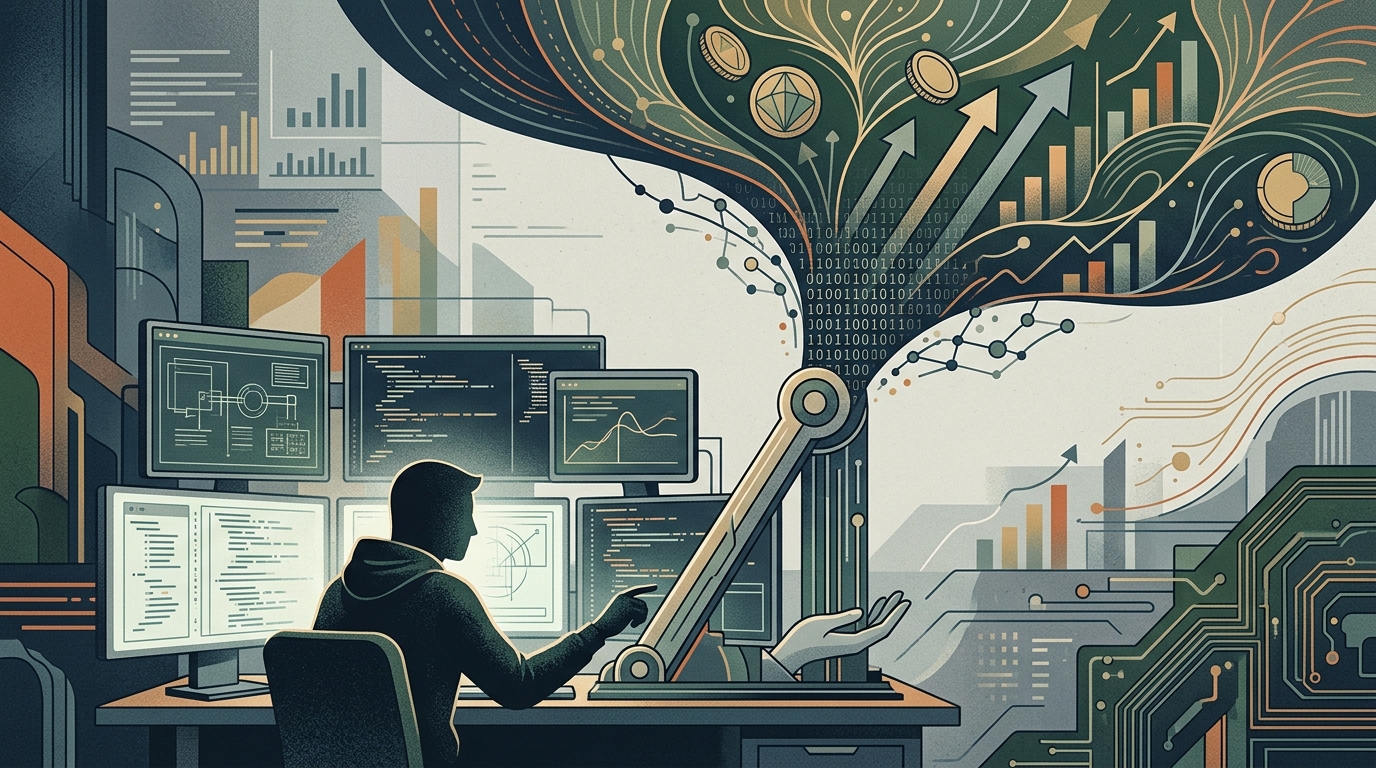
In the ever-evolving landscape of the global economy, Anthony Pompliano, one of the most influential voices in investment and technology, has put forward a provocative yet well-reasoned prediction: AI-based software is not just a convenience tool, but the most powerful mechanism for increasing net worth humanity has ever seen. In his recent analysis, highlighted by Traders Union, Pompliano argues that we are on the threshold of an era where the distinction between labor and capital will become blurrier than ever, thanks to the automation of intelligence.
The Democratization of Sophisticated Financial Strategies
Historically, access to sophisticated financial tools and wealth management strategies was the exclusive domain of the ultra-wealthy and institutional investors. High-frequency algorithms, real-time tax optimization, and big data risk analysis required armies of analysts and massive capital. Pompliano points out that artificial intelligence is democratizing these capabilities. Today, a single user with access to advanced AI agents can execute strategies that once required an entire family office.
This shift means that "software as capital" is becoming the new reality. Instead of users selling their time for money, they are using AI to build systems that generate value independently of their physical presence. This scalability is what leads to exponential net worth growth. As Pompliano emphasizes, AI doesn't just increase transaction speed; it enhances decision quality, reducing the human errors that often cost individual investors dearly.
From Productivity to Capital Accumulation
One of Pompliano's core arguments concerns the relationship between productivity and wealth. In the past, productivity gains primarily benefited the owners of the means of production. However, in the age of AI, the "means of production" is the software itself, which is accessible to everyone. A developer, a content creator, or a trader can now use AI to tenfold their output without increasing their overhead.
- Automated Entrepreneurship: The ability to create entire business workflows that operate autonomously.
- Marginal Cost Reduction: AI allows for the provision of services or production of goods at near-zero marginal cost, boosting profit margins.
- Smart Asset Management: Systems that reallocate portfolios based on global economic shifts in seconds.
According to Pompliano, early adopters of these technologies will see a disproportionate increase in their wealth compared to those clinging to traditional service-delivery models. Artificial intelligence acts as a "force multiplier," allowing an individual to function with the output capacity of an entire corporation.
Challenges and the "AI-Wealth Gap"
Despite his optimism, Pompliano does not overlook the risks. The widespread use of similar algorithms could lead to systemic instabilities or "herd behavior" in the markets. Furthermore, there is the risk of creating a new kind of inequality: the gap between those who know how to direct AI and those who merely consume it. Net worth will not automatically increase for everyone; it will increase for those who perceive AI as a tool for capital leverage.
Moreover, the issue of trust arises. Can software be trusted to manage a lifetime of savings? Pompliano argues that just as we grew to trust algorithms for navigating roads or social connections, we will do the same with our finances. The difference is that in the financial realm, mistakes are irreversible. The need for critical oversight remains, but the human role is shifting from "executor" to "strategic director" of one's own digital assets.
Conclusion: The New Economic Reality
As we move into the second half of 2026, Anthony Pompliano's predictions seem more relevant than ever. Artificial intelligence is no longer a future promise but a present economic force. The promise of increasing net worth through software is based on the simple logic of efficiency: whoever can produce more with less will inevitably accumulate more wealth. The question remaining for the average user is not whether AI will affect their finances, but whether they will be the driver or the passenger in this race for digital capital accumulation.