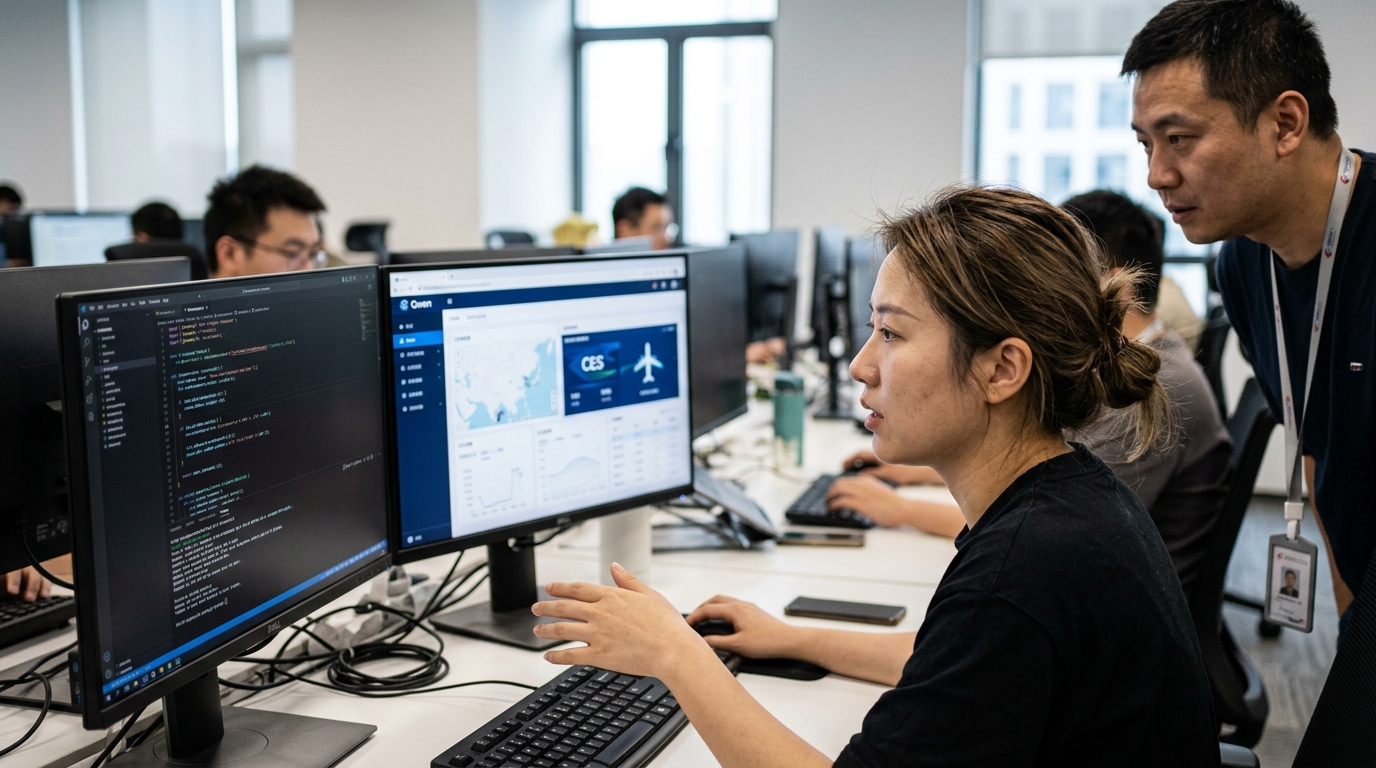
At the heart of the global race for Artificial Intelligence supremacy, Alibaba Cloud has made an announcement that signals a fundamental shift in strategy. Alibaba Qwen President, Zhou Jingren, revealed that the 'AI Service' platform is now accessible to external partners, with China Eastern Airlines leading the first major integration. This move is not merely a technical upgrade but a calculated attempt by Alibaba to establish the Qwen model (Tongyi Qianwen) as the operating system of Chinese industry.
The Shift from General Models to Industry-Specific Solutions
For years, the conversation around AI centered on the capabilities of Large Language Models (LLMs) to answer questions or write code. However, 2026 finds the market in a phase of maturity where 'general intelligence' is no longer sufficient. Alibaba recognizes that real value lies in specialization. By opening Qwen to external partners, it allows giants like China Eastern Airlines to train the model on private, industry-specific data, creating customized solutions that can optimize everything from flight scheduling to predictive aircraft maintenance.
The partnership with China Eastern Airlines is emblematic. The aviation sector is characterized by extreme complexity and zero tolerance for error. Integrating Qwen into the airline's operational workflows suggests a vote of confidence in the reliability of Alibaba's models. According to company sources, the AI will be used to analyze vast volumes of flight data, optimize fuel consumption, and upgrade the customer experience through hyper-personalized support services.
The Qwen Ecosystem as a Counterweight to the West
Alibaba's strategy is not evolving in a vacuum. While OpenAI and Microsoft dominate Western markets, China is building its own autonomous ecosystem. Qwen-Max, the flagship version of the model, has already demonstrated performance that rivals GPT-4 in specific benchmarks, particularly those concerning logic and Chinese language understanding. By opening the 'AI Service' platform, Alibaba aims to create a network effect: the more companies use Qwen, the more the model 'learns' from industrial applications, making it indispensable.
"We are not just offering a model, but an infrastructure of intelligence," stated Zhou Jingren. "Our collaboration with China Eastern Airlines is just the beginning of a new era where AI will be the invisible engine of every major enterprise."
Challenges and Regulatory Framework
Despite the optimism, the road is not without obstacles. The Chinese government maintains a strict control framework over AI-generated content, forcing Alibaba to invest massive resources into safety filters and alignment. Furthermore, the global competition for high-tech semiconductors (chips), due to US sanctions, remains a constant threat to Alibaba Cloud's ability to scale its infrastructure. However, the focus on the domestic market and deep integration with state-owned industry provides a stability that Western competitors often lack.
- Real-time supply chain optimization.
- Automated customer service with deep understanding of industry-specific terms.
- Predictive infrastructure maintenance using multimodal data.
In conclusion, Alibaba's move to open Qwen to third parties is a statement of power. By transforming Artificial Intelligence from an experimental tool into a utility service for businesses, the company is not only claiming leadership in China but setting the standards for what corporate intelligence will look like globally in the coming years.