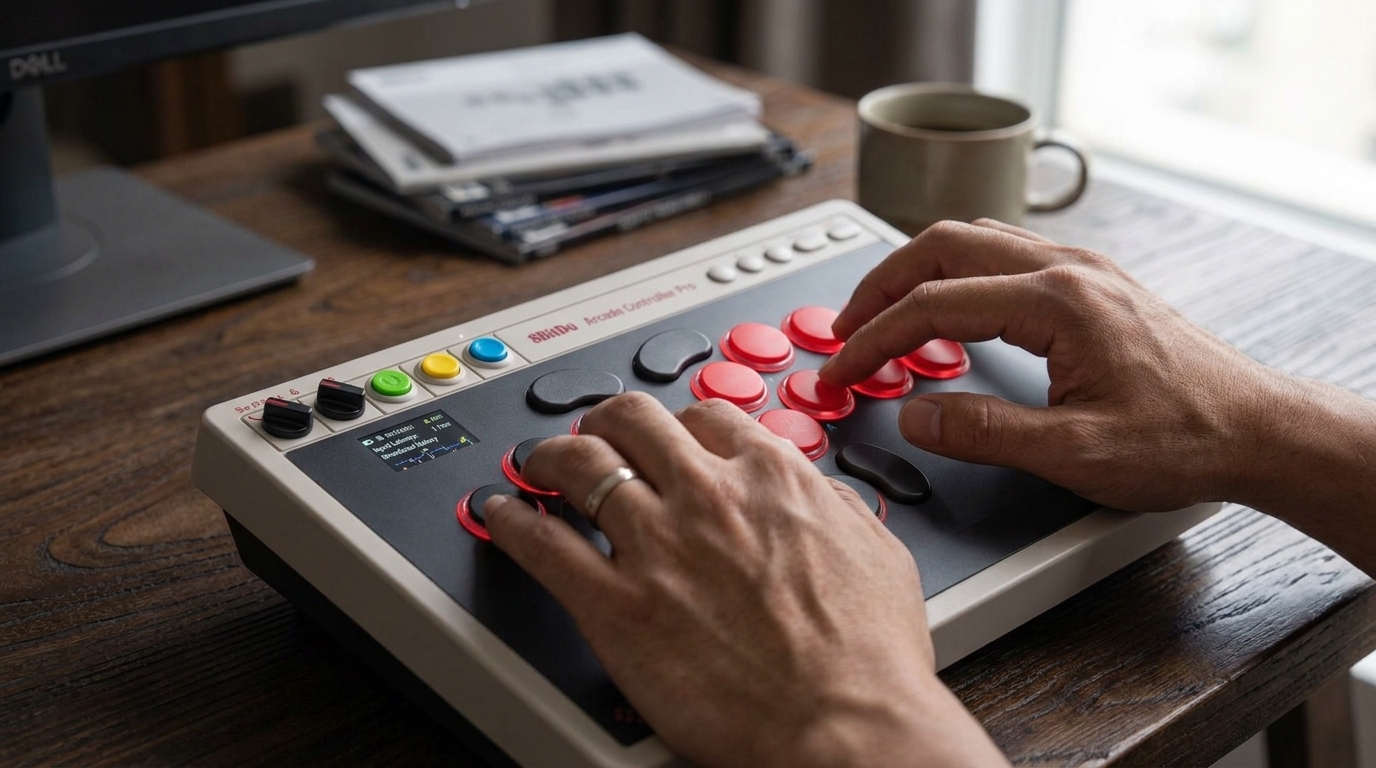
In the high-stakes arena of the Fighting Game Community (FGC), precision isn't just a preference; it’s the razor-thin margin between a glorious victory and a crushing defeat. 8BitDo, a brand that has carved a niche by blending retro aesthetics with cutting-edge engineering, has unveiled the Arcade Controller Pro. This is an evolution of their leverless (joystick-free) design, now featuring an integrated OLED screen that allows for full customization—remapping, macros, and profile management—without ever needing to touch a PC or a smartphone app.
The Leverless Revolution and the Hitbox Paradigm
For decades, the arcade stick with its iconic ball-top lever was the undisputed king of the genre. However, the landscape has shifted. The rise of 'leverless' controllers, popularized by brands like Hitbox, has changed how players approach movement. By replacing the joystick with four directional buttons, players can execute complex motions with mechanical certainty, eliminating the physical travel time of a lever. 8BitDo’s Arcade Controller Pro embraces this philosophy, providing a layout optimized for the frantic pace of modern titles like Street Fighter 6 and Tekken 8.
The 'Pro' designation here is more than marketing fluff. The inclusion of an on-board screen is a direct response to a common friction point: the 'companion app' fatigue. Traditionally, remapping buttons or adjusting SOCD (Simultaneous Opposite Cardinal Direction) cleaning settings required tethering the device to a computer. 8BitDo’s new interface grants players hardware sovereignty, allowing for instant adjustments in the heat of a tournament or a casual session. It represents a return to a 'plug-and-play' ethos that feels refreshingly modern.
Technical Specifications and Versatility
8BitDo has designed the Arcade Controller Pro to be the 'Swiss Army Knife' of peripherals. It features a tri-mode connectivity suite: Bluetooth for convenience, 2.4GHz wireless for low-latency cable-free play, and a wired USB-C mode for the most demanding competitive environments. Compatibility is broad, covering Nintendo Switch, Windows, and Android, making it a versatile tool for cross-platform enthusiasts. Furthermore, the controller maintains 8BitDo’s commitment to moddability, featuring hot-swappable mechanical switches that allow users to tailor the tactile response to their specific liking.
- Integrated screen for app-free customization and settings.
- Tri-mode connectivity (Bluetooth, 2.4GHz, and USB-C).
- Hot-swappable switches for ultimate tactile personalization.
- Broad compatibility with Switch, PC, and mobile platforms.
- Quick-toggle profile switch for seamless game transitions.
The Philosophical Shift: Hardware Sovereignty
We live in an era where even basic household appliances demand a cloud account and a mobile app. In this context, 8BitDo’s decision to bake the control logic directly into the hardware is a significant move. For a tournament player, the ability to tweak a macro or change a button layout in seconds, without hunting for a laptop, is a major competitive advantage. This 'Hardware First' approach demonstrates a profound understanding of the user's workflow. The screen isn't a gimmick; it’s an emancipation from the manufacturer’s software ecosystem.
However, the transition to leverless isn't without its hurdles. There is a steep learning curve for those raised on joysticks or traditional gamepads. 8BitDo attempts to mitigate this with a robust, ergonomic chassis that provides ample wrist support—a feature often sacrificed in the race for portability. The Pro version seems to target the 'Goldilocks' zone: the performance of a high-end Hitbox with the comfort and build quality of a premium arcade stick.
Conclusion: Setting a New Standard for Peripherals
The 8BitDo Arcade Controller Pro is a testament to the maturation of the fighting game peripheral market. By merging the elite precision of a leverless layout with the user-centric innovation of an integrated screen, 8BitDo is challenging the industry to do better. While price and regional availability will determine its mass-market success, the strategic pivot toward user autonomy is a clear win for gamers who value independence from software bloat. It is a sophisticated tool for a more demanding era of play.