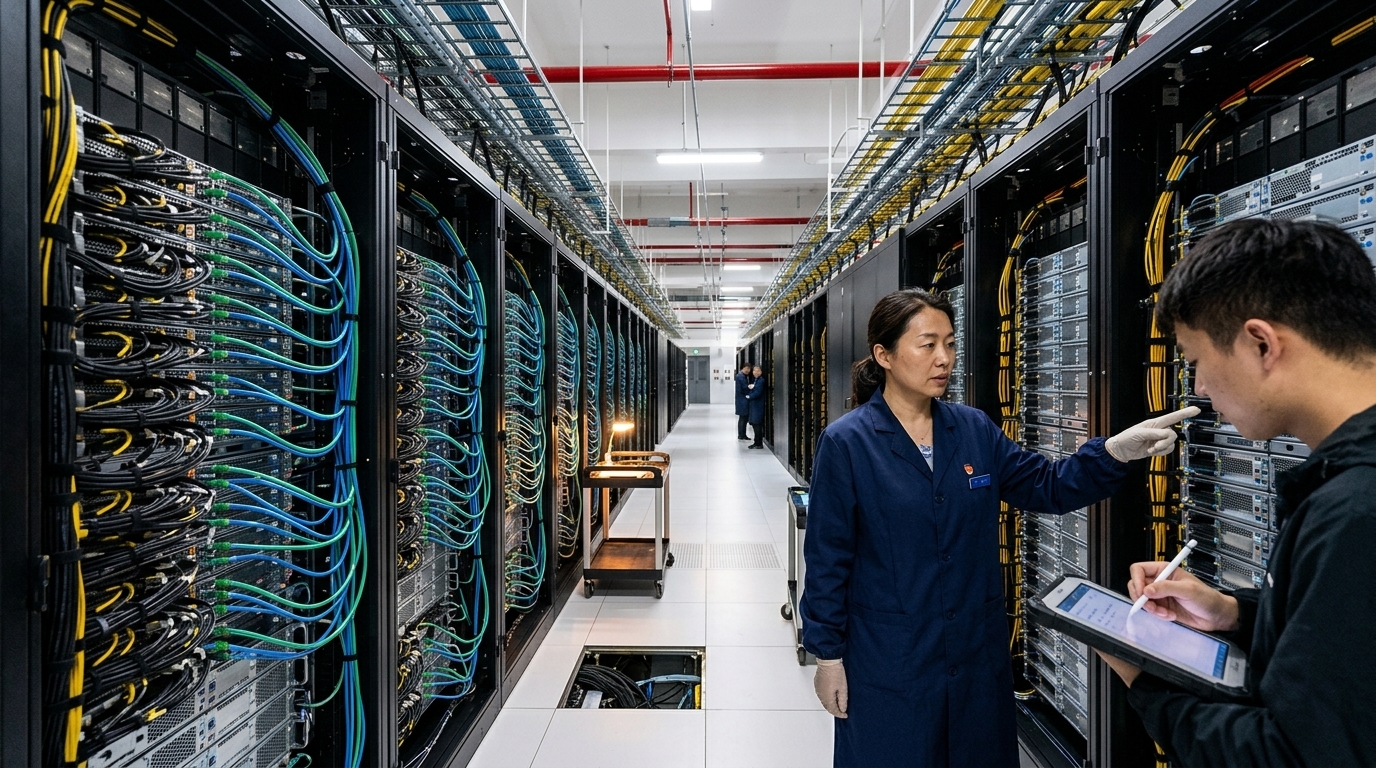
The global chessboard of technological supremacy experienced a major shift this week as the latest reports confirm that China has regained the lead in the supercomputing race. After years of dominance by American systems like Frontier and Aurora, a new Chinese exascale supercomputer—developed under conditions of extreme secrecy—has shattered previous computational records. This development is not merely a technical achievement; it is a resounding geopolitical statement: Washington's strategy to "strangle" Chinese access to advanced semiconductors appears to have acted as a catalyst for Beijing's domestic innovation.
The Dragon Returns to the Summit
Since 2017, China had adopted a low-profile tactic, avoiding official data submissions to international ranking lists like the TOP500, partly to avoid provoking further US sanctions. However, the reality on the testing ground could not remain hidden forever. The new system, based on the Sunway architecture, utilizes exclusively Chinese-designed processors, completely bypassing the need for chips from NVIDIA or AMD. Its ability to perform over one quintillion calculations per second (exaflop) places it at the absolute cutting edge of global science.
The significance of supercomputers in the age of Artificial Intelligence is transformative. It is no longer just about weather forecasting or simulating nuclear tests. Exascale supercomputers are the "factories" that train next-generation Large Language Models (LLMs) and accelerate the discovery of new materials and pharmaceuticals. The fact that China now possesses the world's most powerful such tool means it gains a strategic advantage in developing AI that could surpass Western alternatives in depth and speed.
The Failure of Sanctions and the Push for Autonomy
An analysis of the technical specifications of the new Chinese system reveals an impressive pivot toward domestic production. While the US imposed strict export restrictions on high-performance chips, Chinese engineers focused on optimizing the architecture of their own SW26010 Pro processors. This approach, though initially considered less efficient than the American one, has proven highly effective in practice, allowing Beijing to build an ecosystem that is now shielded from external pressures.
- Independence from the Western semiconductor supply chain.
- Software optimization for specific national security needs.
- Enhanced capacity for encryption and cyber defense.
This evolution is creating a "Digital Iron Curtain." On one side, the West continues to rely on its superiority in design and lithography (ASML, TSMC), and on the other, China is constructing a parallel infrastructure that, while perhaps less energy-efficient, is entirely state-controlled. Analysts warn that this divergence will make international collaboration in AI research nearly impossible in the coming years.
Geopolitical Implications: A New Balance of Power?
Supercomputing hegemony translates directly into military power. The ability to simulate aerodynamics for hypersonic missiles or analyze satellite data in real-time requires massive computational power. With China leading, the US now finds itself in a defensive position, forced to accelerate investments in its ECP (Exascale Computing Project) to avoid losing touch with the top.
"Technological sovereignty is no longer a matter of economic prosperity, but of national survival," says a senior Pentagon official.
In conclusion, China's return to the top of the global supercomputing rankings marks the end of an era where the US could dictate the pace of global innovation through trade blockades. Beijing has proven it possesses the intellectual capital and political will to overcome obstacles, creating a new reality where computational power is the most valuable currency in the world.