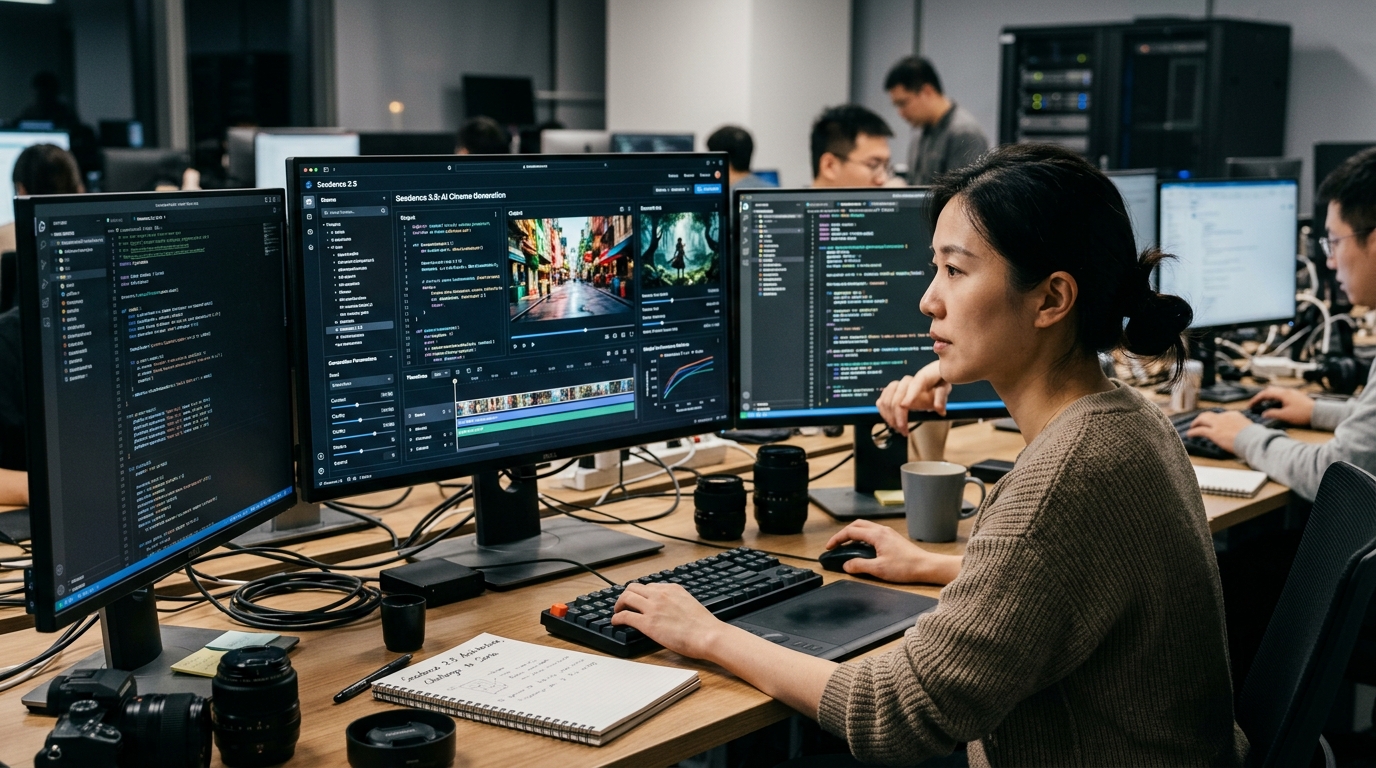
In the heart of 2026, the battle for dominance in Generative AI has shifted from text and static images to the most complex and demanding field: video. ByteDance, the parent company of TikTok, has made a masterstroke by unveiling Seedance 2.5. This video generation model doesn't just aim for short social media clips; it aspires to redefine the very concept of cinematic storytelling.
Seedance 2.5 arrives at a time when the industry was eagerly awaiting the full release of OpenAI's Sora. With this move, ByteDance proves that technological supremacy is no longer a privilege of Silicon Valley. The new model demonstrates an unprecedented ability to understand world physics, render complex lighting, and, most importantly, maintain visual consistency of characters across different shots—one of the biggest hurdles in the technology so far.
Technological Superiority and the Collapse of the Uncanny Valley
The architecture of Seedance 2.5 is based on an evolved version of Diffusion-Transformers (DiT), allowing the model to process vast amounts of video data with greater efficiency. According to the technical specifications released, Seedance 2.5 can produce high-definition (4K) video at 60 frames per second, offering a smoothness of motion that previously required weeks of processing by specialized visual effects (VFX) studios.
One of its most impressive features is "Pixel Emotional Intelligence." The model doesn't just replicate facial movements; it interprets the subtle nuances of human emotions, avoiding the "uncanny valley" phenomenon where digital creations appear disturbingly unnatural. Directors can now give text prompts that include psychological descriptions, and Seedance 2.5 translates these instructions into micro-expressions and eye movements that convince even the most discerning viewer.
ByteDance's Strategy and Western Competition
The release of Seedance 2.5 is not just a technological achievement but also a clear political and economic statement. ByteDance leverages the massive volume of data flowing through TikTok daily to train its models on real human behaviors and trends. Despite the pressures and restrictions it faces in many Western countries, the company is investing billions in AI research, creating an ecosystem that is hard to ignore.
Unlike other platforms, ByteDance seems to be following a more "open" strategy for creators. Seedance 2.5 will be directly integrated into professional editing tools, allowing for hybrid use: a creator can shoot a scene in reality and use AI to change the lighting, environment, or even the actors' clothing while maintaining the original performance. This "augmented creativity" approach sets it apart from models that aim to completely replace the camera.
Ethical Dilemmas and the Future of Truth
Naturally, the emergence of such a powerful tool brings serious questions about misinformation and copyright to the forefront. Seedance 2.5's ability to create photorealistic videos of people who never existed—or, worse, to manipulate videos of real people—poses an existential threat to trust in digital information. ByteDance claims it has integrated advanced digital watermarking that is impossible to remove, but history has shown that malicious users always find ways to bypass such measures.
Furthermore, the film industry is in a state of flux. While independent creators see an opportunity to produce films with minimal budgets, VFX workers and actors worry about the future of their professions. Seedance 2.5 is not just a tool; it is a new player at the creative table, and its presence demands a new social contract for the use of technology in art.
Conclusion: Towards a Synthetic Culture?
As we head into the second half of 2026, Seedance 2.5 marks the beginning of an era where the difference between real and synthetic content will be practically invisible. ByteDance has managed to transform artificial intelligence from an assistant into an equal partner to the cinematic camera. The remaining question is not whether AI can make a movie, but whether we, as viewers, are ready to accept a world where the beauty of a scene stems not from a human lens, but from the algorithms of a supercomputer.