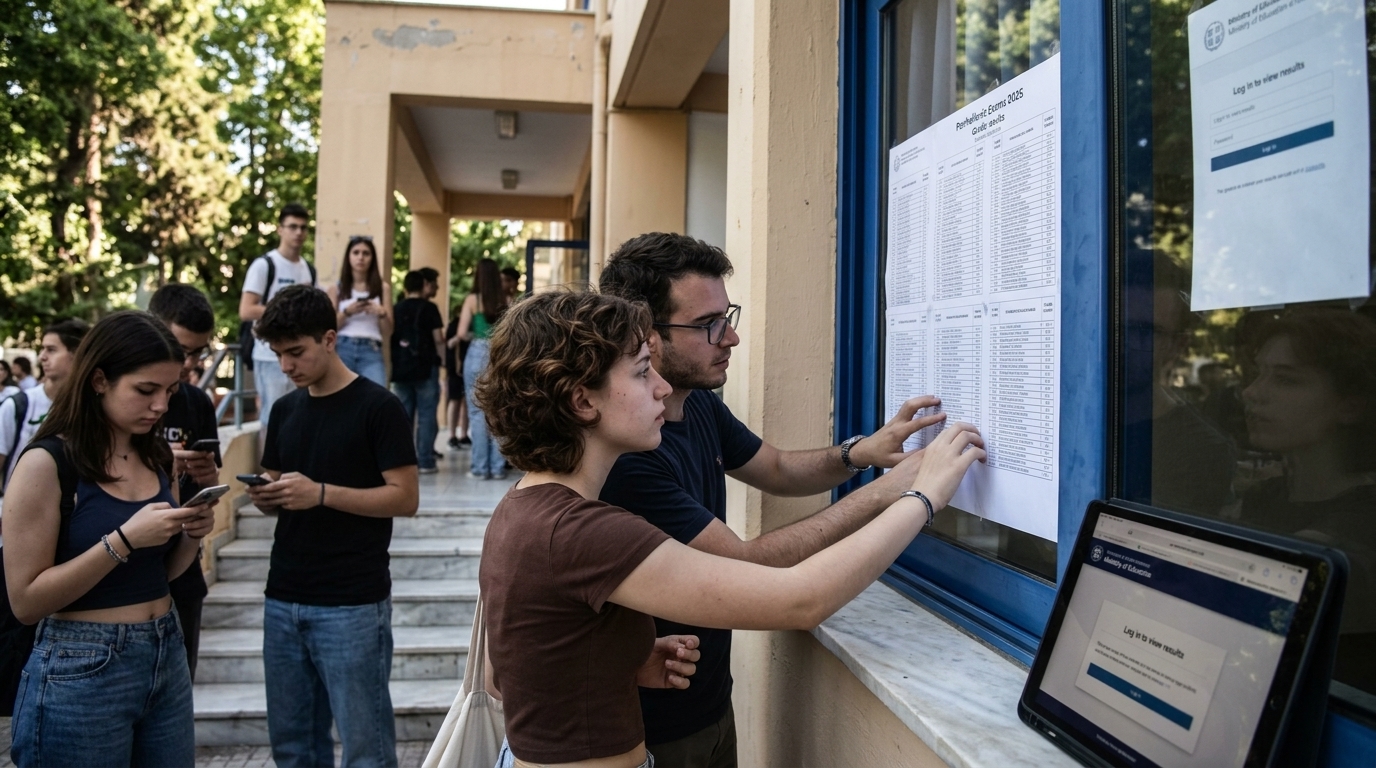
June 25, 2026, will be etched in the memory of thousands of candidates as the day when months—and for many, years—of anxiety were transformed into digits. The Ministry of Education announced early this morning the posting of grades for the Panhellenic Examinations of General (GEL) and Vocational High Schools (EPAL), marking the peak of a process that has long been the "national pillar" of assessment in Greece.
This year, the process unfolded with unprecedented speed, thanks to the full integration of new digital grading and data cross-referencing systems. Candidates were able to access their performances through the dedicated platform results.minedu.gov.gr, as well as via SMS on their personal mobile phones, with the messaging system operating smoothly and without the delays of the past.
An Anatomy of Performance: Where Grades Rose and Fell
Initial analysis of the statistical data reveals an intriguing picture for 2026. According to educational analysts, Physics and Mathematics once again served as the "barometer" for Engineering and Medical schools. The difficulty of the Physics topics led to a slight decrease in high-achievers in the 2nd and 3rd Scientific Fields, a fact expected to exert downward pressure on the admission thresholds (vases) for high-demand schools.
In contrast, in the 1st Field of Humanities, performance in Ancient Greek and History remained stable, with a slight uptick in average scores. "We are observing a maturation in how students approach the 'Combined Text' in Modern Greek Language," says a Ministry official. "Critical thinking seems to be gaining ground over rote memorization, which was the goal of the reforms initiated two years ago."
"The Panhellenic Exams are not the end of the road, but the starting point of a new journey in a world that demands constant adaptation and digital skills," the Minister of Education stated during the official briefing.
The Rise of Vocational Schools (EPAL) and the Shift to Specialization
One of the most notable trends of 2026 is the continuing enhancement of the prestige of Vocational High Schools (EPAL). The number of candidates choosing this path increased by 8% compared to 2025, while their performance in specialized subjects was exceptionally high. The link between vocational education and the labor market—particularly in sectors like IT, green energy, and tourism management—appears to be bearing fruit, making EPAL an attractive and conscious choice for the youth.
Furthermore, the implementation of the Minimum Admission Base (EBE) continues to act as a "sieve," ensuring that students entering universities possess the necessary academic foundations. Although the measure remains controversial for some, data shows a decrease in the percentage of "eternal" students and faster completion of studies for the cohorts admitted under the EBE regime.
The Next Step: The Digital Preference Form and the Role of AI
With grades in hand, candidates are now called upon to complete their Digital Preference Form (Michanografiko). The innovation of 2026 lies in the integration of an AI Career Advisor within the Ministry's platform. This tool analyzes the candidate's scores, interests, and labor market prospects, suggesting departments that fit their profile.
- Deadlines: The submission of the Preference Forms will begin in early July and will last for ten days.
- Point Calculation: The Ministry's official application allows for precise calculation of points, taking into account the weighting factors set by each university department.
- Parallel Preference Form: Candidates can also apply for Public Higher Vocational Training Schools (SAEK - formerly IEK).
At this critical stage, composure and accurate information are essential. Admission thresholds are expected to be announced in late July, allowing new students to plan their lives in their new cities before the academic year begins in September.