In the high-stakes world of modern manufacturing, the concept of resilience has evolved. It is no longer just about stockpiling raw materials or diversifying suppliers; it is about managing the most volatile asset in the production line: human skill. The recent ArXiv paper (2606.17269), titled "Skill-Constrained Model Predictive Control for Resilient Manufacturing Supply Chains," introduces a sophisticated mathematical framework to solve a perennial industrial headache: how to maintain production when workforce capability is a dynamic variable influenced by past training decisions.
The Dynamics of Skill as a Constraint
Traditionally, supply chain management models treated labor as a static input or a resource that could be scaled linearly. However, the reality of advanced manufacturing is far more complex. Every worker requires certifications that expire, skills atrophy without regular use (skill decay), and most importantly, training new staff requires the time and attention of existing experts. This creates a zero-sum game: to increase tomorrow’s capacity, you must sacrifice today’s output.
The research focuses on production-inventory systems where the qualified human capacity available tomorrow is dictated by training decisions made today. By employing Model Predictive Control (MPC), the authors provide a way for companies to look ahead, calculating the optimal balance between meeting immediate demand and investing in long-term skill maintenance.
Model Predictive Control (MPC) in Workforce Management
Model Predictive Control is a well-established methodology in fields like chemical processing and robotics, used to manage complex systems with multiple constraints. Applying it to human skill management is a significant leap forward. The model accounts for "certification decay"—a critical factor in industries like aerospace or pharmaceuticals where workers must regularly renew their qualifications. If a company ignores this decay to rush a large order, they risk finding themselves with a factory floor full of workers who are legally or technically barred from operating the machinery.
MPC acts as an intelligent navigator. At each time step, the system solves an optimization problem over a future horizon, implements the immediate next step, and then recalculates as new data comes in. This feedback loop makes the supply chain exceptionally resilient to unforeseen disruptions, such as sudden labor shortages or spikes in market demand.
"Training is not merely a cost; it is an investment in maintaining the functional integrity of the system under pressure."
Strategic Implications for Industry 5.0
The transition toward Industry 5.0 emphasizes a human-centric approach and human-machine collaboration. This proposed model aligns perfectly with this trend, recognizing that technology cannot function without skilled human intervention. The researchers demonstrate that traditional "greedy" strategies—which focus solely on maximizing immediate production—fail spectacularly over time, leading to a collapse in skill levels and eventual production paralysis.
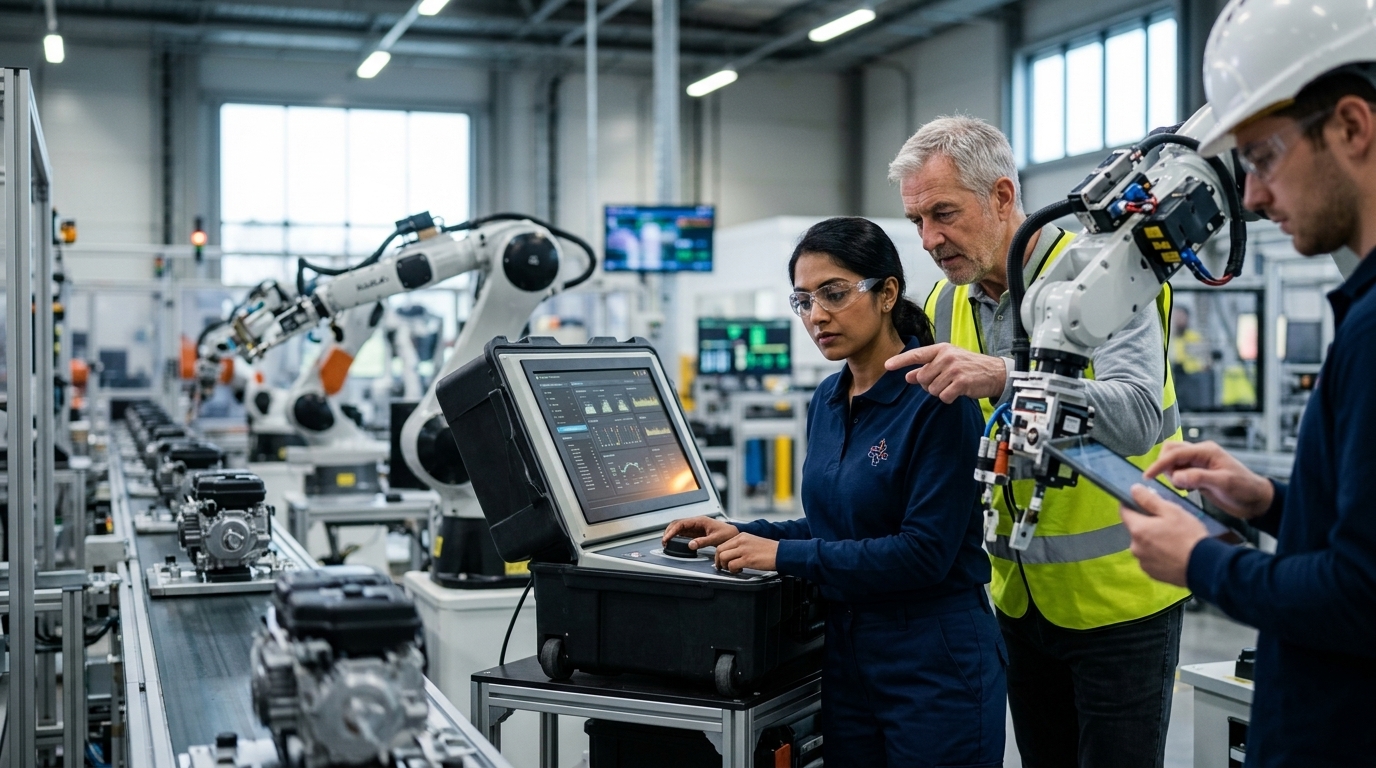
Furthermore, the model evaluates the cost of training not just in monetary terms, but in time. When a senior technician trains a novice, the senior’s productivity drops. MPC manages this "training load" to ensure that market supply remains stable. This is particularly vital during crises, where the ability to pivot and adapt is a matter of corporate survival.
Conclusion and Future Outlook
The study concludes that integrating skill constraints into production control models is not just a mathematical exercise but a necessity for modern management. The proposed algorithms can be integrated into existing ERP (Enterprise Resource Planning) systems, providing production managers with a data-driven decision tool rather than relying on intuition.
As supply chains become increasingly complex, the ability to predict skill requirements will become the next competitive frontier. This research paves the way for "smarter" factories where humans and their knowledge are treated with the strategic importance they deserve, ensuring that the human element remains a source of strength rather than a bottleneck.