Water is the most ubiquitous yet enigmatic liquid on our planet. Despite its simple chemical formula, H2O, its behavior exhibits anomalies that have puzzled scientists for generations. From the fact that ice floats on liquid water to its unusually high heat capacity, water defies the rules governing most other liquids. Today, a new study published on Phys.org reveals how researchers are using Artificial Intelligence (AI) to evaluate a systematic framework describing molecular order in liquid water, opening new avenues in our understanding of matter.
The Challenge of Molecular Order
The difficulty in understanding water lies in how its molecules interact via hydrogen bonds. These bonds form a dynamic, ever-changing network that is exceptionally hard to simulate accurately. Traditional methods, such as 'ab initio' simulations (from first principles), are highly accurate but demand immense computational power, limiting studies to very small systems and short timescales. Conversely, classical models are faster but often fail to capture the subtle quantum interactions that define water's properties.
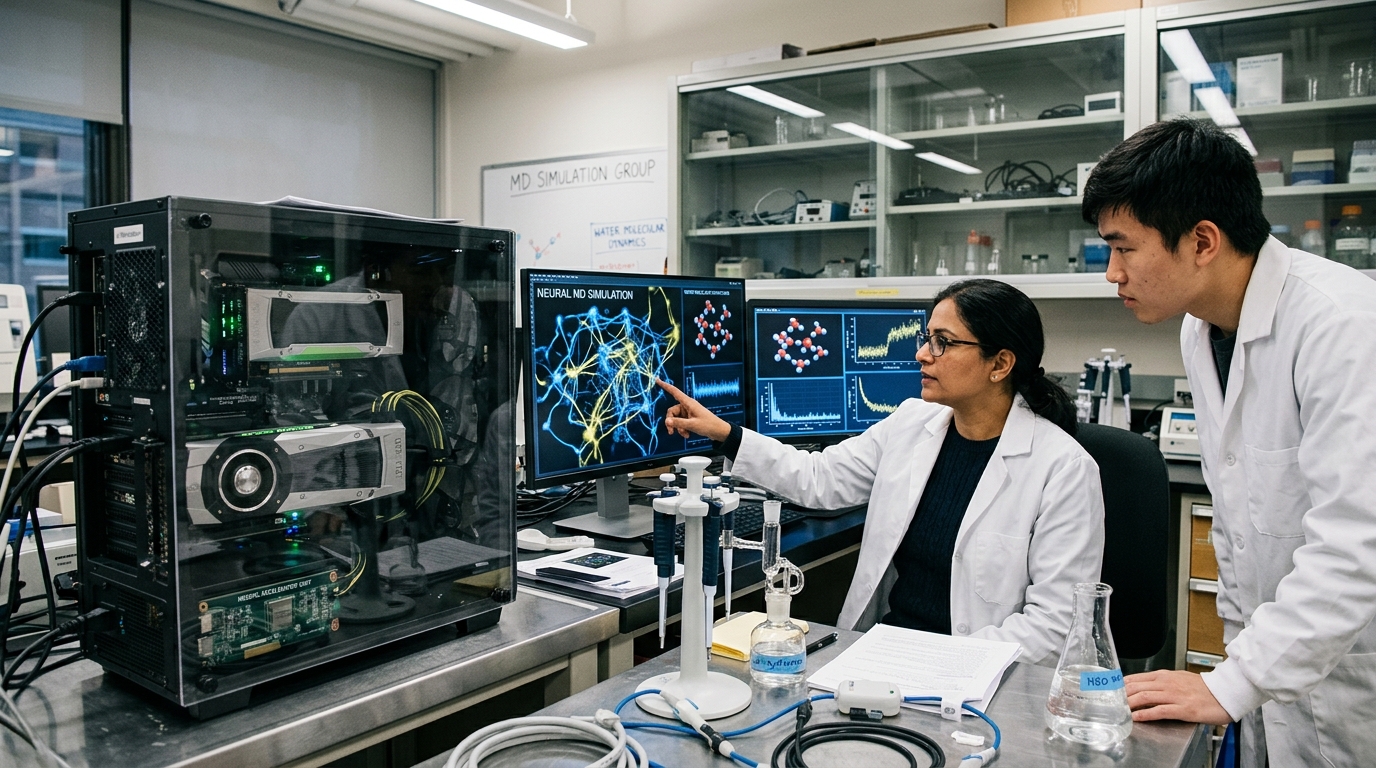
This is where Artificial Intelligence steps in. Researchers developed a framework using neural networks to 'learn' the forces between atoms from quantum mechanical data. This AI model allows scientists to run simulations with quantum-level accuracy but at the speed of classical models. The innovation of this specific research lies in using these models to identify a 'systematic order' within the apparent chaos of liquid water, pinpointing specific structural motifs responsible for its unique traits.
The Systematic Description Framework
The research team applied advanced machine learning algorithms to analyze the local structures of water molecules. Instead of treating the liquid as a homogeneous mass, the AI successfully distinguished regions of high and low order that fluctuate on a femtosecond scale (quadrillionths of a second). This distinction is critical as it supports the 'two-state' theory of water, which posits that water consists of two competing local structures influencing its density and thermodynamics.
- Quantum Accuracy: The AI was trained on datasets involving thousands of molecular configurations, capturing electronic structures without the need for constant, high-cost computations.
- Big Data Analysis: The ability to process millions of snapshots from simulations allowed for the identification of rare molecular arrangements that previously escaped notice.
- Predictive Power: The framework doesn't just describe the existing system; it can predict how water will behave under extreme pressure and temperature conditions, such as those found inside planets.
Implications for Science and Technology
The significance of this research extends far beyond theoretical physics. Understanding water's molecular order is vital for biology, as water is the solvent of life. The interaction of proteins with the surrounding aqueous medium determines their structure and function. With AI's help, scientists can now design drugs more precisely, accounting for the role of water molecules at receptor binding sites.
Furthermore, in the field of climate change, more accurate modeling of water vapor and ice in the atmosphere can improve meteorological models. Materials science also stands to benefit, as understanding the water-solid interface is essential for developing new desalination and energy storage technologies. Artificial Intelligence is no longer just a tool for text or image processing; it is the 21st-century 'microscope' allowing us to see nature with unprecedented clarity.
"The use of machine learning to decode the structure of water represents a fundamental paradigm shift. We no longer rely solely on intuition, but on data that reveals the true nature of matter," the study notes.
In conclusion, the integration of AI into molecular dynamics proves that nature's simplest elements hide the greatest complexity. As these models become more sophisticated, the gap between quantum physics and our daily experience will continue to narrow, offering solutions to some of humanity's greatest challenges.