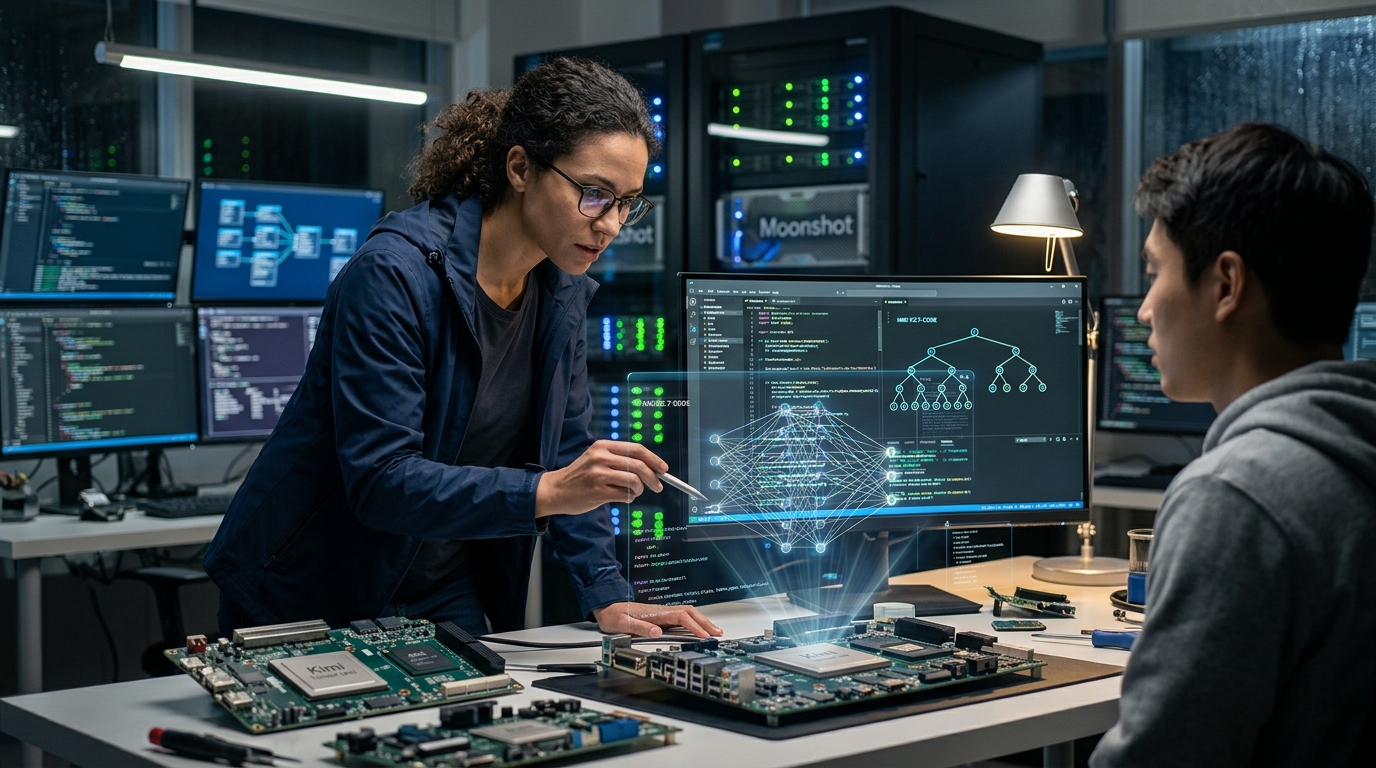
In the breakneck world of artificial intelligence, where weeks often feel like years, China's Moonshot AI has managed to capture the industry's full attention. The announcement of Kimi K2.7-Code is not merely another software update; it is a profound statement of capability. Boasting a staggering 21.8% performance improvement on the proprietary Kimi Code Bench v2 compared to its predecessor, version 2.6, the new model promises to redefine the symbiotic relationship between developers and machines.
Technical Mastery and the Kimi Code Bench v2
Moonshot AI, led by the visionary Yang Zhilin—a researcher with a storied pedigree at Google and Meta—has focused since its inception on solving one of the most persistent bottlenecks in Large Language Models (LLMs): the context window and precision in specialized tasks. Kimi K2.7-Code represents the culmination of this focus. A 21.8% jump in performance is not a linear improvement; it is a qualitative leap that approaches the frontier of autonomous complex logic solving.
The Kimi Code Bench v2, the benchmark utilized by the company, is designed to simulate real-world programming scenarios rather than simplistic academic exercises. It includes rigorous testing across multiple languages, including Python, Java, C++, and Rust, focusing on the model's ability to comprehend entire codebases rather than isolated snippets. The model's capacity to handle massive context windows allows developers to feed entire documentation sets and system architectures into the prompt, receiving answers that account for every system variable.
The Strategy of Specialization and the Model Wars
Moonshot AI’s strategy appears to diverge from the "one model to rule them all" approach favored by some Western giants. While OpenAI and Google strive to perfect their general-purpose models (GPT-4o, Gemini 1.5 Pro), Moonshot is doubling down on vertical specialization. K2.7-Code is "battle-hardened." By employing advanced Reinforcement Learning (RL) techniques and meticulously curated high-quality datasets, the model has developed an "intuition" for bugs and edge cases that often elude general-purpose LLMs.
- Optimized code generation with significantly fewer iterations.
- Superior debugging capabilities through deep logical gap analysis.
- Advanced algorithmic integration for low-level system memory management.
- Exceptional natural language understanding for translating complex requirements into functional code.
This specialization makes Kimi K2.7-Code a formidable challenger to established tools like GitHub Copilot and Cursor. If Moonshot can deliver this level of performance with low latency and competitive pricing, the Integrated Development Environment (IDE) market will face a new, disruptive reality.
Geopolitical Implications and the Chinese AI Landscape
It is impossible to analyze Moonshot AI’s success without considering the broader geopolitical landscape. In an era where the United States imposes strict export controls on high-end semiconductors to China, Chinese firms are forced to be more resourceful. The 21.8% performance gain suggests that Moonshot AI has found ways to maximize the utility of existing hardware through superior software architecture and algorithmic efficiency.
"AI in programming is no longer just an assistant; it is becoming the architect. The progress we see from models like Kimi K2.7-Code indicates that the barriers of language and syntax are crumbling, leaving only the creativity of problem-solving," industry analysts note.
Moonshot AI, backed by titans like Alibaba and Tencent, serves as China’s "heavy artillery" in the quest for technological self-reliance. K2.7-Code is not just aimed at the domestic market; it targets the global developer community seeking the most powerful tools, regardless of their origin.
The Future of Software Development
What does this mean for the average developer? The rise of models like Kimi K2.7-Code signifies that a developer's value is shifting from knowing syntax to knowing systems. The ability to guide the AI, verify the correctness of its suggestions, and synthesize complex architectures is becoming the essential new skill set. Moonshot AI, with its latest model, is not just offering a better "autocomplete"; it is providing a partner that understands the depth of programming logic.
In conclusion, the release of Kimi K2.7-Code is a milestone. A 21.8% performance increase in such a competitive field is rare and suggests that Moonshot AI has unlocked new training methodologies. As the model becomes more widely available, we will see if this laboratory superiority translates into real-world dominance on the keyboards of developers worldwide.