Quantum computing has long existed in a state of paradox: while the theoretical potential of qubits promises to solve problems that would take classical computers centuries, their physical realization remains trapped in rigid architectures. The primary bottleneck is no longer just maintaining quantum coherence, but the very geometry of communication. In a classical processor, data flows through wiring. In quantum processors, transferring information between distant qubits requires complex sequences of gates that often introduce noise and errors. Recent research into "mobile qubits" promises to shift this paradigm, introducing dynamic flexibility into the silicon structure itself.
The Problem of Static Architecture
To date, most quantum chips rely on a grid-like layout where each qubit is fixed in a specific location. For two non-adjacent qubits to interact, information must be moved "step-by-step" through intermediate qubits (a process known as SWAP gates). This model is highly inefficient as the number of quantum bits scales. The larger the chip, the more time and energy the system spends just moving information to the right spot, dramatically increasing the probability of quantum state collapse.
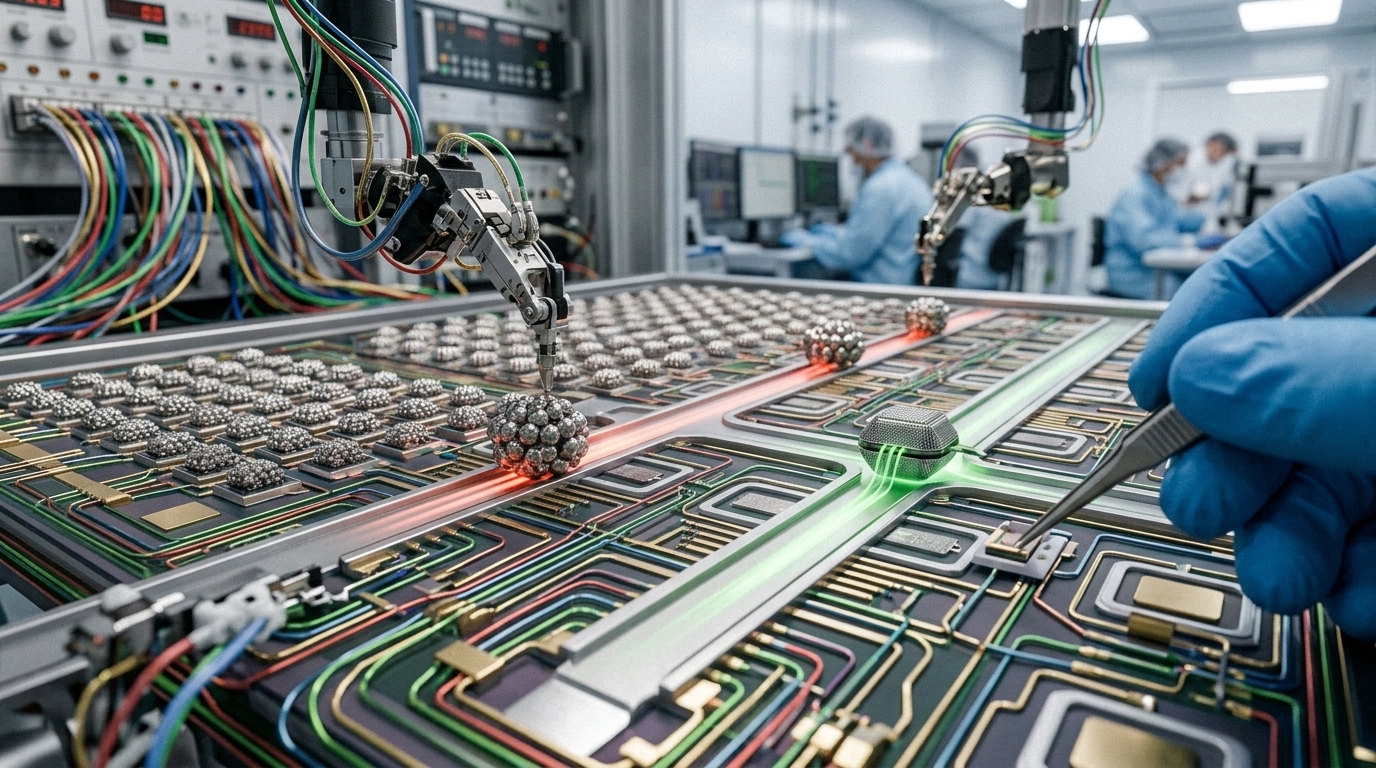
The solution proposed by new research efforts, as detailed in developments from May 2026, focuses on physically moving the carriers of quantum information—typically electrons—over long distances across the chip without losing their quantum property (their spin). This is achieved through "quantum conveyor belts," which use electric fields to push electrons along silicon channels.
The CMOS Manufacturing Challenge
The real breakthrough is not just moving the qubit, but the ability to manufacture these devices using standard CMOS (Complementary Metal-Oxide-Semiconductor) technology. The semiconductor industry has perfected transistor fabrication at the nanometer scale, but integrating quantum functions requires precision that touches the limits of atomic structure. Mixing electronic manufacturing with flexible geometry is exceptionally difficult, as the materials used to transport qubits must be free of impurities that could cause decoherence.
- Surface Acoustic Waves (SAWs): One of the most promising methods involves using acoustic waves that propagate on the chip's surface, "surfing" the electrons on the crest of the wave.
- Electrostatic Shuttling: Using a series of gates that are activated sequentially to pull the electron from one position to the next.
- High-Purity Materials: The use of isotopically pure silicon-28 is essential to avoid magnetic interference from atomic nuclei.
Toward a Modular Quantum Architecture
The ability to move qubits paves the way for modular quantum computers. Instead of one massive, monolithic, and rigid chip, we could have smaller processing units connected via "quantum buses." This would allow for easier cooling and maintenance of the systems, as well as the ability to replace defective parts without discarding the entire processor.
"We are not just building a computer; we are redesigning how matter carries information at the most fundamental level," say researchers involved in the project.
In conclusion, the transition from static to mobile qubits represents the critical milestone for moving quantum computing out of the lab and onto the production line. While technical difficulties remain immense, the convergence of quantum physics with traditional nanofabrication shows that the path to millions of qubits is now visible, though still arduous.