The field of regenerative medicine is standing at a historic crossroads. For decades, end-stage liver failure has been a death sentence for many, with the only hope being a long and often futile wait for a compatible organ from a deceased donor. Today, news of the development of functional "mini-livers" in the laboratory, capable of supporting vital human functions, is fundamentally altering the landscape of transplant science.
The liver is the body's "chemical plant," responsible for over 500 functions, ranging from blood detoxification to protein synthesis and metabolic regulation. Its sheer complexity makes artificial reproduction one of the most daunting tasks in biological history. However, international research teams, utilizing bioengineering and advanced cell culture techniques, have succeeded in creating liver grafts that are not merely static structures but living, functional tissues.
The Technology Behind the Breakthrough: Decellularization and Recellularization
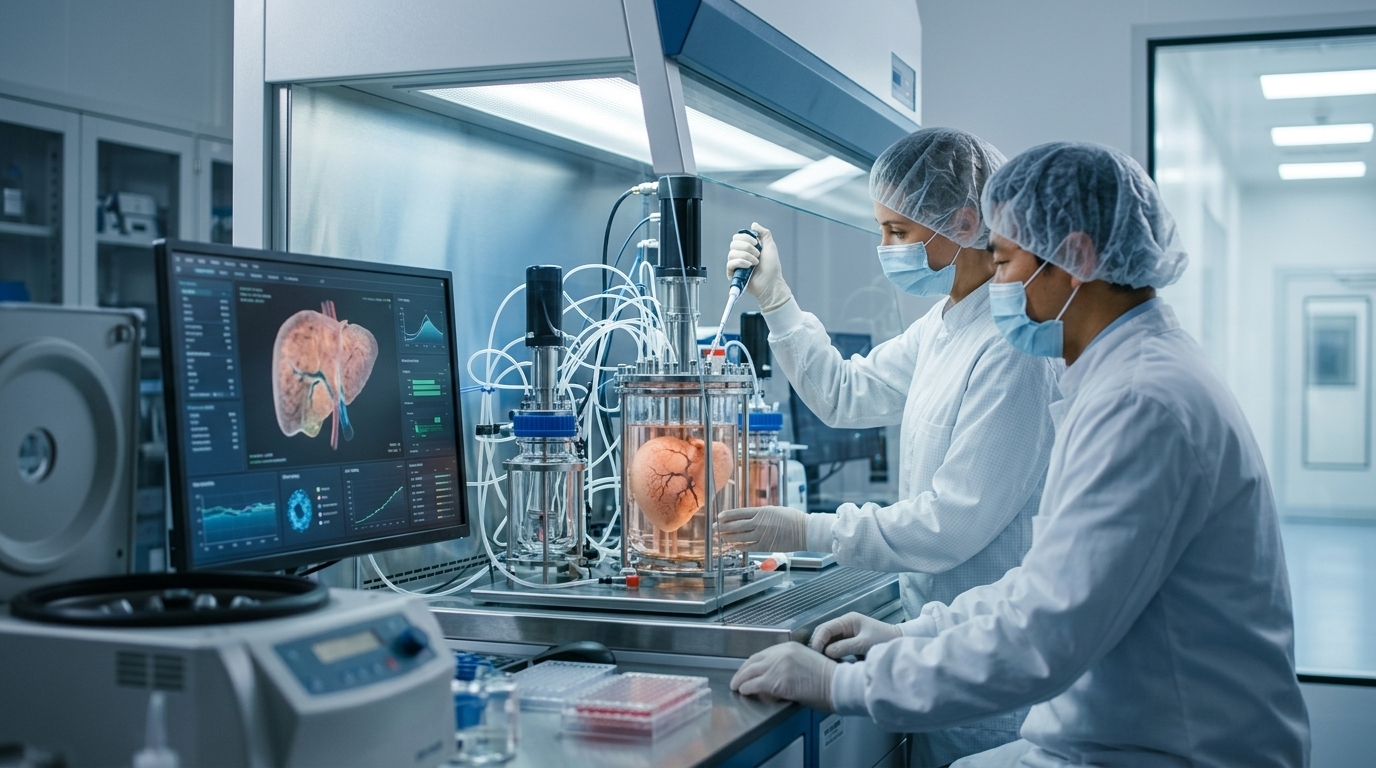
The method leading to this achievement is based on an ingenious approach: using a natural "scaffold." Scientists take a liver that is unsuitable for transplantation and, through a process called decellularization, strip away all donor cells. What remains is the extracellular matrix (ECM)—a ghost-like structure of collagen and proteins that perfectly preserves the organ's shape and intricate vascular network.
Next, this scaffold is "reseeded" with healthy hepatocytes (liver cells) and endothelial cells, often derived from the patient's own body using induced pluripotent stem cell (iPSC) technology. The result is an organ that carries the recipient's genetic signature, drastically reducing the risk of rejection and the need for lifelong immunosuppressive drugs.
"We are not trying to copy nature from scratch, but rather using its own architecture to guide regeneration," researchers note.
From Bench to Bedside: The Strategy of Ectopic Transplantation
One of the most compelling aspects of this research is how these "mini-livers" are deployed. Instead of immediately replacing the damaged organ, these bioengineered grafts can be implanted in other parts of the body, such as lymph nodes or the peritoneal cavity. There, they act as auxiliary units, performing a fraction of the liver's function (roughly 10-20%), which is often enough to sustain a patient's life or allow their native liver to recover.
This approach addresses the organ shortage crisis in a multiplicative way. A single donor liver that would otherwise be discarded can provide scaffolds for dozens of mini-livers, offering hope to multiple patients simultaneously. Furthermore, the transplant procedure becomes less invasive, as it doesn't require the complete removal of the diseased organ—a high-risk surgery for patients with advanced cirrhosis or liver failure.
Ethical Dilemmas and the Future of Biomedicine
Despite the excitement, the path to widespread clinical use is fraught with challenges. Ensuring the long-term viability of cells within the artificial scaffold and preventing tumorigenesis (a risk always present with stem cell use) are primary concerns. Additionally, the cost of these therapies is expected to be astronomical initially, raising questions about equitable access to healthcare.
Nevertheless, the prospect of a society where transplant waiting lists are a thing of the past is now within sight. The convergence of biology, nanotechnology, and artificial intelligence—used to model blood flow in new vessels—is accelerating progress. The "mini-liver" is not just an experiment; it is the first step toward an era where replacement human organs will be manufactured on demand, turning once-fatal diseases into manageable conditions.
- Decellularized scaffolds preserve the natural architecture of the organ.
- Patient-derived cells eliminate the need for immunosuppressive therapy.
- Auxiliary grafts can stabilize patients in critical condition.
- This technology could eventually be applied to other organs like kidneys and lungs.