The artificial intelligence industry is at a critical turning point where the initial awe of machine-generated imagery is being replaced by professional demands for quality, speed, and, most importantly, character. Krea AI, one of the most dynamic players in the visual AI space, has announced the release of Krea 2, introducing two groundbreaking models: 'Raw' and 'Turbo'. This move is not merely a technical iteration; it is a strategic response to the primary grievance of creative directors worldwide—the homogenized, 'overly perfect,' and often indistinguishable aesthetic of AI-generated visuals.
Combating the 'AI Look'
For years, images produced by models like Midjourney or DALL-E 3 shared a common DNA: a specific sheen, a smoothed texture, and a structural composition that betrayed their synthetic origins. In the worlds of advertising and high-end branding, this is a cardinal sin. Authenticity is the currency of our time. The Krea 2 Raw model was specifically engineered to shatter this mold. Instead of chasing digital perfection, it focuses on replicating the aesthetics of traditional photography, featuring natural lighting, skin imperfections, and a color palette reminiscent of film or professional RAW camera outputs.
This approach is vital for enterprises. A fashion house or an interior design firm cannot rely on images that look like generic computer graphics. They require visual assets that can stand alongside professional photography in a high-gloss magazine. Krea 2 Raw promises this seamless integration, allowing creators to dictate style without sacrificing the organic feel that resonates with human audiences.
Turbo: Speed as a Creative Catalyst
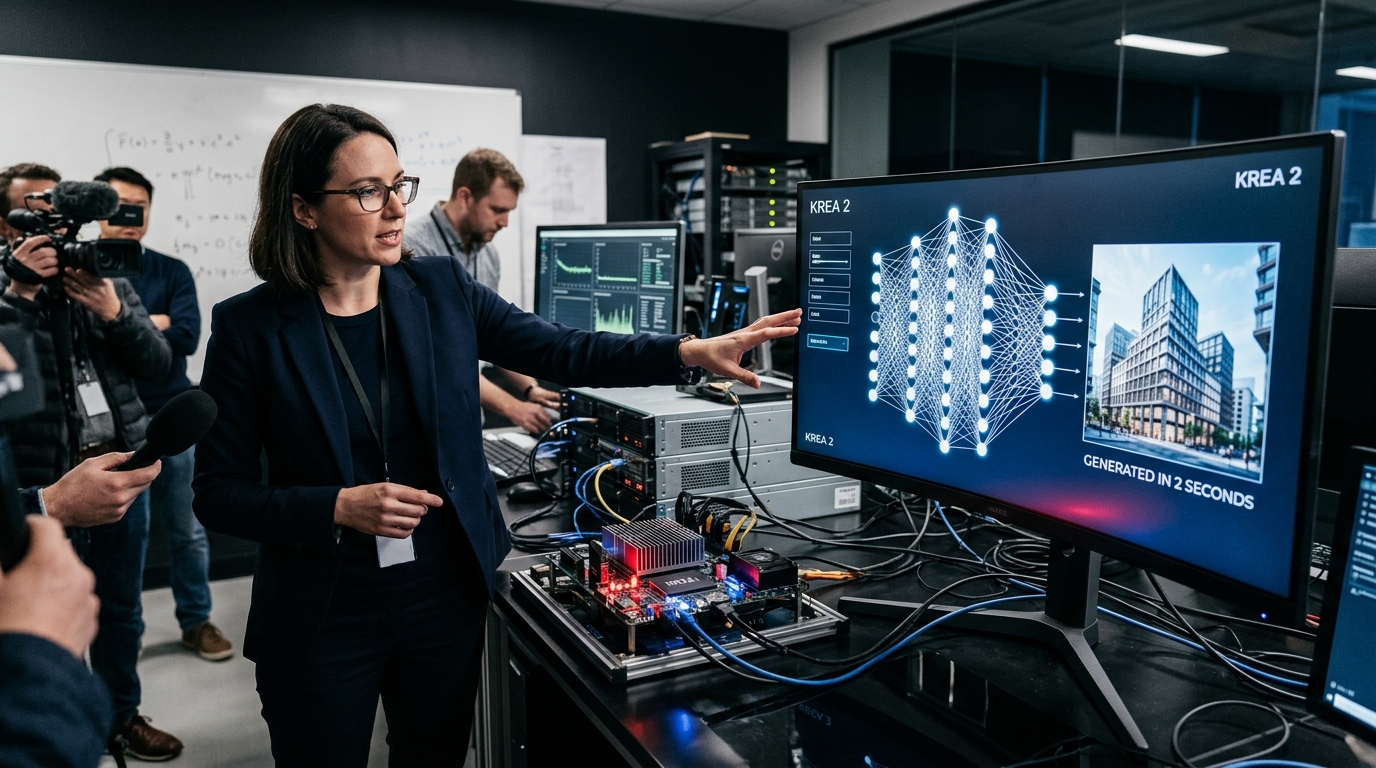
Alongside the Raw model, Krea introduced Turbo, which achieves the staggering milestone of generating high-fidelity images in under 2 seconds. Historically, generating a high-resolution image was a time-consuming process that frequently broke the 'creative flow.' With Turbo, the process becomes nearly instantaneous. This paves the way for true real-time collaboration between human intuition and machine execution.
Imagine an art director in a client meeting, tweaking visual concepts on the fly—adjusting camera angles, lighting conditions, and object placements without a moment of lag. Speed in this context is not just a technical boast; it is a productivity transformer. In an enterprise environment where time is inextricably linked to cost, reducing production cycles from minutes to seconds can fundamentally restructure creative department budgets and project timelines.
Open Weights and the Strategy of Freedom
Perhaps the most significant news for the developer community and large-scale organizations is Krea's decision to release these models as 'open weights' under a custom license. Unlike the closed-loop systems of OpenAI or Adobe, an open-weights approach allows enterprises to host the models on their own infrastructure. This addresses two fundamental corporate concerns: data security and deep customization.
- Privacy: Companies can process sensitive proprietary data without the risk of it being leaked or used to train third-party models in the cloud.
- Fine-tuning: A brand can further train the model on its own visual archives, ensuring that every generated asset adheres strictly to the brand’s unique identity and style guide.
This positioning puts Krea in direct competition with Stable Diffusion, but with a more 'production-ready' out-of-the-box experience tailored for professionals rather than just enthusiasts.
The Future of Visual Storytelling
As we move through 2026, AI is no longer viewed as a 'magic trick' but as a foundational tool in the creator’s kit. Krea 2 demonstrates that the future belongs not to the 'smartest' AI, but to the most malleable and efficient. The challenge for creators is shifting from learning how to use the tools to developing a unique visual vocabulary that the AI is then tasked to execute.
"Technology isn't replacing the artist; it's giving the artist the ability to fail and succeed ten times faster until they find the perfect moment," industry analysts observe.
In conclusion, the arrival of Krea 2 Raw and Turbo marks the end of the era of generic AI imagery. For enterprises, the ability to produce high-aesthetic visual content in seconds, with full data sovereignty, represents the 'holy grail' of digital strategy. The battle for dominance in the visual generative AI space has just gained a formidable, high-speed contender.