Human history is riddled with gaps—silences imposed by time, decay, and natural disasters. However, in the heart of Italy, a technological revolution led by Artificial Intelligence (AI) is beginning to give voice to those once thought lost forever in the ashes of Vesuvius. The Herculaneum scrolls, a collection of hundreds of documents carbonized during the eruption of 79 AD, have become the site of one of the most fascinating encounters between classical antiquity and cutting-edge computer science.
The Enigma of the Carbonized Scrolls
When Vesuvius erupted, the town of Herculaneum was buried under a thick layer of volcanic mud and ash. Unlike Pompeii, the heat at Herculaneum was so intense that it instantly carbonized the scrolls of a lavish library—the Villa of the Papyri—turning them into fragile, cylindrical lumps of charcoal. For centuries, any attempt to unroll these scrolls resulted in their disintegration. Archaeologists faced a tragic dilemma: preserve the closed "charcoal blocks" or risk their total destruction for the sake of a single word.
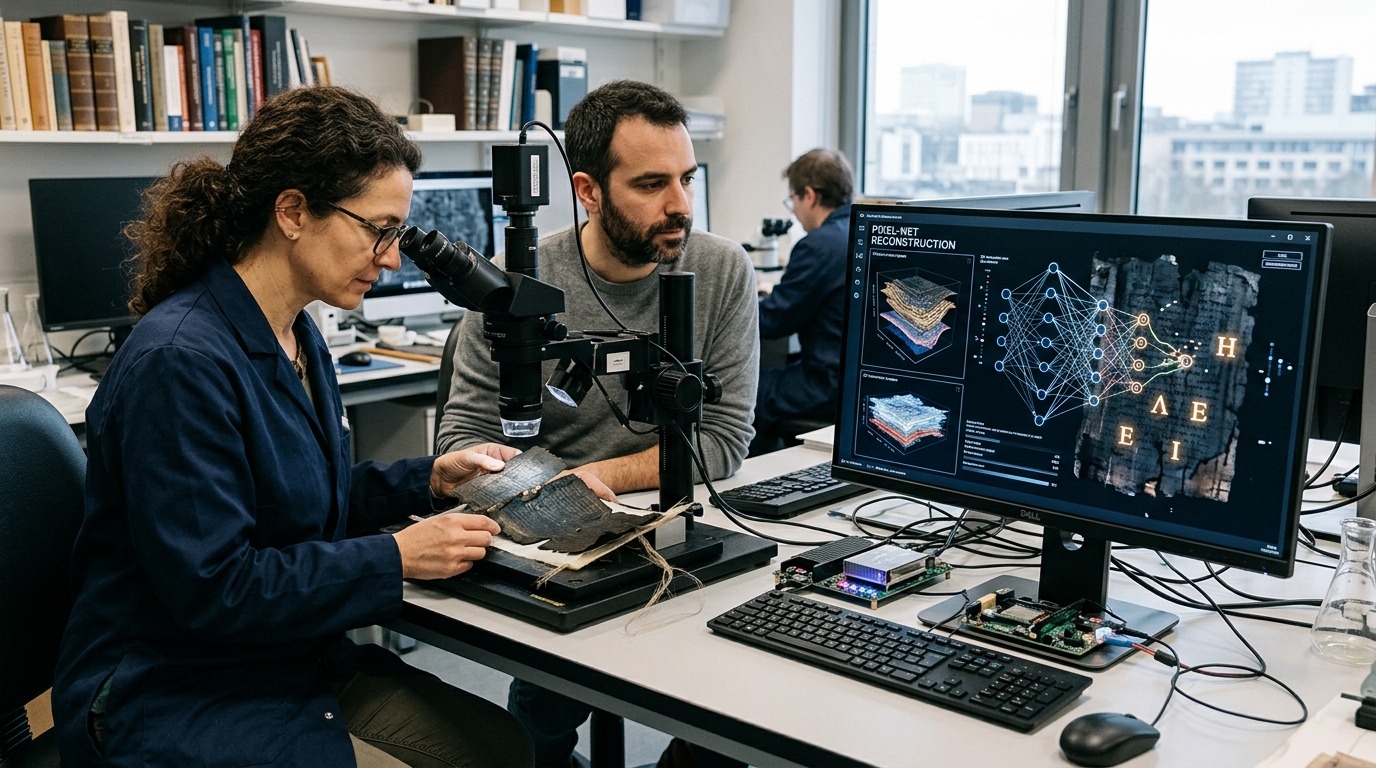
The solution did not come from an archaeologist's scalpel, but from CT scanners and software engineers. Using high-resolution X-rays from synchrotrons, scientists managed to create 3D scans of the scrolls' internal layers without touching them. However, the ink—which was carbon-based—was nearly indistinguishable from the carbonized papyrus itself. This is where Artificial Intelligence steps in.
Digital Revelation: Machine Learning and "Virtual Unrolling"
2024 and 2025 were milestone years for the "Vesuvius Challenge." Using sophisticated machine learning algorithms, researchers trained models to recognize subtle differences in the texture of the papyrus surface where ink had once been absorbed. AI can "see" patterns invisible to the human eye, pulling letters, words, and entire sentences out of the digital darkness.
- Ink Detection: Algorithms identify microscopic changes in the papyrus thickness that indicate the presence of ancient ink.
- Virtual Unrolling: Through geometric calculations, AI flattens the curves of the scanned papyrus layers, creating a readable 2D image.
- Text Reconstruction: With the help of Large Language Models (LLMs) fine-tuned for Ancient Greek, scientists can fill in gaps in damaged sections with impressive accuracy.
The results are staggering. Passages concerning Epicurean philosophy have already been read, with texts by Philodemus of Gadara coming to light. Researchers are discovering thoughts on music, food, and the enjoyment of the senses, offering a rare glimpse into the intellectual life of the Roman elite.
Implications for the Humanities
The significance of this development goes far beyond technical achievement. We are on the verge of recovering lost works by Aristotle, Sophocles, or Livy. The Villa of the Papyri is the only intact library from antiquity to survive, and AI is the key that unlocks it. This process redefines our relationship with the past: technology is no longer just a tool for the future, but a magnifying glass illuminating our roots.
"We are not just reading words; we are recovering the thought of an era we believed was lost forever. AI is transforming archaeology from an excavation of objects into an excavation of ideas," says one of the project's lead researchers.
However, the challenge remains immense. Thousands of scrolls are still waiting their turn, and the processing power required is unprecedented. Furthermore, the need for expert papyrologists to interpret the AI's findings is greater than ever, proving that technology and the humanities must walk hand in hand.
The Future of Digital Archaeology
As we move through 2026, the next step is automating the process at scale. If AI can decode the entire Herculaneum library, we could double the volume of surviving ancient literature within a few years. This could lead to a "New Renaissance," where classical studies are fueled by new, unknown material, prompting a re-evaluation of the history of philosophy, science, and politics.
Italy, as the custodian of this treasure, is at the center of a global collaboration. The Herculaneum example shows that Artificial Intelligence, when used with respect and vision, can bridge a two-millennium gap, proving that nothing is truly lost as long as the will for knowledge remains.