The current decade is defined by a striking asymmetry. On one hand, the "brain" of machines—Artificial Intelligence—is evolving at an exponential pace, delivering capabilities that were pure science fiction just a few years ago. On the other, their "body"—the physical hardware of humanoid robots—remains trapped in an economic and technical reality that makes mass production nearly impossible for now. Recent analysis of supply chain challenges and material costs highlights the industry's critical weakness: hardware is simply too expensive to become a common reality.
The Price of Precision: Actuators and Sensors
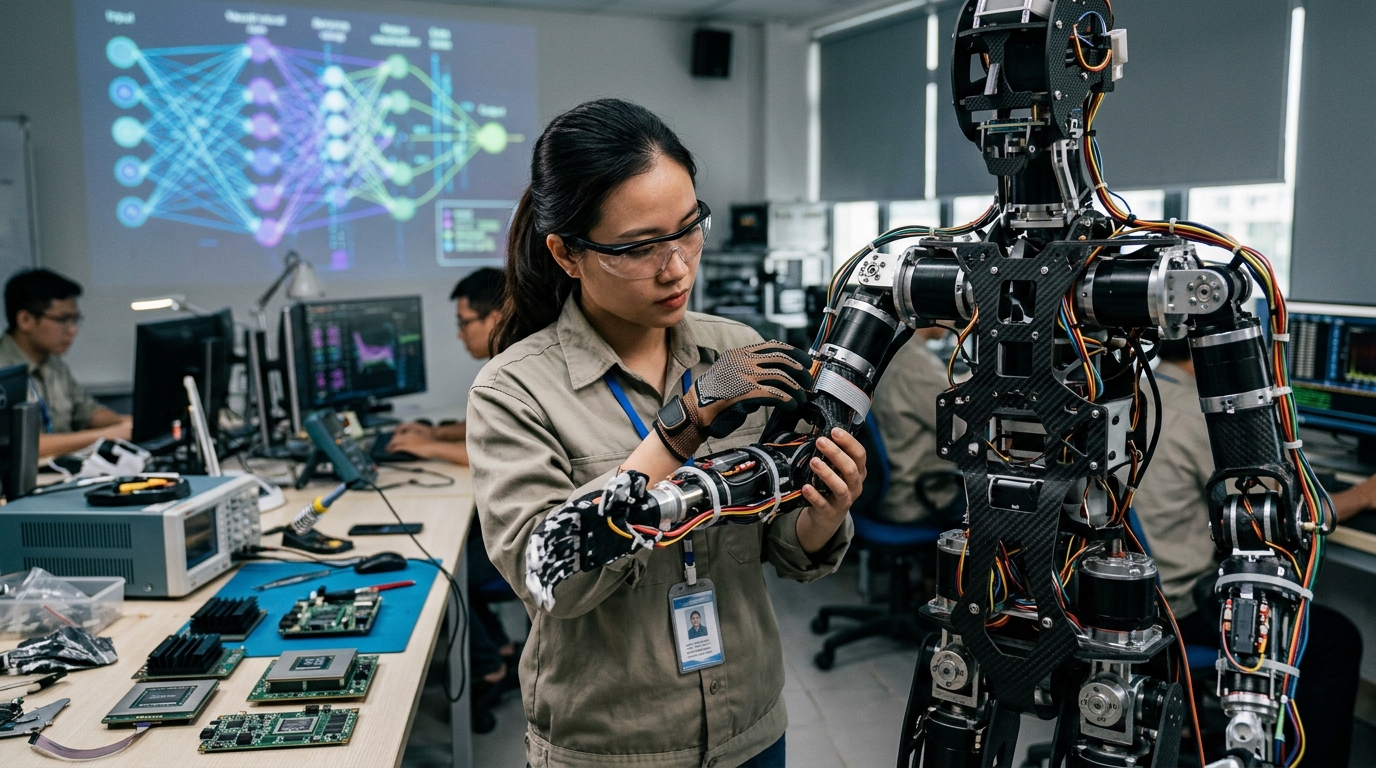
For a humanoid robot to mimic human movement naturally, it requires dozens of actuators—the "muscles" of the machine. These components are not simple motors; they are high-precision systems that must combine strength, speed, and extremely low weight. Today, the cost of a single advanced actuator can exceed $2,000. When you consider that a functional humanoid needs anywhere from 20 to 50 of these units, the cost for motion alone skyrockets into six figures.
Furthermore, environmental awareness requires a network of LiDAR sensors, depth cameras, and tactile pressure sensors at the extremities. Integrating these technologies into a body that must withstand falls and continuous use creates an engineering nightmare. The use of carbon fiber and lightweight aluminum alloys improves performance but adds further weight to the manufacturing budget, making the final product affordable only to research labs or industrial giants.
The Geopolitics of Rare Earths
Beyond design, there is the issue of raw materials. Permanent magnets used in high-performance motors rely on rare earth elements like neodymium and dysprosium. The extraction and control of these materials are concentrated in specific geographic regions, primarily China, creating geopolitical dependencies and price volatility. As demand for electric vehicles surges, competition for these same materials intensifies, leaving robotics at a disadvantage in terms of purchasing power.
Analysts point out that for robots to appear in homes or small businesses, production costs must drop by at least 80%. This requires a radical shift toward more common materials or a revolution in manufacturing processes, such as large-scale metal 3D printing, which is still in its infancy regarding reliability for critical components.
The Strategy of Simplification
Many companies, such as Tesla with its Optimus program or Figure AI, are attempting to tackle the problem through "vertical integration"—manufacturing their own components rather than buying them from suppliers. This strategy aims for economies of scale. However, there is another school of thought: simplification. Instead of robots with five fingers that move exactly like humans, some designers propose more abstract forms with fewer moving parts, drastically reducing cost and the likelihood of mechanical failure.
The question remains: do we want a machine that looks exactly like us, or a machine that is economically viable? The history of technology shows that utility always triumphs over aesthetics. If humanoid robots fail to break the hardware cost barrier, they risk remaining expensive showpieces at tech expos, while simpler, specialized machines take over the tasks of the future.