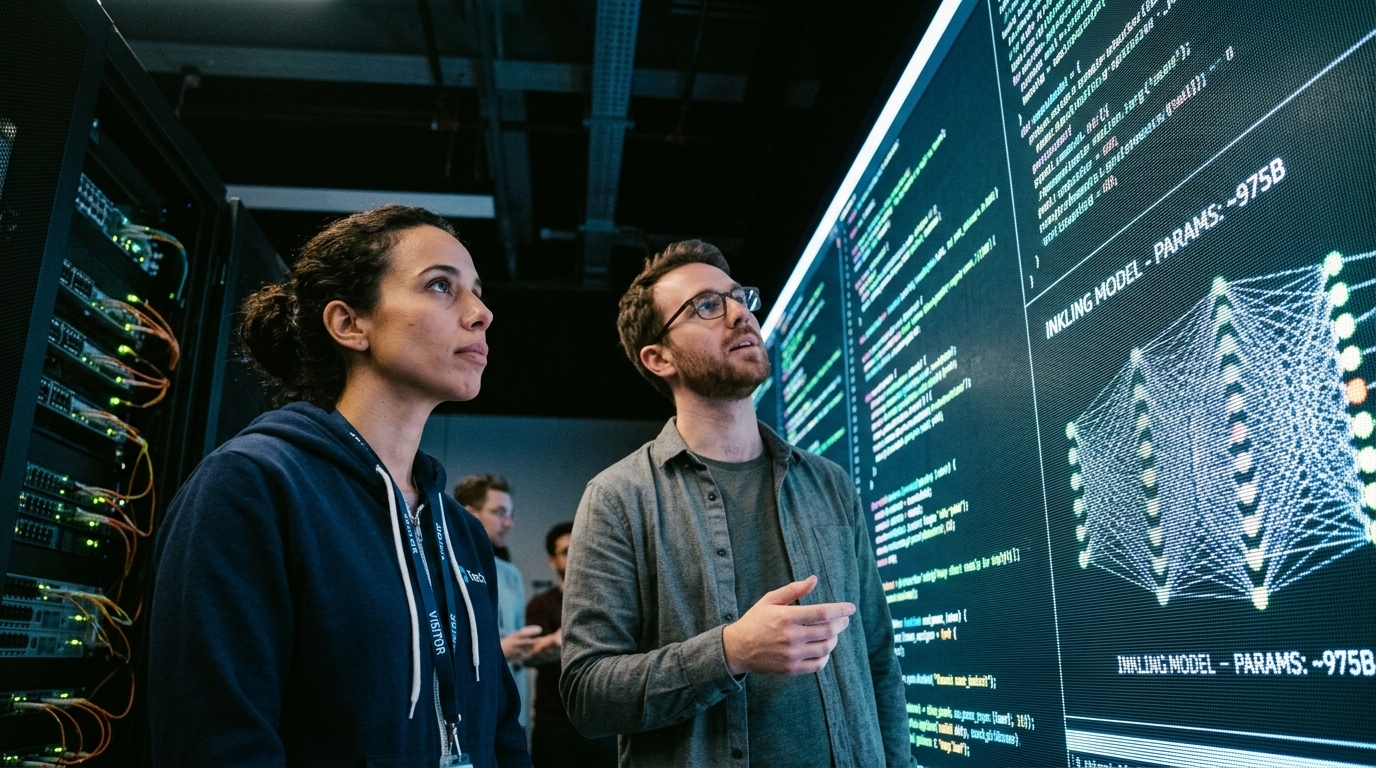
For years, the narrative surrounding Artificial Intelligence has been one-dimensional: the larger the model, the more data it consumes, and the more expensive the compute, the better the result. This "scaling dogma" built an almost impenetrable fortress around Silicon Valley’s tech giants. Today, June 10, 2026, we stand before a tectonic shift. Researchers at Sapient have announced that they successfully trained a foundation model from scratch for a mere $1,500. This achievement is not just a technical milestone; it is an act of democratization that threatens to upend the industry's established order.
The HRM-Text Architecture: Moving Beyond Transformers
The core of this innovation lies in abandoning the traditional Transformer architecture, which has dominated the field since 2017. While Transformers are exceptionally powerful, they suffer from a fundamental flaw: their computational complexity increases quadratically with the sequence length. This means that to make a model "smarter" or capable of handling longer documents, the cost skyrocket exponentially.
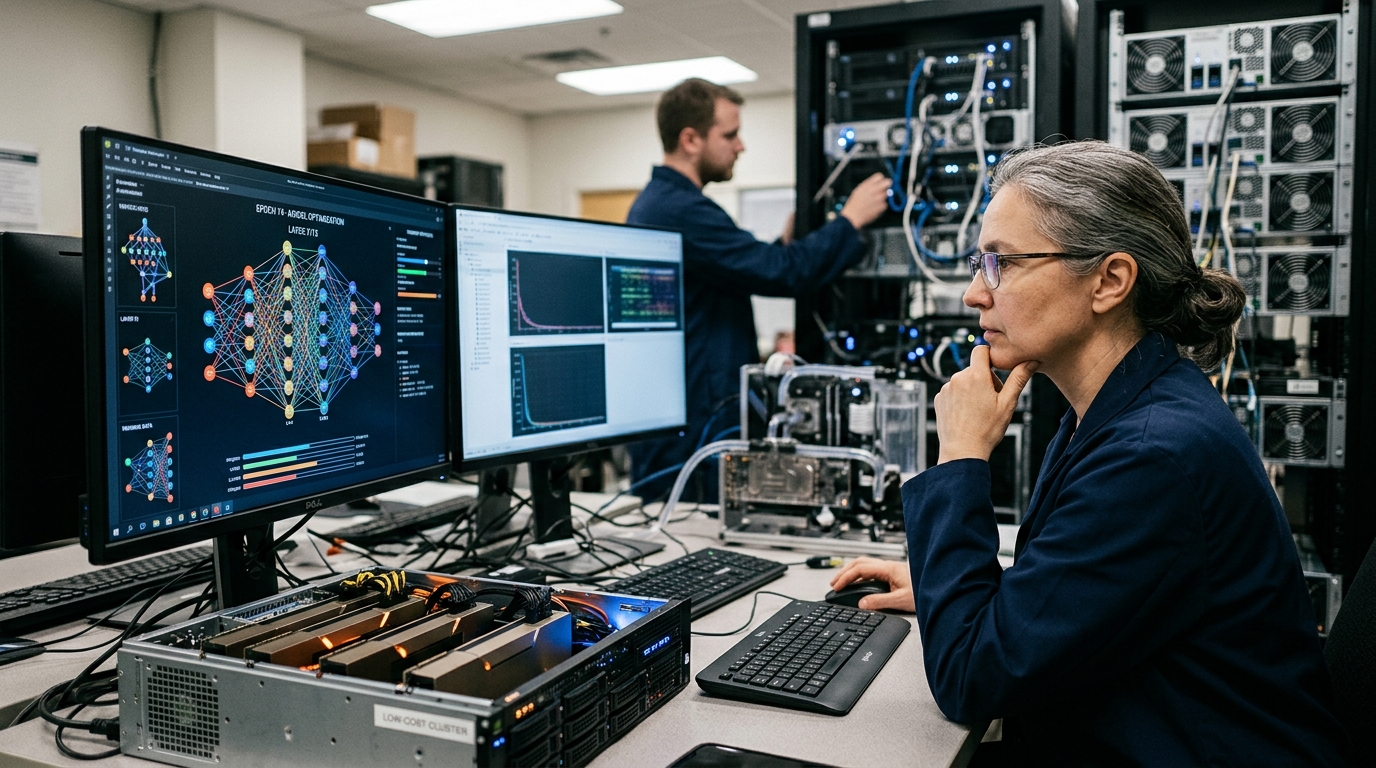
Sapient researchers developed HRM-Text (Hierarchical Recurrent Model). Instead of relying solely on the "attention mechanism" that demands massive memory, HRM-Text utilizes a hierarchical recurrent structure. This allows the model to process information with linear complexity while maintaining the ability to understand complex concepts. This strategy enables training on consumer-grade or mid-range GPUs instead of the prohibitively expensive Nvidia H100 clusters that rent for thousands of dollars per hour.
Challenging the Brute-Force Dogma
Until recently, training a model like GPT-4 was estimated to cost upwards of $100 million. Sapient’s approach proves that brute force—the accumulation of unthinkable amounts of computing power—is not the only path to intelligence. With HRM-Text, the focus shifts from quantity to the quality of architecture and data curation.
- Data Efficiency: The model was trained on highly curated, high-quality datasets, avoiding the "noise" of the open internet that often hampers larger models.
- Algorithmic Optimization: The hierarchical structure allows the model to "remember" context without needing to recalculate every word's relationship to every other word constantly.
- Accessibility: At a cost of $1,500, even a small startup or a university lab can now build its own specialized foundation model.
Implications for Enterprise and Sovereignty
This development arrives at a critical moment for global digital sovereignty. Dependence on a handful of US and Chinese models has been a major concern for governments and enterprises alike. If the cost of creating a foundation model drops to levels affordable for a medium-sized business, the moat protecting Big Tech (Google, Microsoft, Meta) begins to evaporate.
"We no longer need a nuclear reactor to light a candle," said Sapient’s lead researcher. "Intelligence should be cheap, ubiquitous, and, most importantly, under the user's control."
On an economic level, this could lead to a stabilization of GPU prices as the demand for extreme hyperscale clusters might wane in favor of more efficient, localized solutions. Furthermore, the environmental footprint of AI—a significant point of contention—is drastically reduced. Training a model for $1,500 consumes only a fraction of the energy required by traditional LLMs.
Conclusion: A New Paradigm
2026 will be remembered as the year AI ceased to be the privilege of the few. Sapient’s success reminds us that human ingenuity will always find ways to bypass the barriers of capital. The challenge is no longer who has the deepest pockets, but who has the best vision for applying this now-accessible intelligence to solve real-world problems. The era of "Big AI" is being replaced by the era of "Smart AI."