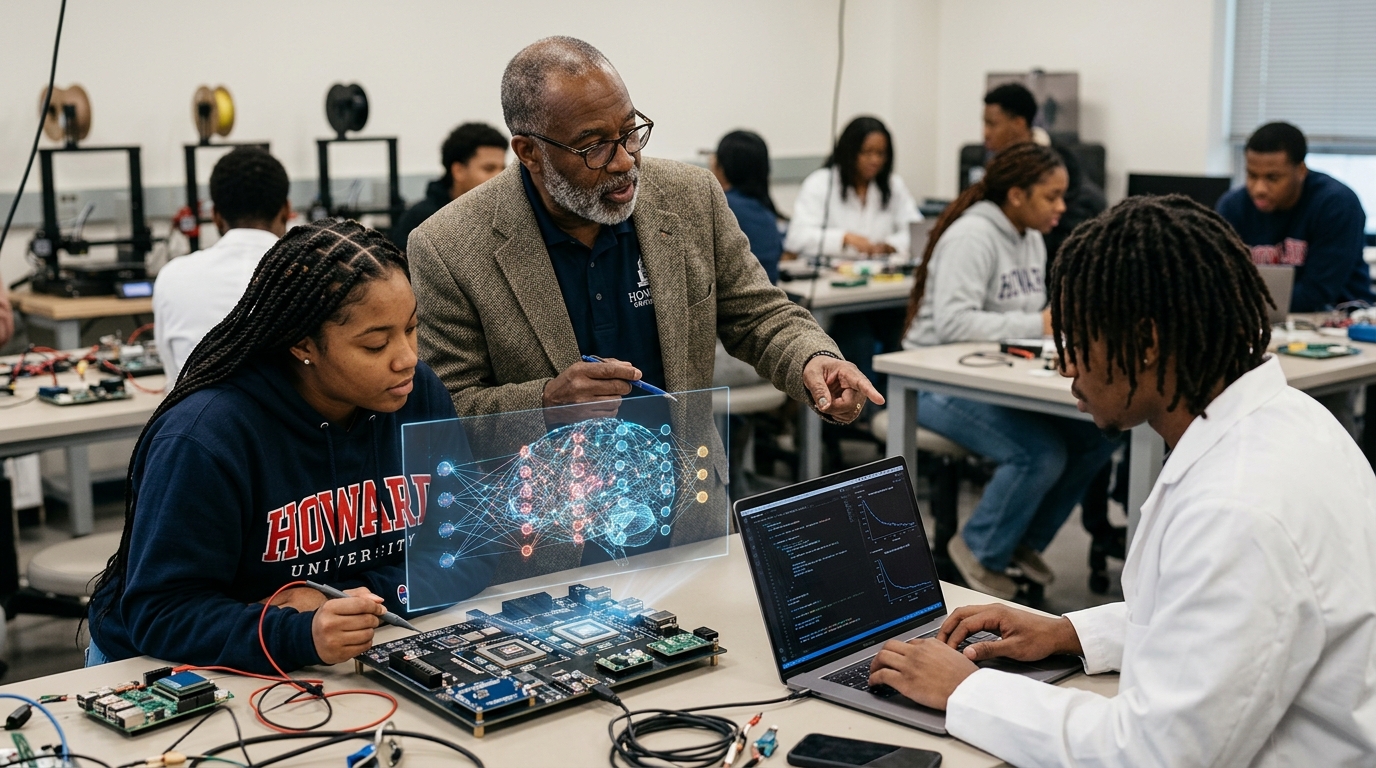
In the heart of Washington, D.C., Howard University, one of the nation's premier Historically Black Colleges and Universities (HBCUs), is carving a new path in technological education. The "AI Tinkery" series, an initiative by the College of Engineering and Architecture (CEA), is far more than just another academic seminar. It is a bold attempt to transform theoretical knowledge into applied skill, providing students with the tools to "tinker"—to experiment, fail, and ultimately master—the technologies reshaping our world in 2026.
The Philosophy of Tinkering in the Digital Age
The term "tinkering" traditionally evokes images of garages filled with tools and mechanical parts. Within the context of Howard, this concept is translated into code and neural networks. The AI Tinkery Series aims to demystify Artificial Intelligence, stripping away the veil of the "magical" or "inexplicable" that often surrounds algorithms. The core premise is simple: to truly understand AI, you must deconstruct it.
Participants are not limited to learning how to use ready-made tools like ChatGPT or Midjourney. Instead, they are encouraged to understand data structures, the biases embedded in models, and the ethical implications of automation. This approach is critical for engineers and architects, professions where precision and safety are non-negotiable. An architect using Generative AI to design a building must know not only how to produce a beautiful render but also how the algorithm affects structural integrity and sustainability.
Engineering and Architecture: The Convergence of Physical and Digital
The application of AI in architecture and engineering represents one of the most exciting challenges of our decade. Through the AI Tinkery, Howard University explores how algorithms can optimize material usage, reduce the carbon footprint of constructions, and predict the resilience of materials against extreme weather events—an urgent need driven by the climate crisis.
- Generative Design: Students learn to set parameters (such as budget, materials, location) and allow AI to suggest thousands of design variations, selecting the most efficient one.
- Predictive Maintenance: In engineering, training focuses on sensors and AI models that can predict when a bridge or a power grid needs repair before a failure occurs.
- Sustainable Urban Development: Using data to model traffic and energy consumption at a city-wide level.
"Artificial Intelligence is no longer an optional add-on for the engineer of the future; it is the very language of creation," notes one of the series' instructors.
Social Justice and Representation in Technology
Perhaps the most significant aspect of Howard's initiative is the context in which it takes place. As an HBCU, Howard has a mission to ensure that communities historically sidelined by technological advances not only have access to them but lead their development. AI suffers from serious bias issues, as training data often reflects societal inequalities.
The AI Tinkery trains students to recognize and correct these flaws. When an algorithm used in urban planning or credit scoring tends to discriminate against minorities, Howard graduates will be the ones with the technical expertise and social consciousness to intervene. This transforms AI from a tool of potential oppression into a tool for social empowerment.
Conclusion: A New Pedagogy for a Changing World
The AI Tinkery series serves as a model for how higher education institutions must adapt to the speed of technological change. Instead of static curricula that become obsolete before graduation, Howard proposes a dynamic model of continuous experimentation. "Practical fluency" in AI is not about memorizing code; it's about developing a critical relationship with technology.
As we head into the second half of the 2020s, the success of such programs will be judged by whether graduates are mere users of Silicon Valley platforms or the architects of a new, more equitable, and efficient digital reality. Howard University, through the AI Tinkery, demonstrates that the answer lies in tinkering with purpose and vision.