In the wake of the climate crises of the early 2020s, industrial production stands at a critical crossroads. The traditional linear model of "extract-make-dispose" is fading, giving way to the Circular Economy. However, transitioning to "Circular Factories" presents a massive technical challenge: how can we know if a component that has already been used for years is safe and functional for a second or third life cycle? The recent study published on ArXiv (2606.05334) proposes a revolutionary solution through uncertainty-aware Artificial Intelligence.
The Challenge of Heterogeneity in Reused Products
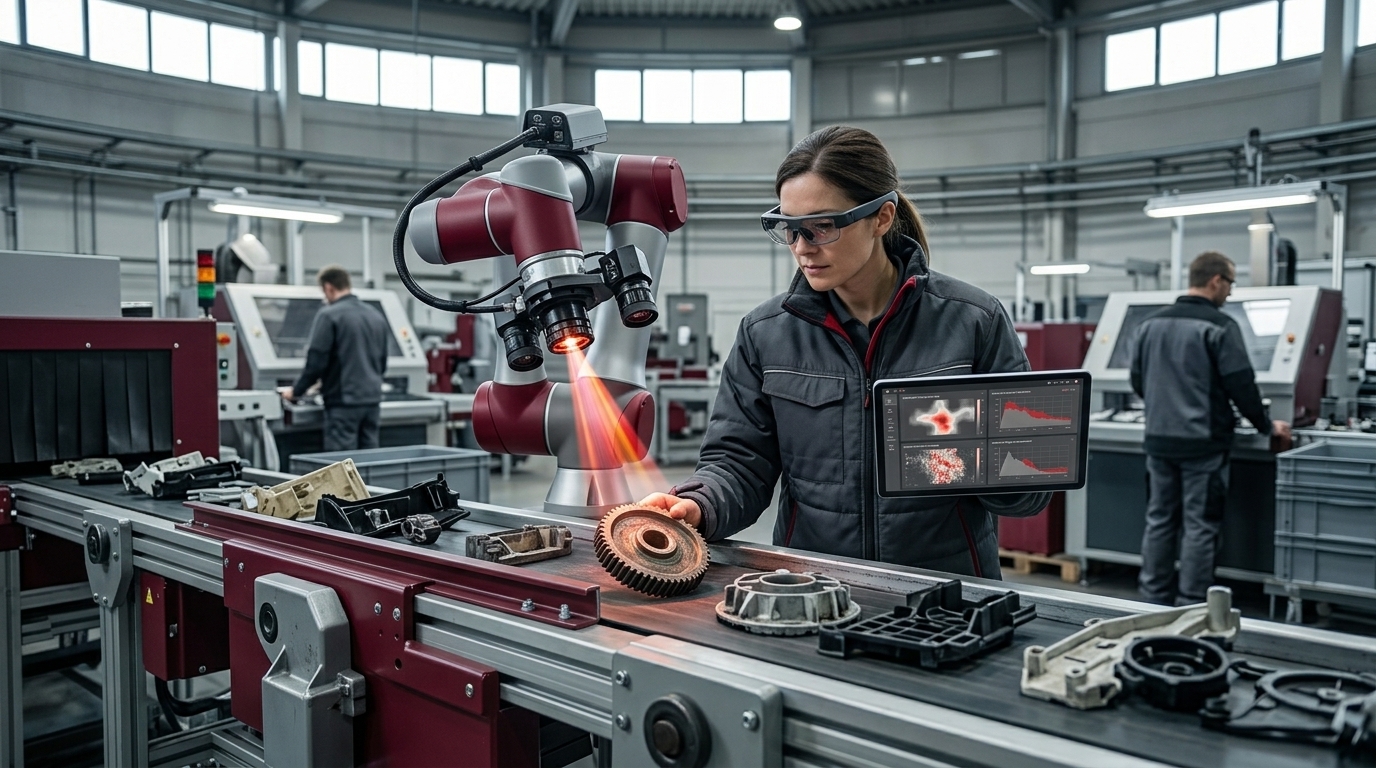
When a product returns to the factory for remanufacturing, it is no longer the standardized object that originally rolled off the assembly line. Each unit carries a unique history: different operating hours, exposure to varying environmental conditions, and distinct levels of stress. This "degradation state heterogeneity" makes traditional inspection methods insufficient. A simple visual check or dimensional measurement cannot reveal microscopic material fatigue or predict how much longer the component will last under pressure.
The research team argues that reuse decisions cannot be based solely on current status. A predictive approach that accounts for the future is required. This is where AI enters the frame, tasked with bridging the gap between sensor data and material science. The key, however, is not just prediction, but the quantification of uncertainty that accompanies that prediction.
Uncertainty-Aware Models: Beyond Deterministic Prediction
Most classical machine learning models provide a "deterministic" answer: "This component will last 500 hours." In a factory environment, such an absolute statement is dangerous if not accompanied by a margin of error. The new research focuses on Uncertainty-Aware Functional Behavior Prediction. By using probabilistic models (such as Bayesian Neural Networks or Gaussian Processes), the system doesn't just say what will happen, but also how confident it is about it.
- Stochastic Modeling: Incorporating variations in product usage.
- Material Fatigue Assessment: Utilizing physics-based models combined with real- time data to identify internal wear.
- Dynamic Decision Making: If uncertainty is too high, the system suggests material recycling instead of reuse.
This approach allows factory managers to set risk thresholds. For example, in critical aerospace components, 99.9% certainty might be required, while for household appliances, the threshold could be lower, allowing for greater circularity.
The Significance of Material Fatigue
Material fatigue is the "silent killer" of machinery. It is the gradual accumulation of damage due to repeated loading, leading to sudden failure. In the context of the Circular Factory, fatigue assessment is the governor of sustainability. The research proposes the use of AI-powered "Digital Twins" that simulate the future stresses of a component based on its history.
"Reuse without an accurate assessment of remaining useful life is not circular economy; it is risk. AI transforms this risk into a measurable parameter."
This level of analysis is essential for building trust in second-hand industrial goods markets. If a company can guarantee the performance of a remanufactured engine with the same precision it guarantees a new one, the economic barriers to circularity will crumble.
Policy Implications and the Future of Industry
The implementation of such systems is not just a technical issue, but a political one. The European Union, through new regulations on the "Digital Product Passport," is expected to require manufacturers to provide data on lifespan and repairability. The technology described in the ArXiv 2606.05334 research serves as the cornerstone for these passports.
In conclusion, the Circular Factory of 2026 and beyond will not just be an assembly site, but a center for intelligent resource management. The ability to predict failure before it occurs, while accounting for the inherent uncertainty of the real world, is the key for a planet that can no longer afford waste. AI is no longer just a profit optimization tool, but the essential science for industrial survival in a resource-constrained world.