The global geopolitical chessboard of artificial intelligence has just experienced a profound shock. While Silicon Valley assumed its dominance was secured through the proprietary, closed-door models of OpenAI and Google, a Chinese startup—DeepSeek—and the broader Chinese open-source community have proven that innovation knows no borders and cannot be contained by trade embargoes. The recent release of models like DeepSeek-V3, and their subsequent reasoning iterations, is more than a technical milestone; it is a declaration of independence.
The Architecture of Efficiency
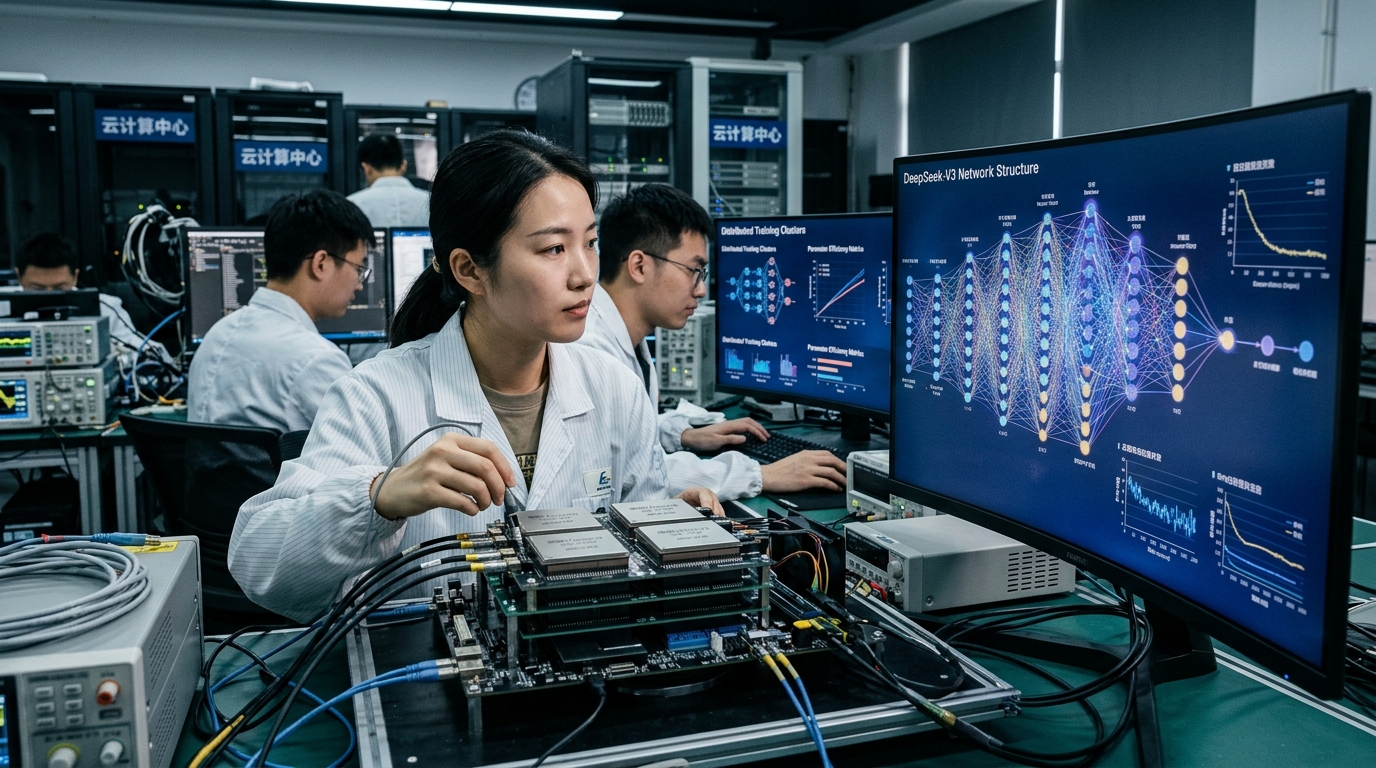
What is truly remarkable about the new wave of Chinese open-source models is not just their raw power, but their unprecedented efficiency. Unlike American giants that rely on massive clusters of Nvidia H100 GPUs, Chinese researchers have been forced by US export controls to innovate at the software level. By utilizing techniques such as Multi-head Latent Attention (MLA) and DeepSeekMoE (Mixture of Experts), they have successfully trained models that rival GPT-4o while spending only a fraction of the capital and energy.
This "forced" innovation has led to an architecture that allows the model to activate only the necessary parts of its network for any given query, drastically reducing operational costs. For businesses worldwide, this means that access to top-tier AI no longer requires expensive subscriptions to US-based platforms; it can be achieved locally and affordably. The narrative that more compute always equals better AI has been debunked by the sheer elegance of Chinese algorithmic optimization.
Open Source as a Geopolitical Gambit
The decision by Chinese entities, including DeepSeek and Alibaba (with its Qwen series), to release their model weights openly is a high-level strategic move. By making their technology the global standard for developers, China is effectively bypassing US efforts to isolate it technologically. When millions of developers around the world build their applications on Chinese code, China gains a form of "soft power" that Silicon Valley finds difficult to counter.
Furthermore, this move exerts immense pressure on the business models of companies like OpenAI. If an open-source model provides 95% of the performance of a closed model for free, the economic moat of the closed model evaporates. We are witnessing the democratization of intelligence, where knowledge is no longer locked behind paywalls but flows freely across the digital commons. This shift is forcing a radical re-evaluation of how AI value is captured and distributed.
The Western Response and the Road Ahead
The response from the West has been a mix of disbelief and alarm. Policy analysts in Washington are questioning how a startup with a relatively small team managed to outperform conglomerates with billions in funding. The answer lies in focus and academic rigor. While American firms are often bogged down by "alignment" issues that sometimes border on ideological filtering, Chinese teams have remained laser-focused on pure mathematical and programmatic excellence.
However, challenges remain. The adoption of Chinese models by Western governments or critical infrastructure providers raises significant national security questions. While the weights may be open, the training data and the fine-tuning processes remain largely opaque. Nevertheless, the market appears to be voting based on performance and cost-effectiveness. As of June 2026, the AI landscape has reached a tipping point: the era of Silicon Valley’s absolute monopoly is officially over.
- Algorithmic efficiency is proving more vital than raw chip counts.
- Open source has become the primary weapon in the technological cold war.
- The marginal cost of intelligence is heading toward zero, reshaping the global economy.
In conclusion, the rise of Chinese open-source AI is not merely a threat to Big Tech margins; it is an opportunity for humanity to access tools that were previously the privilege of a few. The history of technology is now being written with Chinese characters and open-source code, signaling a multi-polar future for the most important technology of our time.