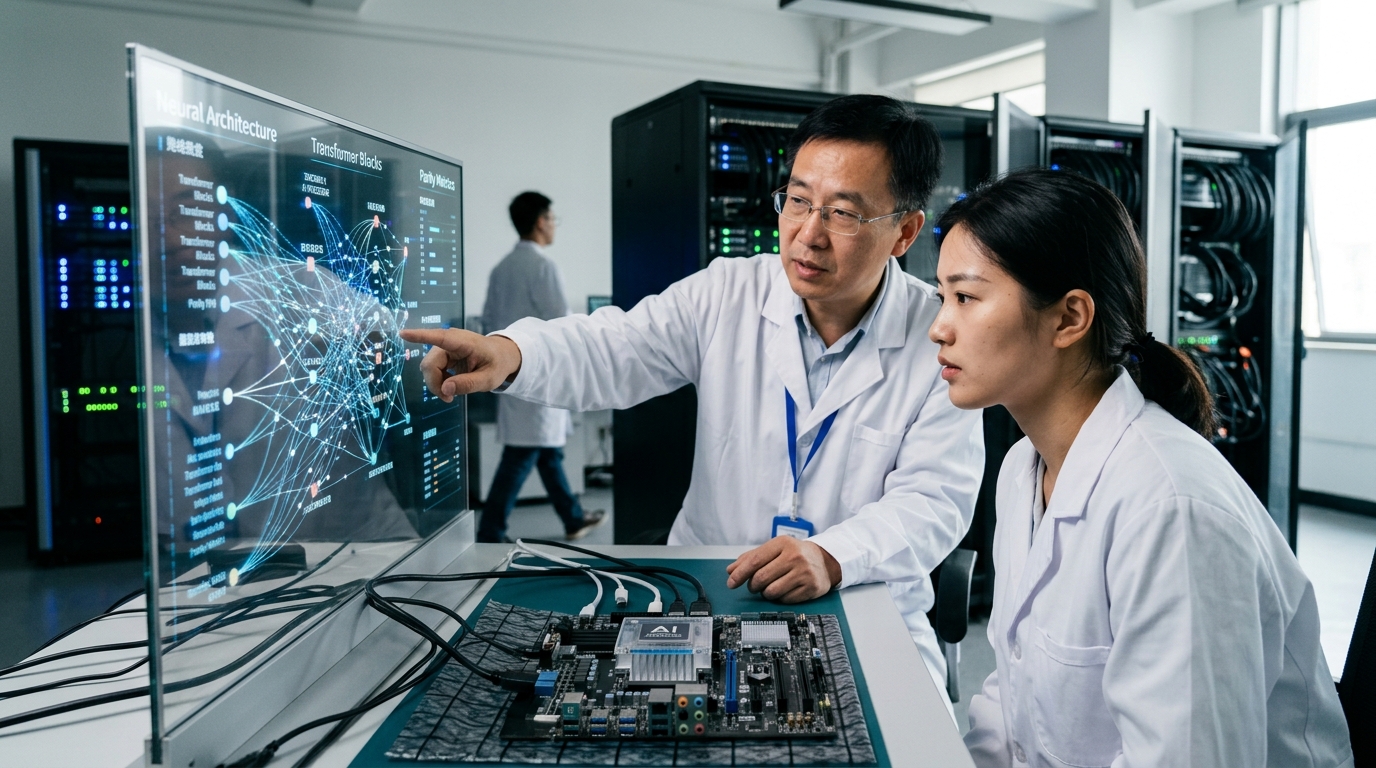
The global AI chessboard is witnessing a seismic shift. While Western attention has been fixated on the rivalry between OpenAI and Anthropic, a quiet yet decisive revolution has been unfolding in the laboratories of Beijing. According to recent reports and data from the LMSYS Chatbot Arena, new artificial intelligence models from Chinese giants and startups, such as Zhipu AI and 01.AI, have achieved the unthinkable: full functional parity with Anthropic’s Claude 3.5 Sonnet and OpenAI’s GPT-4o.
The Rise of the Digital Dragons
For years, the prevailing wisdom in Silicon Valley was that US export restrictions on high-end semiconductors—specifically NVIDIA’s H100 GPUs—would keep China at least two years behind in the AI race. However, reality is proving far more complex. Zhipu AI, a startup born out of Tsinghua University, and 01.AI, founded by tech veteran Kai-Fu Lee, haven't merely attempted to clone Western tech. Instead, they have developed innovative architectures that maximize performance even on less powerful hardware.
Zhipu AI’s GLM-4 model has shown impressive results in logic, programming, and linguistic understanding benchmarks. Analysts note that these models' ability to handle complex instructions in Chinese is superior to any Western counterpart, while the gap in English-language performance has effectively vanished. This is not just a technical milestone; it is a declaration of digital sovereignty.
Algorithmic Ingenuity vs. Brute Computational Power
One of the most compelling aspects of this development is how Chinese researchers navigated the chip shortage. While OpenAI can rely on massive server farms with nearly unlimited power, Chinese developers were forced to become more inventive. They focused on algorithmic optimization and rigorous data curation.
- Fine-tuning Optimization: Utilizing advanced techniques to train high-performing models with fewer computational resources.
- Synthetic Data Generation: Creating high-quality synthetic datasets to fill knowledge gaps and improve reasoning.
- Native Multilinguality: Built-in support for multiple languages with a strategic focus on Asian economies.
This approach has made models like Yi-Large exceptionally efficient in tasks requiring deep context windows and mathematical precision. Comparisons with the "Anthropic Mythos" (a term often used in internal reports to describe Anthropic's high-tier model suite) indicate that China has closed the gap in machine "common sense" and reasoning capabilities.
Geopolitical Implications and the Digital Iron Curtain
The success of Chinese AI creates new variables in international diplomacy. If countries in the Global South can access GPT-4 level models from Chinese sources without the ethical or political constraints often imposed by US firms, Beijing’s influence will surge. Already, many enterprises in Southeast Asia and the Middle East are turning to Alibaba’s Qwen and Zhipu’s GLM for their digital infrastructure.
"We are no longer in an era where the West defines the rules of intelligence. China has proven that innovation knows no borders, even under a regime of sanctions," noted a leading technology analyst.
The question now is how Washington will respond. The strategy of containment via sanctions seems to have reached its limits, as China’s domestic chip production accelerates and its algorithms become leaner. The battle for AI supremacy is no longer just a race for who has the most chips, but who can think more cleverly about the code itself.
The Future of Coexistence
As we move toward 2027, the coexistence of two powerful, competing AI ecosystems seems inevitable. On one side, the Western model focused on AI Safety and decentralized ethics; on the other, the Chinese model focused on speed of implementation and state-aligned strategic goals. The success of Zhipu and 01.AI is merely the beginning of a new epoch where "intelligence as a service" becomes the world's most powerful currency.