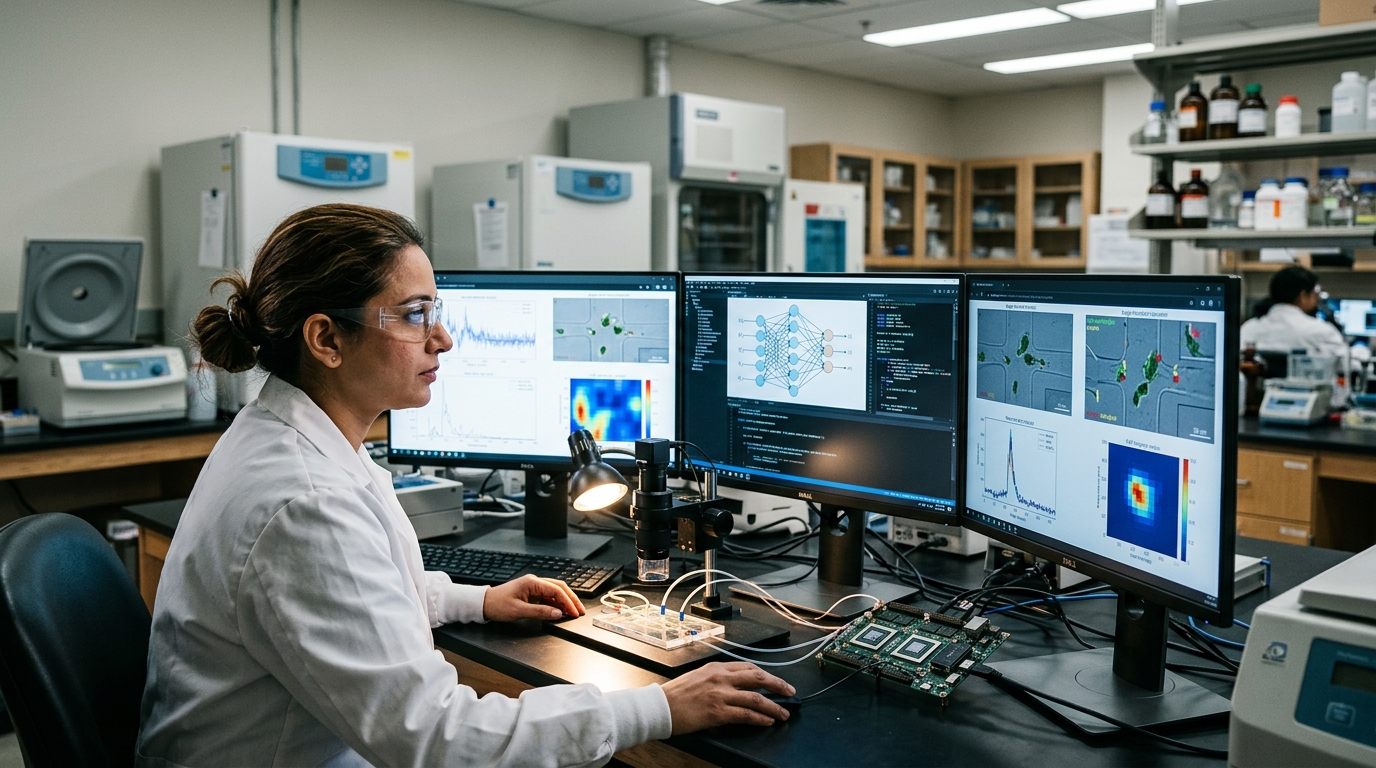
The battle against cancer is entering a radical new phase where the boundaries between biology and engineering are becoming increasingly blurred. At the forefront of this revolution are "bio-hybrid microrobots"—living organisms modified to perform specific medical missions. Recent research, highlighted by *The Scientist*, reveals how the use of microscopic green algae can solve one of the greatest challenges in treating bladder cancer: the effective delivery of drugs in an environment constantly "flushed" by the body's natural fluids.
Nature as a Machine: Why Algae?
Bladder cancer is notorious for its high recurrence rates, forcing patients into painful and repetitive treatments. The traditional method involves instilling chemotherapeutic drugs directly into the bladder. However, the problem is mechanical: the drugs are often excreted during urination before they have a chance to penetrate the tumors. This is where nanotechnology and biology intervene.
Researchers chose *Chlamydomonas reinhardtii*, a single-celled green alga, as the foundation for their microrobots. The choice is not accidental. These algae possess flagella that allow them to swim autonomously at high speeds. Unlike traditional synthetic nanoparticles that rely on passive diffusion, algae are "motorized." They can navigate through the dense mucus layer lining the bladder, reaching areas that simple drugs cannot access.
The Engineering of a Microscopic Assault
To transform the alga into a therapeutic tool, scientists "equip" it with nanoparticles. These particles, often made of biocompatible polymers, carry the drug payload. In the experiments conducted, radioactive isotopes or chemotherapeutic agents were used. The nanoparticles attach to the surface of the alga via chemical bonds or electrostatic forces, creating a hybrid system that combines living motility with pharmaceutical power.
"We are not just building a robot; we are conscripting billions of years of evolution to solve a modern medical problem," members of the research team state.
Once introduced into the bladder, the microrobots begin their search. Due to their natural tendency to move toward specific stimuli (phototaxis or chemotaxis), they can be directed with precision. Most importantly, their active movement helps distribute the drug uniformly across the entire bladder wall, reducing the chances of leaving "blind spots" where cancer could survive.
Results and Future Challenges
In trials conducted on mouse models, the results were impressive. The algae microrobots managed to reduce tumor volume by 90% more than traditional passive instillation methods. Furthermore, the use of algae allowed for lower drug doses, which dramatically reduces side effects for the patient's body.
However, the path to human clinical application still has hurdles. The first is safety. Although *C. reinhardtii* is generally considered safe and does not cause infections in humans, introducing foreign biological organisms into the body requires strict oversight from regulatory bodies like the FDA and EMA. There is also the question of the algae's "survival": how long can they remain active in the hostile environment of the human bladder?
Additionally, manufacturing these microrobots on an industrial scale is a challenge. Maintaining the vitality of the algae during the drug-"loading" process and transport requires specialized conditions. Despite the difficulties, the scientific community is optimistic. The idea that in the future, an "army" of microscopic plants will clear our bodies of cancer cells is no longer in the realm of science fiction, but a tangible field of research promising to radically change oncology.