Humanity has been locked in a race against time and evolution for decades. Antimicrobial resistance (AMR) has been identified by the World Health Organization as one of the top ten global public health threats. As bacteria evolve to neutralize existing drugs, traditional pharmaceutical research struggles to keep pace; developing a new antibiotic often requires over a decade and billions of dollars in investment. However, a recent announcement from the U.S. National Institutes of Health (NIH) marks a radical paradigm shift: Artificial Intelligence is no longer just a supporting tool, but the architect of a new generation of medicine.
The Silent Pandemic and the Chemical Deadlock
To understand the significance of this development, one must consider the scale of the challenge. Antibiotic-resistant microbes cause millions of deaths annually, turning once-treatable infections into lethal threats. The core problem with traditional drug discovery is the sheer size of "chemical space." There are more potential drug-like molecules than there are atoms in the observable universe. Manually testing these combinations in laboratories is akin to searching for a specific grain of sand across all the beaches in the world.
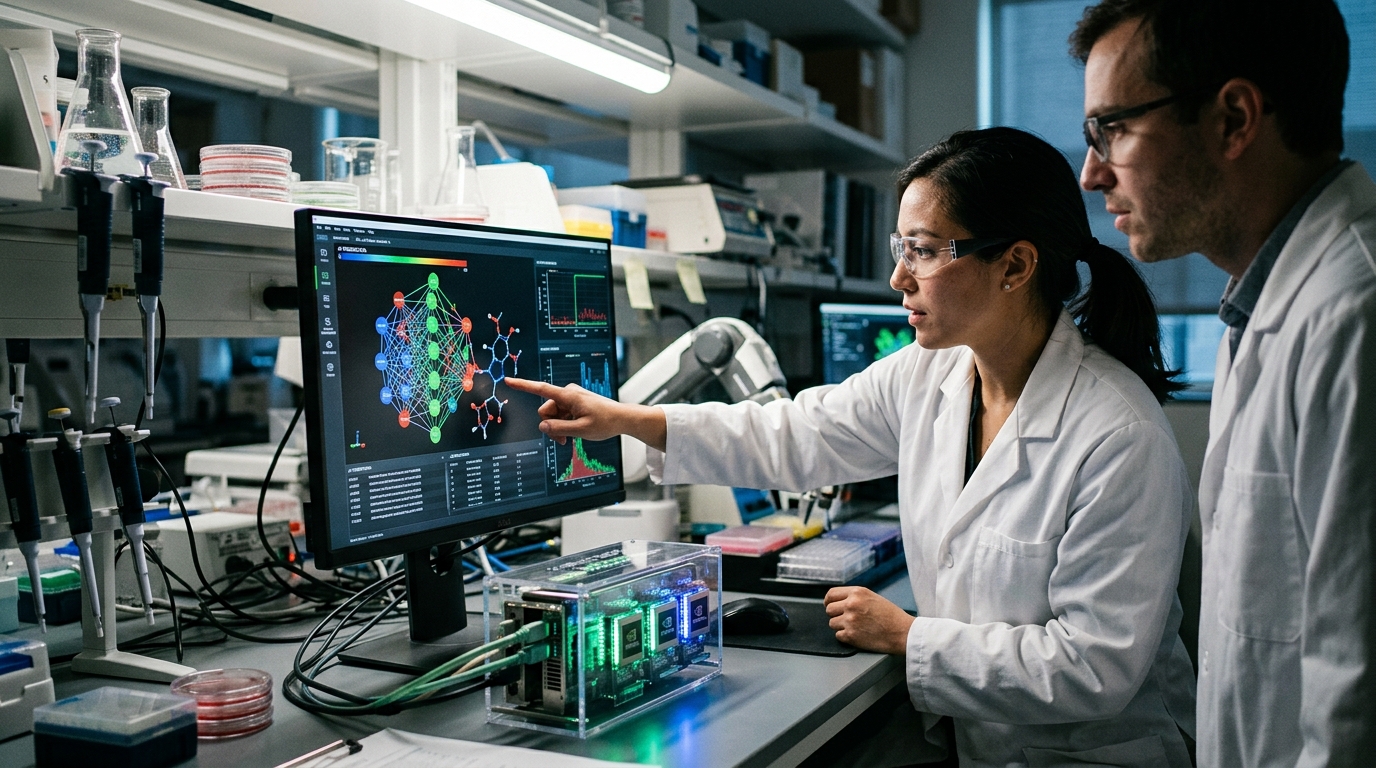
This is where AI steps in. Instead of relying on luck or exhaustive trial-and-error, researchers are now utilizing deep learning models that can "predict" which molecules will exhibit antimicrobial activity without causing toxicity in humans. The tool highlighted by the NIH research focused on Acinetobacter baumannii, a bacterium frequently found in hospital settings and notorious for its resistance to nearly all known antibiotics.
SyntheMol: Designing the Future from Scratch
The innovation described in the recent study concerns the "SyntheMol" model. Unlike previous AI models that merely scanned existing libraries of chemical compounds, SyntheMol is generative. This means it can design entirely new molecules that have never existed in nature or the lab. The model was trained on a database of 132,000 molecular fragments and learned how to combine them like pieces of a puzzle.
What is impressive is not just the speed, but the practicality. One of the biggest hurdles with AI in chemistry was that it often suggested molecules that were impossible to manufacture in reality. SyntheMol, however, was designed to propose only compounds that can be easily synthesized by chemists. From thousands of AI suggestions, researchers selected and synthesized 58 molecules, six of which showed exceptional activity against the resistant bacterium. This success rate is unprecedented in the pharmaceutical industry.
From Silicon to the Lab: Ethical and Practical Dimensions
The use of AI in antibiotic research is not just about efficiency; it is about sustainability. Many major pharmaceutical companies have abandoned antibiotic development because it is not seen as profitable—patients take them for short periods, unlike drugs for chronic conditions. Reducing the cost and time of research through AI could revitalize private sector interest, or at least allow public institutions and universities to lead the charge.
However, challenges remain. The "black box" of AI—the difficulty in understanding exactly why a model chose a specific structure—remains an issue. Furthermore, discovering a molecule is only the beginning. Clinical trials in humans follow, which remain time-consuming and essential for safety. AI can accelerate the discovery phase, but biology remains a complex and often unpredictable adversary.
The Future of Healthcare
As we move into the latter half of the 2020s, the integration of AI into medical research will be taken for granted. The success against A. baumannii is just the beginning. Scientists hope to apply similar techniques to combat tuberculosis, malaria, and even certain forms of cancer. The vision is one of "personalized pharmacology," where new drugs are designed in near real-time to meet emerging threats.
In conclusion, the NIH initiative proves that Artificial Intelligence can be our ultimate weapon against antimicrobial resistance. This technology does not replace the scientist; it grants them a "superpower": the ability to see patterns within the chaos of molecular chemistry. If we can bridge the gap between digital prediction and clinical application, we may finally win the war against superbugs.