The discourse surrounding Artificial Intelligence (AI) has shifted from science fiction to the core of economic strategy. Yet, while headlines are saturated with predictions of a new 'industrial revolution,' empirical data from the field of US business offers a more complex and often contradictory picture. A recent study by the Centre for Economic Policy Research (CEPR) sheds light on the question haunting economists and policymakers: Is AI truly boosting productivity, or is it another digital bubble?
The Illusion of Speed vs. The Reality of Numbers
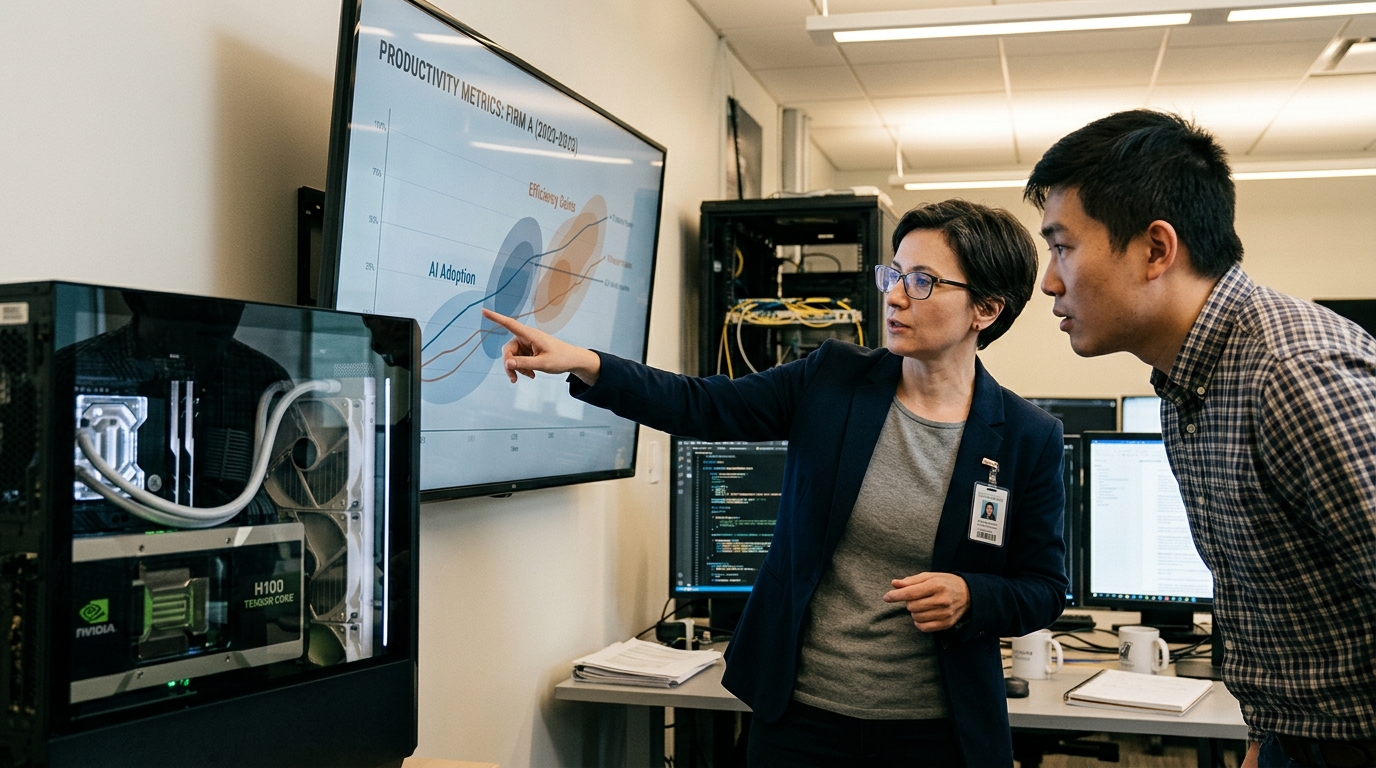
According to data gathered from thousands of US firms over the past two years, the adoption of AI has not yet led to a universal explosion in productivity at the macroeconomic level. Instead, we are witnessing what economists call the '21st-century productivity paradox.' While individual tasks—such as coding, copywriting, or customer service—see speed improvements of 30% to 40%, the overall output of firms is not following the same trajectory.
The explanation lies in the cost of integration. Businesses do not simply purchase software; they are required to reorganize entire value chains. This process takes time, capital, and, most importantly, a radical shift in corporate culture. The CEPR study highlights that the firms achieving the greatest productivity gains were not those that replaced employees with algorithms, but those that used AI to augment human capabilities.
Task Displacement and the New Structure of Work
One of the most intriguing findings of the research concerns the nature of work. AI does not appear to be eliminating jobs at the rate many analysts feared back in 2023. Instead, it is causing a violent 'task decomposition.' Workers are being freed from repetitive, low-value tasks but are being called upon to manage more complex problems requiring critical thinking and emotional intelligence.
- AI takes over data collection and initial analysis.
- Workers focus on decision-making and strategic implementation.
- The skills gap is widening as workers unable to handle new tools are left behind.
However, this transition is not painless. The study shows that in the US, firms aggressively adopting AI tend to reduce hiring for entry-level positions, creating a difficult problem for the younger generation seeking their first professional experience.
The 'Superstar Firms' Gap and Economic Inequality
The CEPR report warns of a dangerous trend: the concentration of productivity gains within a small elite of companies, the so-called 'Superstar Firms.' These companies possess the data infrastructure and financial power to train their own AI models, creating a competitive advantage that is nearly impossible for small and medium-sized enterprises (SMEs) to bridge.
"Artificial Intelligence is not an equalizer, but an accelerator of existing market inequalities," the study notes.
If this trend continues, the US economy risks splitting in two: a hyper-productive technological elite and a broad base of firms struggling to survive using traditional means. The political response to this phenomenon will determine social cohesion in the coming decades.
Conclusions and Outlook for 2026
As we move through 2026, it is becoming clear that AI is not a 'magic wand' that will solve the problem of stagnant productivity in the West overnight. It requires long-term investment in education and careful regulatory intervention to ensure that the benefits of technology are diffused throughout society. The experience of US firms shows that the path to prosperity through AI lies in empowering the human element, not devaluing it.