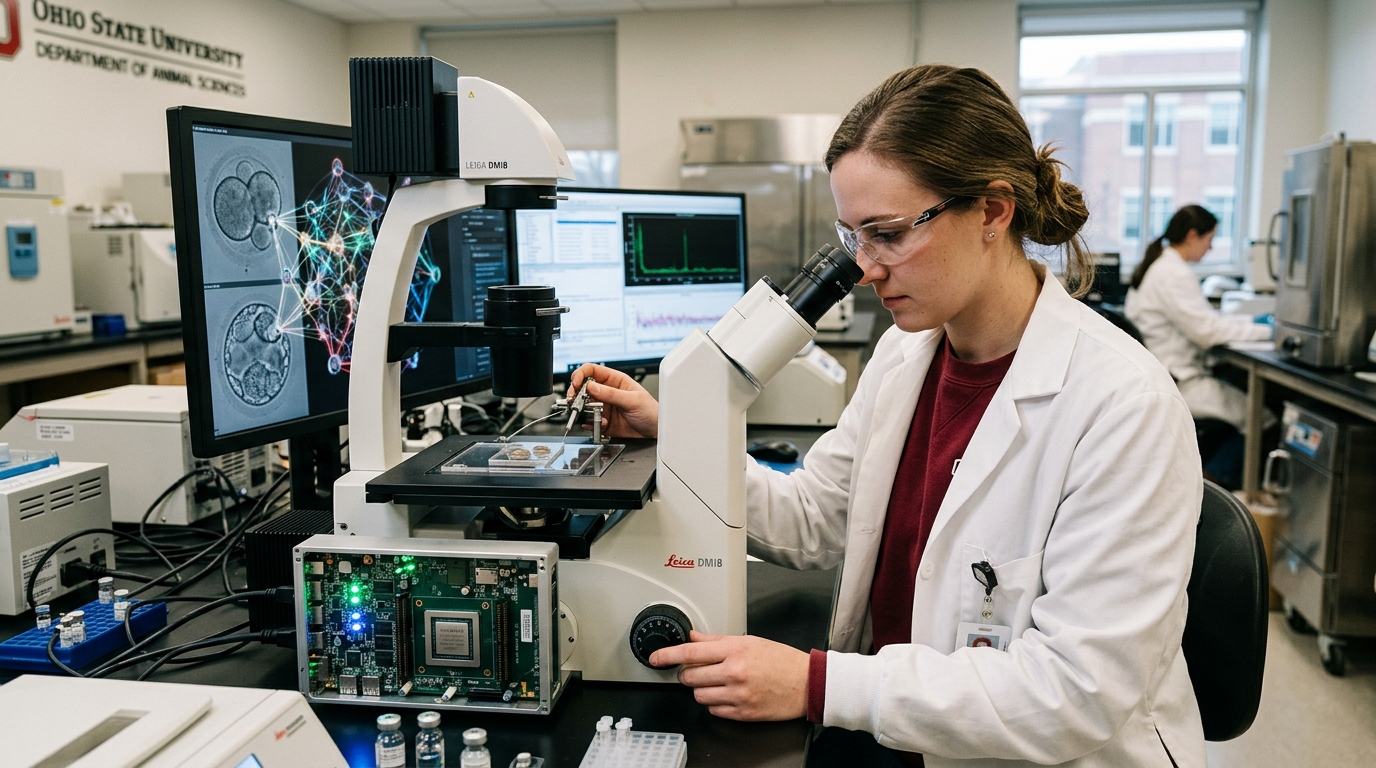
In the heart of the American Midwest, where the storied tradition of cattle ranching meets the cutting edge of Silicon Valley innovation, a new scientific breakthrough is poised to redefine animal husbandry. Researchers at Ohio State University (OSU) are pioneering Artificial Intelligence (AI) systems designed to enhance the outcomes of In Vitro Fertilization (IVF) in cattle—a process that has long been hampered by the limitations of human observation.
The Subjectivity Crisis in Embryology
Cattle IVF is a cornerstone of modern agriculture, used to propagate elite genetics that ensure herd resilience, superior meat quality, and optimized milk production. However, the process remains notoriously hit-or-miss. The critical bottleneck lies in embryo selection: which of the lab-grown embryos is most likely to result in a healthy calf?
For decades, this decision has rested on the shoulders of embryologists who grade embryos under a microscope based on their physical appearance. This morphological grading is inherently subjective. Variations in lighting, microscope quality, and even the professional's level of fatigue can lead to inconsistent results. One expert might deem an embryo "Grade A," while another sees flaws that suggest failure. This inconsistency costs the industry millions of dollars annually in failed pregnancies.
The Algorithmic Arbiter
The OSU study leverages computer vision—a subset of AI that trains machines to interpret and act upon visual data. By feeding deep learning models thousands of high-resolution images of bovine embryos, researchers have created a system that can "see" beyond the capabilities of the human eye. These models were trained not just on images, but on the ultimate outcomes: whether those specific embryos successfully implanted and led to live births.
"The AI doesn't have 'off days.' It analyzes cellular symmetry, blastocoele expansion, and fragmentation patterns with a level of mathematical precision that a human simply cannot replicate in a high-throughput environment," the researchers noted.
The preliminary results indicate a significant jump in predictive accuracy. By identifying subtle biomarkers in the embryo's development, the AI can rank candidates with a success probability score, allowing farmers to invest their resources in the most viable options. This shift from subjective "grading" to objective "predicting" is a paradigm shift for the industry.
Economic and Global Implications
While the research is grounded in biology, its implications are profoundly economic. The global cattle industry is under immense pressure to become more efficient and less environmentally taxing. Precision AI tools offer a pathway to meet these demands.
- Operational Efficiency: Each failed IVF transfer represents a loss of hundreds of dollars in veterinary fees, hormonal treatments, and lost time. AI drastically improves the Return on Investment (ROI) for advanced breeding programs.
- Environmental Stewardship: By accelerating genetic progress, producers can raise animals that reach market weight faster or produce more milk with fewer inputs. This leads to a smaller carbon footprint per gallon of milk or pound of beef.
- Human Medicine Crossover: Interestingly, the techniques developed for bovine embryos often provide insights into human IVF. The large datasets available in cattle research provide a testing ground for algorithms that could eventually improve human fertility treatments.
The Dawn of the Digital Farm
The integration of AI into cattle reproduction is a harbinger of the "Digital Farm" era. We are moving toward a future where every stage of a cow's life—from conception to the parlor—is monitored and optimized by data. Critics may argue that this level of intervention treats living beings as mere biological machines, but proponents point to the welfare benefits: healthier animals, fewer invasive procedures, and a more secure food supply chain.
As the Ohio State research moves from the laboratory to commercial application, the agricultural sector stands at a crossroads. The transition to AI-driven embryology is not just about better statistics; it is about the sustainable evolution of how we feed a planet of 8 billion people. The silicon chips in the lab are becoming as vital to the modern farmer as the soil in the fields.