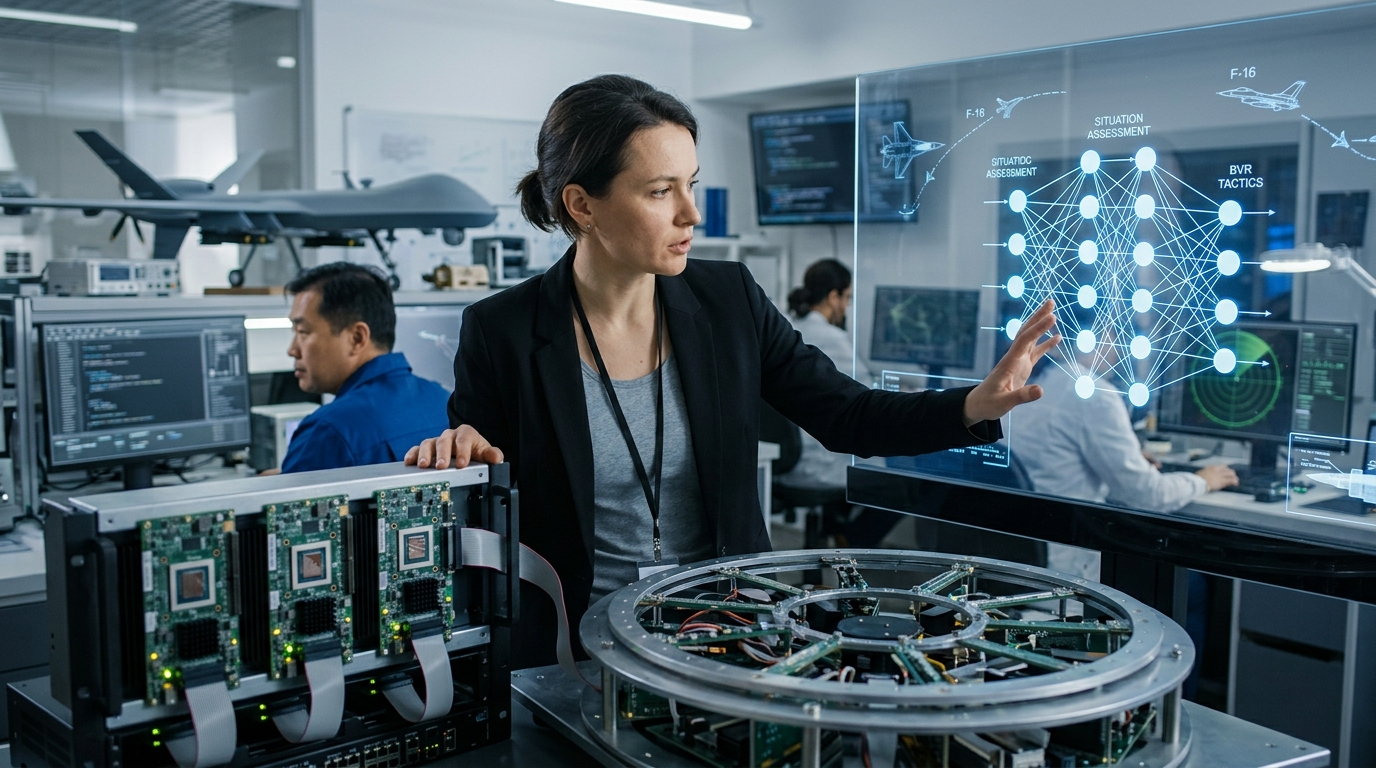
The image of a pilot relying on instinct and visual contact with an adversary to prevail in the skies is increasingly becoming a relic of cinema rather than modern military reality. Today, the U.S. Air Force (USAF) and DARPA are spearheading a tectonic shift in aerial warfare doctrine. Through the Air Combat Evolution (ACE) program, Artificial Intelligence is not just learning to fly; it is learning to dominate in Beyond-Visual-Range (BVR) combat, utilizing modified F-16 fighters known as the X-62A VISTA.
From the ACE Program to Stratospheric Reality
The ACE program did not emerge overnight. Its foundations were laid several years ago with the AlphaDogfight trials, where an AI algorithm managed to defeat a seasoned Air Force pilot in a simulated close-quarters dogfight. However, transitioning from a digital environment to the actual cockpit of an F-16 fighter is an achievement many considered impossible a decade ago. The X-62A VISTA (Variable In-flight Simulation Test Aircraft) serves as the ultimate laboratory for training the 'neural networks of war.'
Recent reports that AI is now being trained in BVR scenarios are of pivotal importance. In modern warfare, most shoot-downs occur before pilots ever see one another. The ability of an AI to process data from multiple sensors, radars, and satellite links in fractions of a second offers an advantage that the human brain—limited by biology and fatigue—cannot match. AI does not panic, is not affected by G-forces, and can calculate the ideal missile trajectory with mathematical precision.
The 'Loyal Wingman' Strategy
Despite this impressive autonomy, the Pentagon's goal is not the complete replacement of humans—at least not yet. The core concept is the Collaborative Combat Aircraft (CCA), or the 'Loyal Wingman.' In this model, a manned fifth- or sixth-generation fighter will lead a swarm of AI-controlled unmanned aerial vehicles (UAVs). These drones will undertake the most dangerous missions, act as decoys, or launch weapons at the command of the human leader.
This approach radically changes the economics of war. An F-35 costs approximately $80-100 million, while training a pilot takes years and millions more. AI-driven aircraft can be mass-produced at a lower cost, allowing the Air Force to accept a higher risk of attrition in a high-intensity conflict, such as those projected in potential Pacific theater scenarios.
Geopolitical Race and Ethical Dilemmas
This development is not happening in a vacuum. China and Russia are also investing billions in autonomous military technology. The AI arms race mirrors the nuclear race of the Cold War, with the difference being that the speed of evolution is now exponential. Using AI in BVR combat raises serious questions regarding the 'black box' of decision-making: If an AI makes a mistake and downs a civilian aircraft or triggers an unintended escalation, who is held accountable?
"Artificial Intelligence is no longer a future promise; it is the foundation of our national security in the skies," a USAF official recently stated, emphasizing the need for "responsible autonomy."
However, 'responsible autonomy' remains a controversial term. While the US maintains that a human will always be 'in the loop,' the sheer speed of BVR combat might make human intervention merely symbolic. The necessity for rapid reaction times may force commanders to delegate full firing authority to the algorithm, opening the door to a world where machines decide life and death at 40,000 feet.
Conclusion: The New Era of Air Power
Training F-16s with AI in BVR scenarios is the prelude to a new era. The Air Force of the future will be a hybrid of biological intelligence and digital power. As algorithms become more sophisticated, the challenge for humanity will not only be technical superiority but also maintaining control over the very tools created for its protection. The X-62A VISTA is not just an experimental plane; it is the harbinger of a revolution that will define the balance of power in the 21st century.