For millennia, humanity has dreamed of understanding the language of animals. From the myth of King Solomon to the modern tales of Dr. Dolittle, the desire for two-way communication with the non-human world remained in the realm of fantasy. However, in 2026, Artificial Intelligence appears to be unlocking the gates of a world previously considered inaccessible. The recent decoding of birdsong through advanced machine learning algorithms is not just a scientific achievement; it is the dawn of a new era in our relationship with the environment.
The Revolution of Bioacoustics and Transformers
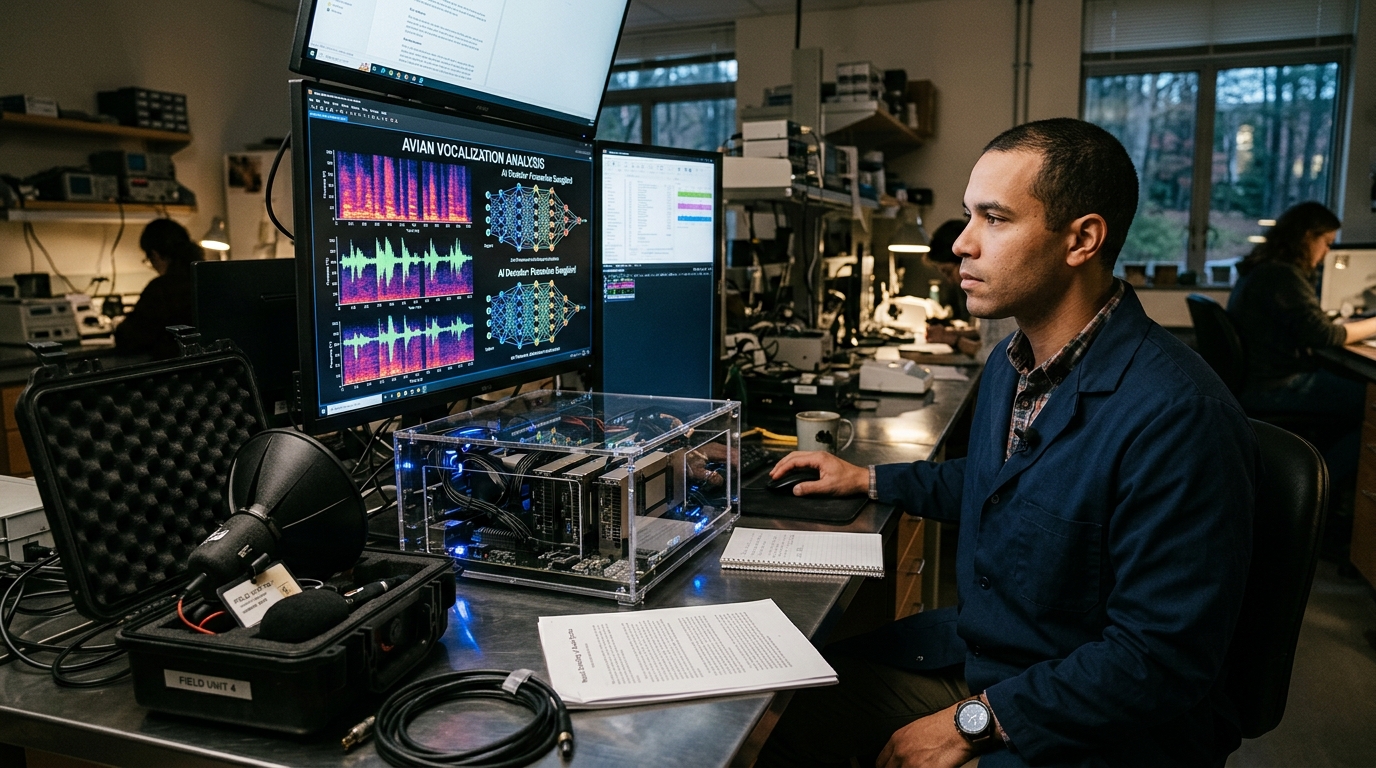
Traditional biology relied on observation and manual sound recording. Scientists spent decades trying to link a specific chirp to a behavior, such as mating or a distress call. The advent of Transformer models—the same technology powering ChatGPT—changed everything. These models don't need a "dictionary" to start. Instead, they analyze vast volumes of audio data, identifying patterns, structures, and syntaxes that the human ear simply cannot perceive.
According to recent research analyzed by international networks, researchers are now utilizing "self-supervised learning." This means the AI is trained on thousands of hours of forest recordings, learning to predict the next "element" in a sequence of sounds. In this way, a multidimensional map of birdsong is created, where sounds with similar meanings are clustered together in a digital latent space.
From Syntax to Semantics: The Great Question
The fact that AI can recognize the structure of a song does not necessarily mean it understands its meaning. This is where the great challenge lies. Birds, such as zebra finches or nightingales, possess extremely complex syntax. Certain sound sequences follow rules similar to the grammar of human languages. AI has managed to prove that if we change the order of "syllables" in a song, the birds' reaction changes radically, suggesting that the message has been altered.
"We are not just trying to translate words, but to understand entire systems of thought that are fundamentally different from our own," states a lead researcher from the Earth Species Project.
Decoding birdsong offers a unique glimpse into their social lives. It has been found that some species have "dialects" depending on their region, while others use specific sounds to "name" individuals within their group. AI can now distinguish these details with an accuracy reaching 95%, allowing scientists to monitor ecosystem health through the "soundscape."
When Will Humans "Talk" to Animals?
The prospect of two-way communication evokes both excitement and skepticism. If we can decode what birds are saying, can we talk back? Experiments already exist where AI produces synthetic sounds that are accepted by animals as "natural." However, ethical issues arise immediately. The use of synthetic calls could disrupt natural balances, mislead animals, or be exploited for hunting and poaching.
- Ethics of Communication: Who has the right to intervene in the social structure of a species?
- Biodiversity Protection: AI can identify endangered species in vast forest areas solely by their sound.
- Understanding Consciousness: If it is proven that animals have complex language, their legal and ethical treatment by society must undergo a radical shift.
The answer to the question "when" is not just about technology, but about our own capacity to listen. AI is the tool that removes the veil of anthropocentrism, forcing us to admit that we are not the only inhabitants of this planet with stories to tell. The next five years will be critical as programs like CETI (for whales) and the Earth Species Project expand their research across all species.
Conclusion
Decoding birdsong is just the tip of the iceberg. As Artificial Intelligence evolves, the line separating humans from the rest of the animal kingdom grows thinner. Perhaps AI's greatest contribution will not be its ability to speak like a human, but its ability to teach us how to understand life in all its forms. The silence of nature is ending, and the question is whether we are ready for what we will hear.