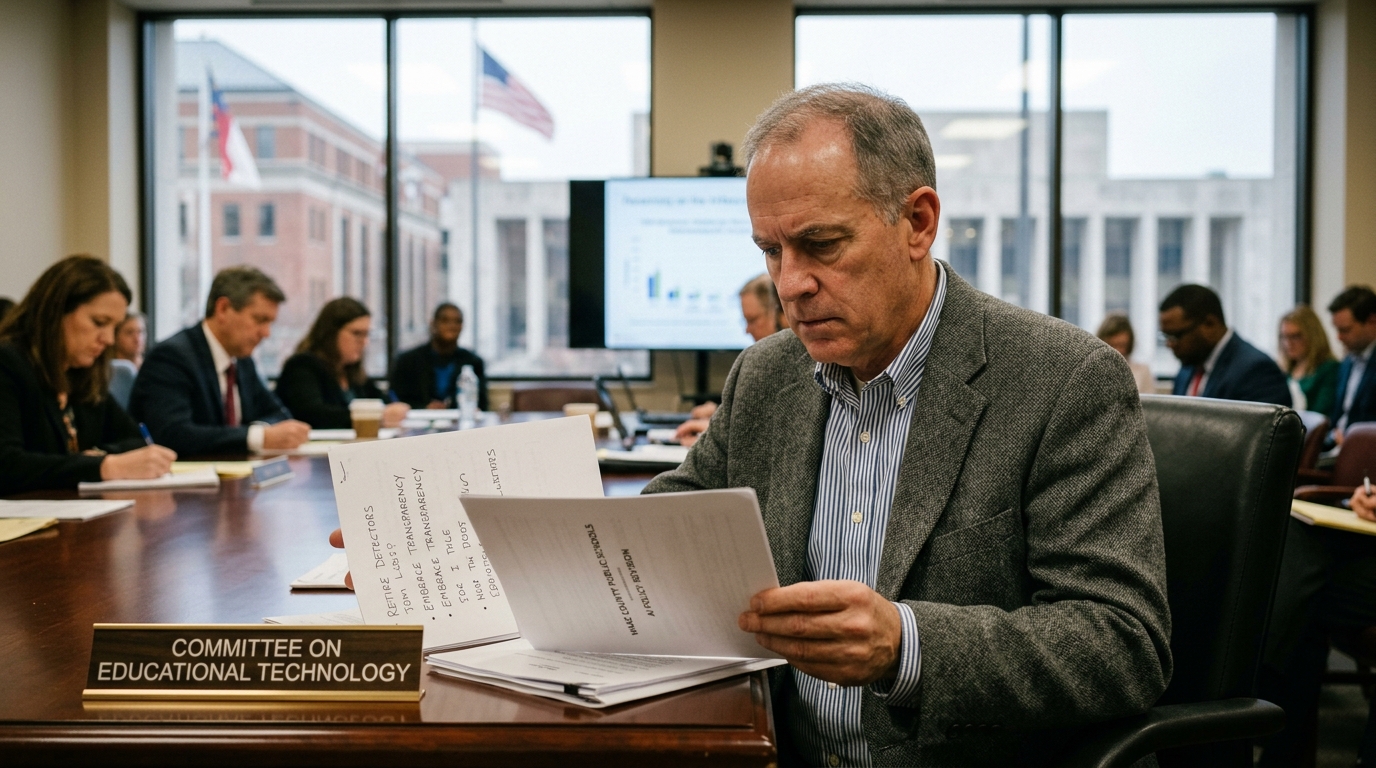
In a move poised to become a blueprint for educational systems globally, the Wake County Public School System (WCPSS) in North Carolina has unveiled a draft policy that fundamentally reimagines the role of Artificial Intelligence (AI) in the classroom. The core premise? AI detectors don't work, and the punitive approach has failed. Instead, the new framework proposes a radical shift toward transparency, mandatory AI citations, and teaching students to critically evaluate these tools.
The End of the 'Witch Hunt'
Since the emergence of ChatGPT in late 2022, schools have been in a panicked race to catch cheaters. The initial reaction was the widespread adoption of AI detection software, promising to distinguish human prose from machine-generated text. However, reality proved far more complex. Studies have shown these tools have high false-positive rates, disproportionately affecting non-native English speakers and neurodivergent students whose writing styles might appear "formulaic" to algorithms.
Wake County’s decision to retire these tools is a courageous admission of technical failure. "We cannot base our disciplinary process on dubious technological tools that are frequently wrong," the policy's spirit suggests. This pivot moves the burden from "policing" to "pedagogy," recognizing that AI is now an inseparable part of students' professional and academic futures.
The New Ethics of Citation
Rather than banning the tech, Wake County is introducing a tiered usage system. According to the draft, students will be required to explicitly state when and how they used AI. This includes a new form of bibliographic citation where the student doesn't just name the tool (e.g., "I used Claude"), but describes the process: What was the initial prompt? How was the output modified? Which facts were verified for accuracy?
- Level 1: No AI usage. For assignments requiring purely personal reflection and original expression.
- Level 2: AI as a brainstorming assistant. Used for outlining or research, with mandatory disclosure.
- Level 3: Full collaboration. Using AI to generate content that is then analyzed, critiqued, and refined by the student.
This approach transforms AI from a "cheating tool" into a "thinking tool." It teaches students that their value lies not in the mere production of text, but in their ability to direct technology and exercise critical judgment over its output.
Challenges and Social Equity
Of course, implementing such a policy is not without hurdles. The greatest challenge lies in teacher training. Many educators feel ill-equipped to grade assignments produced with AI assistance, as traditional rubrics crumble. Wake County plans extensive workshops to help teachers focus on "process" rather than just the "final product."
"Education is not the filling of a pail, but the lighting of a fire. If AI can fill the pail, then we must redefine what we consider the fire," remarked one of the committee's advisors.
Furthermore, there is the issue of the "Digital Divide 2.0." Students from affluent families have access to paid, more powerful AI models, while others rely on free, less capable versions. Wake’s policy attempts to address this by ensuring that tools used in the classroom are accessible to all, while strictly protecting student data privacy—a critical issue often overlooked in the rush to integrate tech.
The Future of Academic Integrity
Wake County’s move may mark the beginning of the end for traditional "homework" as we knew it. If AI can write an essay in seconds, the value of that essay as an assessment tool diminishes. Schools will likely pivot toward oral exams, in-class writing, and complex, hands-on projects that require physical presence and collaboration.
In conclusion, the new policy is not a surrender to technology but a pragmatic adaptation. By removing unreliable detectors, Wake County restores the bond of trust between teacher and student, laying the groundwork for an education system that doesn't fear the future but actively shapes it.