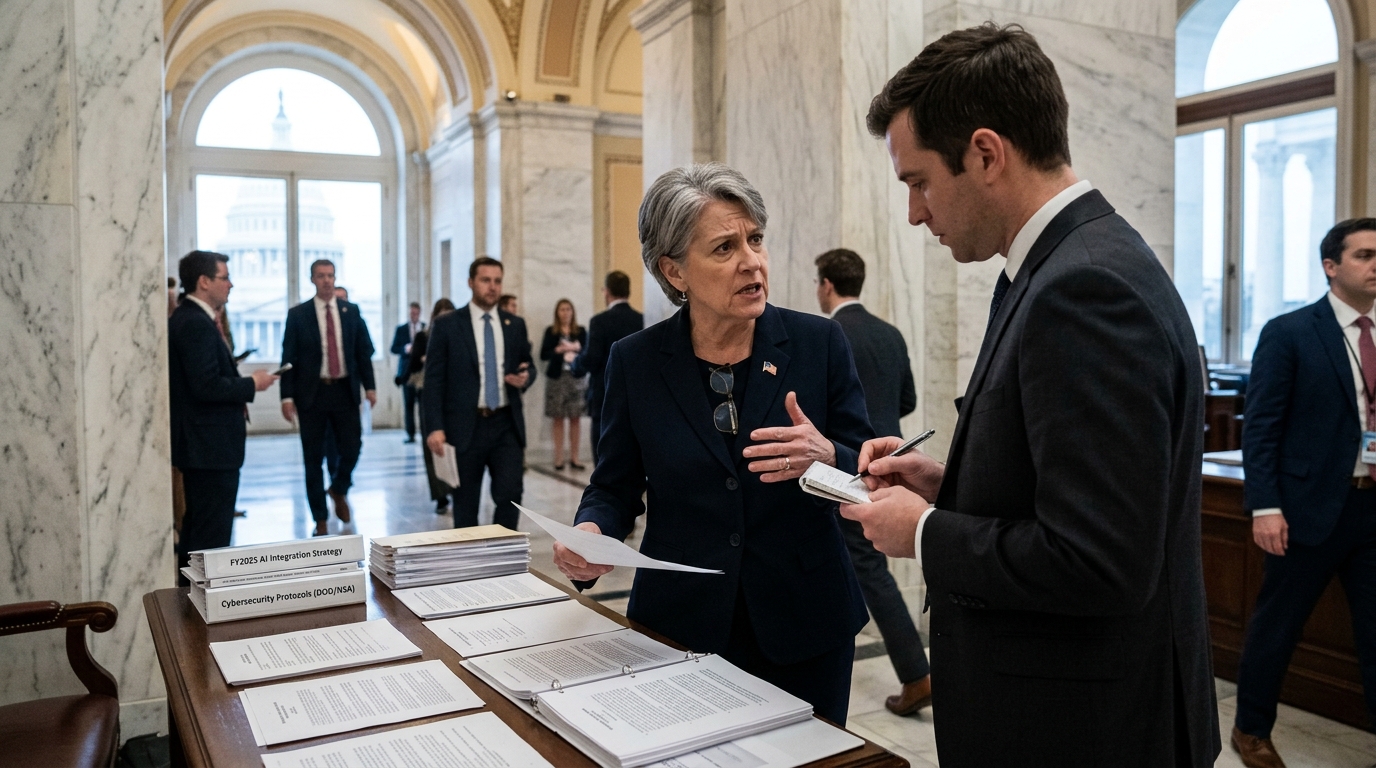
In the contemporary geopolitical landscape, speed is not merely an advantage; it is the cornerstone of national sovereignty. The United States federal government currently finds itself at a critical juncture, striving to integrate Artificial Intelligence (AI) across the full spectrum of its operations, from national defense to public health. However, a fundamental challenge remains: data security. While technology promises the so-called 'decision advantage,' stringent and often inflexible security protocols are hindering the full realization of its potential.
The Concept of Decision Advantage
'Decision advantage' refers to an organization's ability to process information and make sound decisions faster than its adversary. In a government context, this means using AI to analyze vast amounts of data in real-time, predicting crises, and optimizing supply chains. However, AI is only as good as the data it can access. Herein lies the paradox: for AI to be effective, it needs a free flow of data, but for the government to be secure, it must restrict that flow.
Federal agencies are grappling with the problem of data 'silos.' Information that could save lives or prevent economic disasters remains trapped in classified networks that do not 'communicate' with one another. Integrating Large Language Models (LLMs) into these environments requires a radical reassessment of how we define information security in the 21st century.
The Security Barrier and the FedRAMP Protocol
One of the biggest hurdles to AI adoption is the FedRAMP (Federal Risk and Authorization Management Program). Although designed to ensure that the cloud services used by the government are secure, the certification process is notorious for its sluggishness and high costs. For AI companies innovating at the speed of light, waiting years for an approval means that by the time their technology reaches the hands of government officials, it is already obsolete.
- The necessity for 'Zero Trust' architecture in AI workflows.
- The difficulty of classifying machine-generated data in real-time.
- The risk of sensitive information leakage through user prompts.
- A shortage of specialized personnel who understand both security and AI.
Furthermore, there is the threat of 'adversarial attacks,' where foreign powers could poison the training data of government AI models, leading to flawed decisions with potentially catastrophic consequences. The balance between open innovation and airtight protection is more fragile than ever.
Geopolitical Competition and the Pressure for Speed
It is no secret that the US is in an unofficial race with China for AI supremacy. Beijing, with a different model of governance, can aggregate and utilize data in ways that Western democracies consider unethical or illegal. This gives China a temporary edge in model training. Washington must find a way to accelerate its processes without sacrificing its values regarding privacy and security.
"Security should not be the brake on innovation, but the seatbelt that allows us to drive faster," state officials from the Pentagon.
The solution proposed by many analysts is the adoption of a 'data-centric' security approach. Instead of trying to secure the entire network, we must secure the data itself, allowing AI to process it only under specific, controlled conditions. This requires a cultural shift within a government that traditionally prefers the safety of complete isolation (air-gapping).
The Future of Governance via AI
As we move into the latter half of the decade, the US government's ability to solve the data security puzzle will determine its effectiveness. If AI remains confined to unclassified, administrative tasks, the 'decision advantage' will be lost. However, if secure integration is achieved, we will see a new era of governance where crisis prevention and service delivery are executed with a precision that was previously the domain of science fiction.
In conclusion, the challenge is not technical, but organizational. The technology exists. What is missing is a new framework of trust that allows AI to function as the ultimate power multiplier for the state, while ensuring that the nation's secrets remain impenetrable.