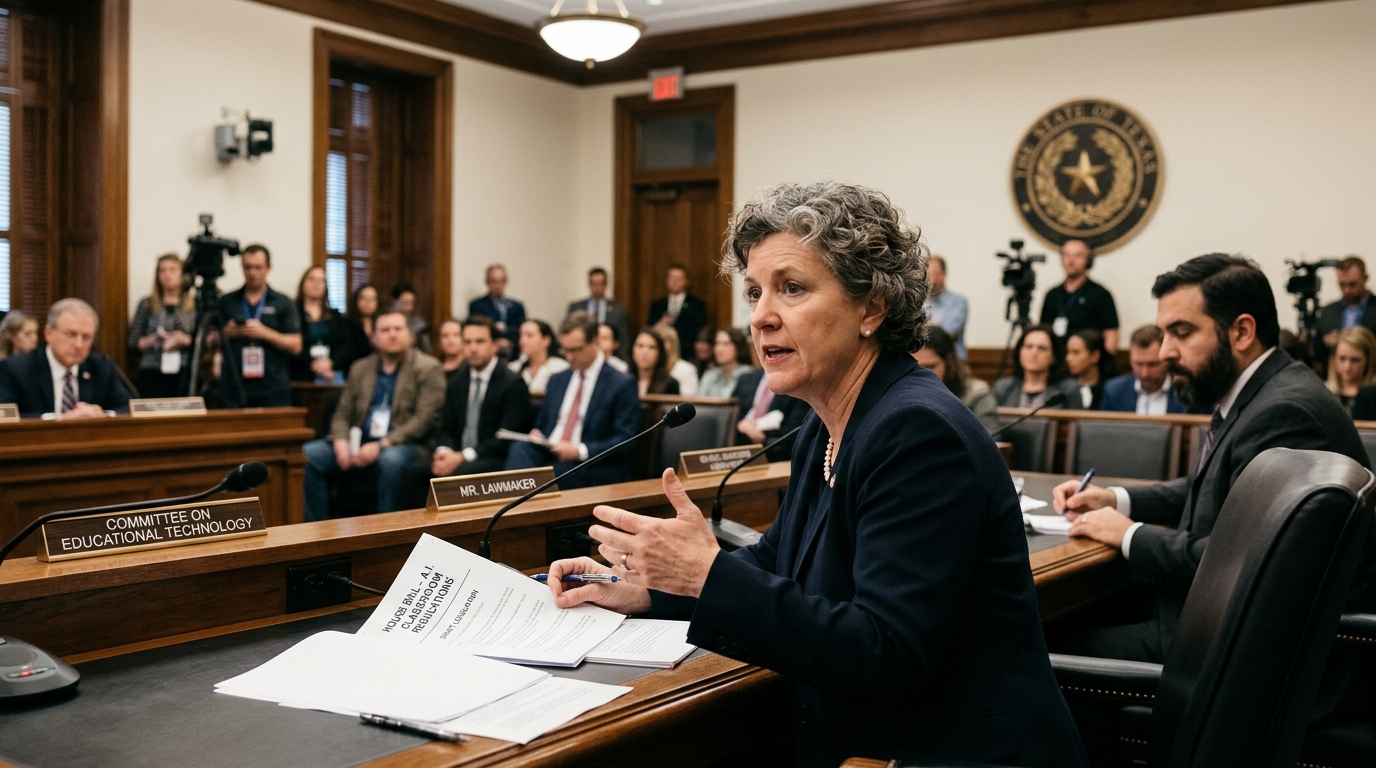
As the dawn of 2026 finds global education systems in a state of perpetual flux, the state of Texas is emerging as an unexpected battlefield for the future of learning. A recent intervention by a prominent Texas lawmaker, calling for stricter rules on the use of Artificial Intelligence (AI) in classrooms, is not merely a reaction to technological progress but a poignant warning about the potential erosion of human critical faculty.
The Legislative Framework and Its Context
At the heart of the proposal lies the conviction that over-reliance on Large Language Models (LLMs) and automated study assistants has begun to undermine the foundations of education. The lawmaker argues that the current "wild west" of AI tools in schools creates an environment where convenience takes precedence over effort. The proposal does not aim for a total ban—something many now consider impossible—but rather for the creation of a rigorous protocol defining when, how, and under what supervision these tools should be utilized.
According to the briefing, schools should adopt transparent grading algorithms and ensure that students do not use AI as an "answer machine," but rather as a research tool. The concern is clear: if a student can compose an essay or solve a complex mathematical problem in seconds without understanding the underlying logic, the educational process becomes a hollow exercise.
The Critical Thinking Crisis in an Automated Age
The strongest argument put forth by the Texas official concerns critical thinking. In a world where information is mass-produced by algorithms, the ability to distinguish truth from falsehood, and logical fallacies from sound arguments, becomes a matter of intellectual survival. "Our students are becoming experts at prompting, but they are losing the ability to question the output," the report accompanying the proposal notes pointedly.
Critical thinking requires time, friction with the subject matter, and, crucially, the possibility of making mistakes. AI, by often providing a "perfect" but superficial answer, removes the right to err and the learning that stems from it. Proponents of stricter regulation emphasize that education must return to Socratic methods, where the process of thinking is more vital than the final product.
The Teacher's Dilemma and the Digital Divide
Implementing such rules, however, is fraught with challenges. Educators in Texas and across the globe are already under immense pressure. The demand to police AI usage while simultaneously attempting to integrate it creatively into the curriculum feels like a Herculean task. Furthermore, there is the risk of a digital divide: if strict rules are applied only to public schools while private institutions allow unrestricted access to advanced tools, inequality will only deepen.
- The need for continuous professional development for teachers in emerging technologies.
- Development of new assessment methods based on oral exams and in-class assignments.
- Establishment of "AI Ethical Codes" for every school district.
The lawmaker also proposes funding programs that teach students the "anatomy" of AI—how algorithms work, what their biases are, and why they should not be viewed as infallible. This approach seeks to transform the student from a passive consumer into an informed user.
Conclusion: Toward a New Educational Social Contract
The movement in Texas is a harbinger of a broader global debate. This is not a battle against technology, but an effort to redefine what "learning" means in the 21st century. If education fails to protect critical thinking, we risk raising a generation that is technologically advanced but intellectually dependent. The Texas legislative initiative, despite its potential flaws, asks the right question: Who controls the student's mind? The individual or the algorithm?