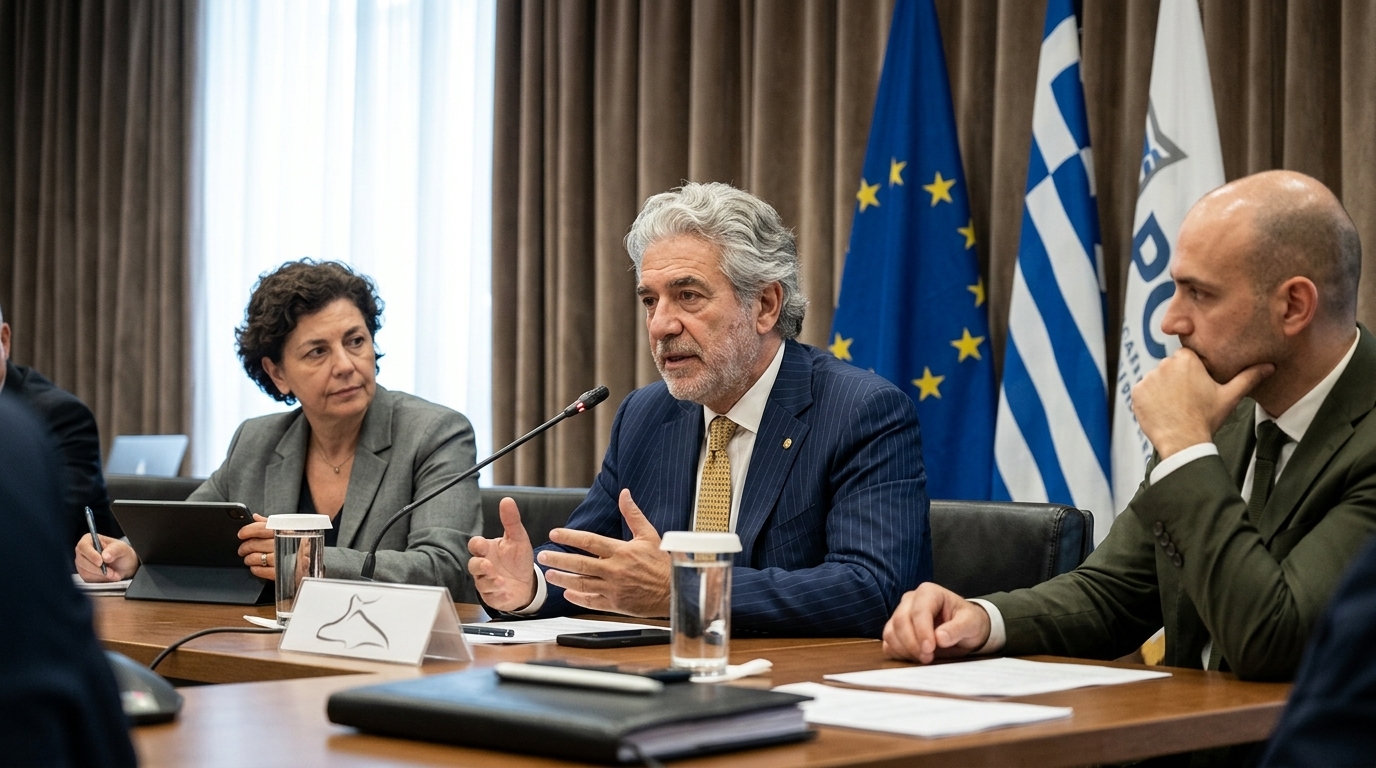
In an era of profound geopolitical shifts and economic restructuring, the role of the European Union's Multiannual Financial Framework (MFF) has emerged as something far more significant than a mere collection of funds. The President of the Piraeus Chamber of Commerce and Industry (PCCI), Vasilis Korkidis, has pointedly noted that the new budget is not a dry accounting exercise, but the central political and developmental tool that will determine the survival of the European economy in the 21st century.
Beyond Numbers: A Manifesto for Resilience
The PCCI's stance comes at a critical juncture. As Europe attempts to balance energy crises, inflation, and the need for rapid decarbonization, the 2021-2027 budget, bolstered by the NextGenerationEU instrument, serves as the Union's "heavy artillery." According to Mr. Korkidis, this strategic focus does not only concern large member states but primarily peripheral economies like Greece, which are called upon to bridge a decades-long investment gap.
The PCCI President emphasizes that the "Twin Transition" (green and digital) requires capital that the private sector alone cannot provide, especially in the current environment of high interest rates. The budget acts as a guarantor and a lever to mobilize private investment, creating a safety net for small and medium-sized enterprises (SMEs) that form the backbone of Greek entrepreneurship.
Piraeus as a Hub and the Blue Economy Bet
Particular weight is given by the PCCI to utilizing European resources to strengthen shipping and port infrastructure. Piraeus, as Europe's main gateway to the East, is at the heart of this planning. The new budget provides significant funds for port modernization, vessel electrification (cold ironing), and the development of alternative fuels.
- Strengthening the connectivity of Trans-European Transport Networks (TEN-T).
- Funding innovative solutions to reduce the environmental footprint of shipping.
- Supporting ship repair activities through training programs and digital transformation.
For the business community of Piraeus, the proper absorption of these resources is not just an opportunity but a prerequisite for maintaining competitiveness against ports in Northern Europe and Asia. Mr. Korkidis points out that bureaucracy remains the greatest enemy, calling on the European Commission to simplify access procedures, especially for smaller companies in the sector.
The Challenge of Strategic Autonomy
One of the most interesting points in the PCCI's analysis is the link between the budget and the concept of "Strategic Autonomy." Following the pandemic and the invasion of Ukraine, the EU realized its dangerous dependence on third countries in critical sectors such as energy, raw materials, and semiconductor technology. The new budget directs resources toward the re-industrialization of Europe.
"We cannot talk about a strong Europe if we do not invest in our production base. The budget must be our shield against US protectionism and China's aggressive trade policy," Mr. Korkidis characteristically notes.
This approach requires a paradigm shift. Instead of horizontal subsidies, the emphasis is now on targeted programs like InvestEU and Horizon Europe, which promote research and development in cutting-edge sectors. For Greece, this represents a unique opportunity to upgrade its production structure, moving away from a low-value-added model.
Conclusions and Outlook
In conclusion, the PCCI President underlines that the success of the new budget will be judged by the speed of implementation on the ground. Greece has at its disposal a historically large package of resources (over 70 billion euros in total), which must be channeled into the real economy without delay. Cooperation between the state, chambers, and the banking system is essential to ensure that not a single euro is wasted.
The new EU budget is, ultimately, a bet on the future of the next generation. As the PCCI emphasizes, growth cannot be merely numerical; it must be inclusive, sustainable, and digitally advanced. Piraeus and Greek entrepreneurship declare their readiness to lead in this new European architecture.