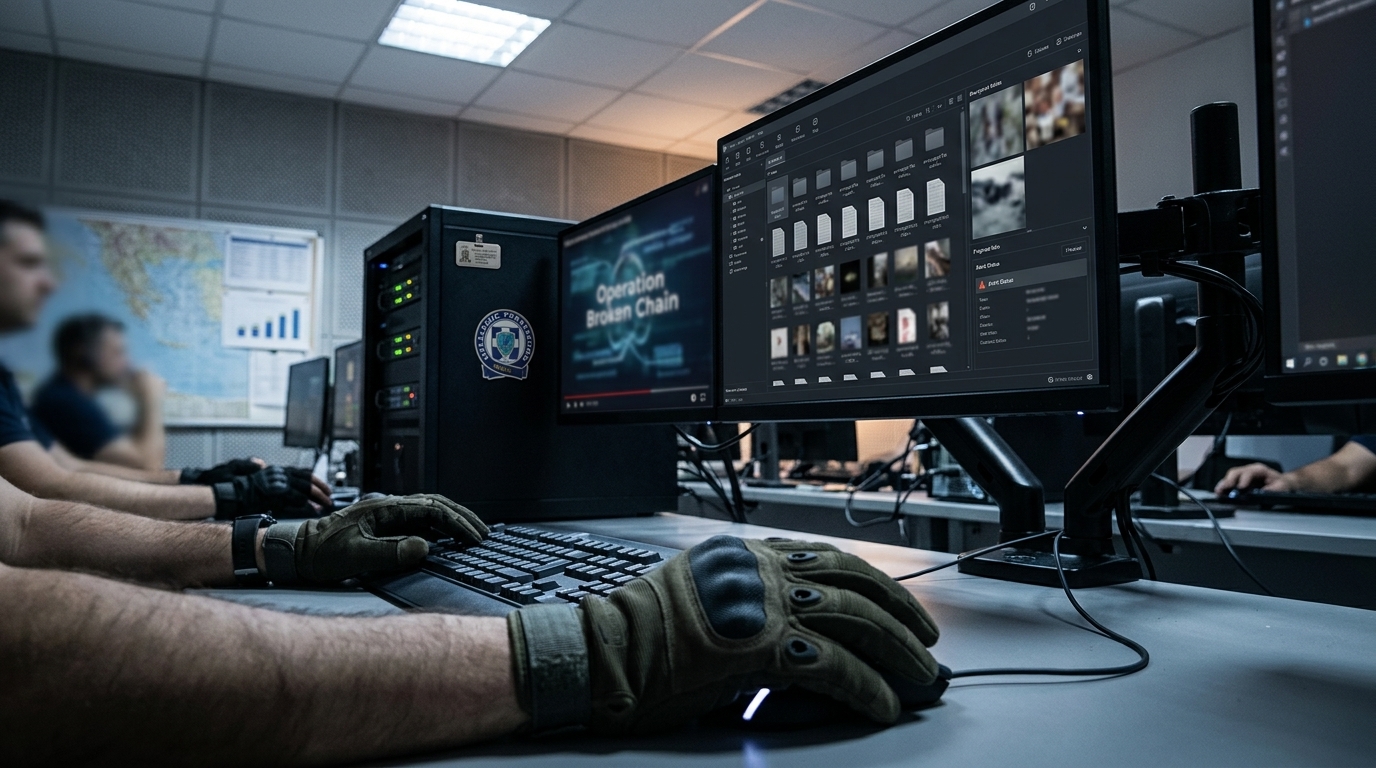
In a coordinated effort to dismantle networks preying on childhood innocence in the digital sphere, the Cybercrime Division of the Hellenic Police has concluded a major operation codenamed "Broken Chain." This operation, which unfolded across various regions of Greece, led to the arrest of two individuals and the filing of charges against three others, bringing the grim reality of Child Sexual Abuse Material (CSAM) production and distribution back into the spotlight.
The name of the operation, "Broken Chain," is highly symbolic. It represents the authorities' attempt to sever the links between distributors, consumers, and the platforms that facilitate these criminal activities. According to official statements, searches were conducted in Attica, Thessaloniki, and other regional units, where a plethora of digital media, hard drives, and devices containing thousands of horrific files were seized.
Anatomy of the Operation and the Digital Footprint
Cybercrime officers, utilizing advanced tracking software and collaborating with international organizations such as Interpol and Europol, managed to trace the digital footsteps of the suspects. The process was far from simple. The perpetrators used sophisticated anonymization methods, encrypted communication apps, and the so-called "Dark Web" to exchange illegal material, believing they were beyond the reach of the law.
During the investigation, evidence emerged showing that the activity was not limited to mere possession but extended to distribution, a fact that significantly worsens the criminal charges. Greek legislation, recently strengthened by the amendments to the Penal Code (Law 5090/2024), now provides for severe prison sentences for those involved in such offenses, recognizing the immeasurable harm caused to the victims.
The Challenge of AI and Deepfakes
In 2026, the battle against child exploitation has entered a new, even more dangerous phase due to the evolution of Artificial Intelligence. The Cybercrime Division is now facing the phenomenon of "AI-generated" images and deepfakes, where technology is used to create realistic abuse material without a physical victim initially present, or by mapping the faces of real minors onto fabricated scenarios.
This development complicates the work of the authorities, as distinguishing between real and synthetic material requires specialized knowledge and AI-forensics tools. However, as Hellenic Police officials point out, the moral and legal depravity remains the same. The demand for such material fuels a cycle that, sooner or later, leads to the abuse of real children. Operation "Broken Chain" demonstrated that Greek authorities are investing in cutting-edge technology to stay ahead of these developments, though the path remains steep.
Social Responsibility and Prevention
Beyond the repressive action of the police, this case highlights the massive gap in digital literacy and minor protection. Parents and educators are called upon to be in constant vigilance, as children's access to the internet is now largely unchecked from a very young age. The use of parental control tools is necessary but not sufficient.
The state must strengthen victim support structures and invest in awareness campaigns that debunk the myth of internet "anonymity." Operation "Broken Chain" is a victory, but the "chain" of abuse is constantly regenerated within the shadows of the digital world. Collective action, international cooperation, and strict law enforcement are the only weapons we have against this crime against humanity.
"Protecting our children in the digital world is not just a police obligation; it is a moral imperative for our civilization," a high-ranking Cybercrime officer stated.
In conclusion, the success of the Cybercrime Division sends a loud message: the internet is not a sanctuary for criminals. However, the continuous evolution of technological means requires equally continuous alertness from all social actors, so that "Broken Chain" is not an isolated success, but the beginning of the end for these networks of shame.